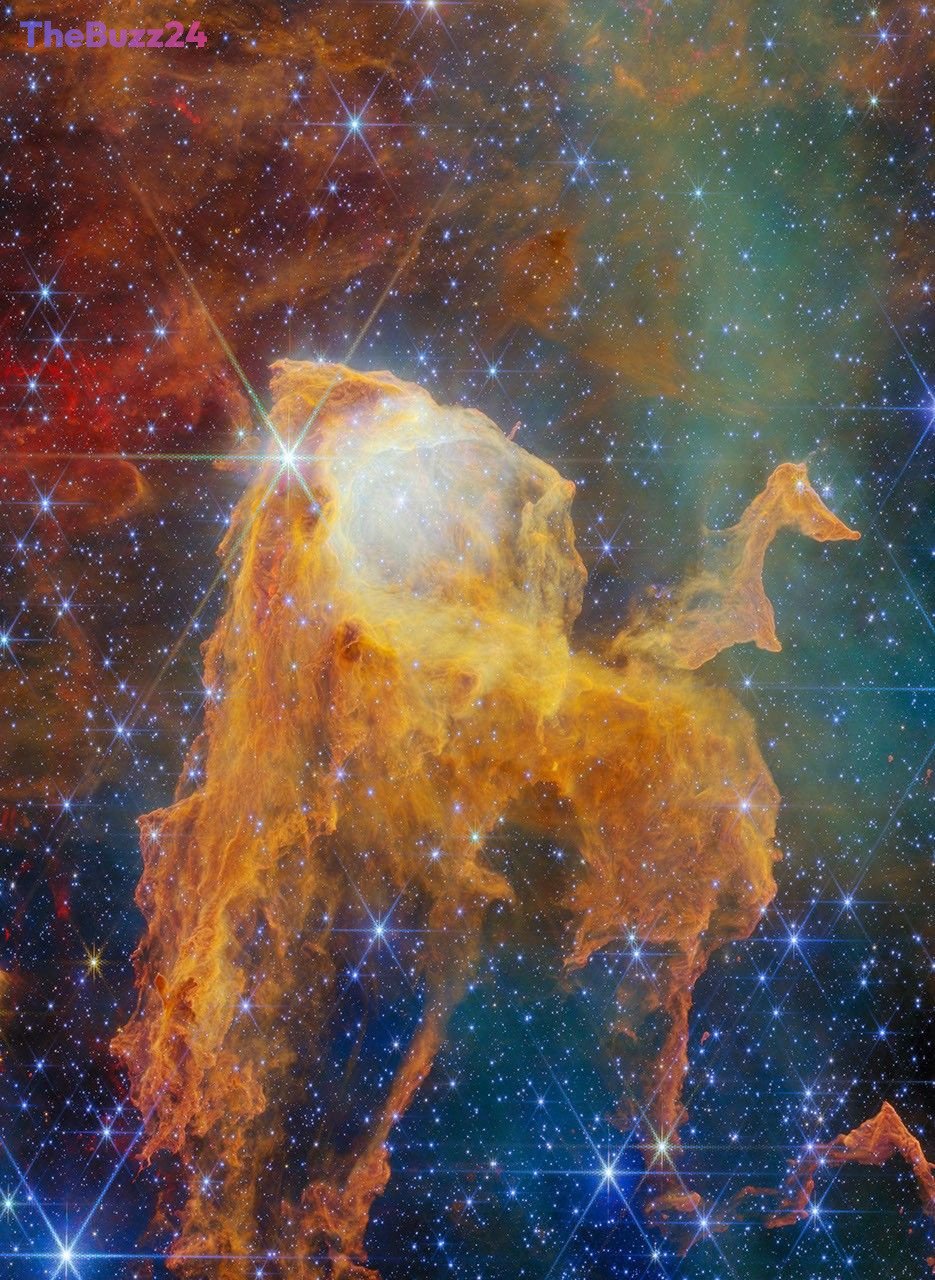
James Webb Telescope Unveils Stellar Nursery Resembling a ‘Treasure Chest’ in Carina Nebula
The James Webb Space Telescope has captured a breathtaking image of a stellar nursery within the Carina Nebula, revealing a cosmic formation that astronomers liken to a treasure chest brimming with newly formed stars. Located approximately 7,500 light-years away in our own galaxy, this celestial structure is a pillar of interstellar gas and dust sculpted by intense stellar winds and radiation from nearby massive stars.
The powerful forces emanating from stars like the Eta Carinae system, which outshines the sun by over five million times, have shaped this pillar. The intense activity within the pillar is actively carving out its ‘head,’ creating an opening that resembles the lid of an unearthed treasure chest. This dynamic process is a testament to the ongoing birth of stars in the region.
Within this cosmic chest, astronomers have identified a dense cluster of approximately 70 young stars, estimated to be only about 1.3 million years old. Among these nascent stars is a particularly massive one, roughly 19 times the mass of our Sun. These more massive stars, though rarer, burn brighter and evolve more rapidly, serving as the most brilliant ‘jewels’ within this stellar collection.
Key Takeaways
- The James Webb Space Telescope has imaged a star-forming region in the Carina Nebula resembling a treasure chest.
- The formation is a pillar of gas and dust shaped by powerful stellar winds from nearby massive stars.
- Approximately 70 young stars, including a massive star 19 times the Sun's mass, have been identified within the pillar.
Editor’s Analysis & Impact
This latest revelation from the James Webb Space Telescope underscores its unparalleled capability in observing the universe’s most dynamic processes. The detailed imagery of the Carina Nebula’s stellar nursery provides invaluable data for understanding star formation, particularly the influence of massive stars on their environment. The ‘treasure chest’ analogy highlights the public engagement potential of such discoveries, bridging complex astrophysics with relatable concepts. This finding reinforces the telescope’s role in pushing the boundaries of astronomical knowledge and inspiring future research into galactic evolution and the conditions necessary for planetary system formation.
Frequently Asked Questions
Q: What is the Carina Nebula?
A: The Carina Nebula is a large, complex region of gas and dust in the Milky Way galaxy, known for being a prolific site of star formation. It is located about 7,500 light-years from Earth.
Q: What is the significance of the 'treasure chest' formation?
A: The 'treasure chest' is a descriptive term for a pillar of gas and dust within the Carina Nebula that has been sculpted by stellar winds. The opening at its 'head' reveals a cluster of young stars, likening it to a chest full of newly born stars.
Q: How massive is the largest star found in this cluster?
A: The most massive star identified within the cluster is approximately 19 times the mass of our Sun. More massive stars are rarer, shine brighter, and evolve faster than less massive stars.
AI Disclosure: This article is based on verified data and official reports. Our Team and AI have cross-referenced every financial detail with primary sources to ensure total accuracy.
More from this Category