Kenya’s Unresolved Wounds: Families Demand Justice Two Years After Deadly Protests
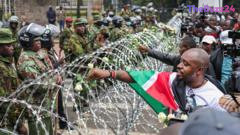
On the two-year anniversary of deadly anti-government protests, families of those killed gathered outside Kenya’s parliament, placing flowers on barbed wire barricades. These solemn acts coincided with demonstrations across the nation, though turnout in the capital, Nairobi, was notably lower than in 2024 and previous anniversary events. Authorities had heavily fortified the parliamentary precinct, using barbed wire to prevent direct access for families wishing to lay wreaths.
The emotional pleas for justice were palpable. Jacinta Anyango, whose 12-year-old son Kennedy was killed in the 2024 clashes on Nairobi’s outskirts, voiced a common sentiment: “All I want is for the government to bring the officers responsible for killing our children before us and let them apologise.” Similarly, Caroline Mutisya, honoring her son Erickson, expressed feeling unsafe despite being near the parliament buildings. Opposition figures, including Kalonzo Musyoka, Martha Karua, and Eugene Wamalwa, joined the families and a small contingent of activists in their march. In Mombasa, hundreds of young people marched in black, carrying Kenyan flags and banners demanding an end to extra-judicial killings.
Nationwide, police reported 355 arrests and implemented significant road closures in Nairobi, effectively stranding commuters and leading many businesses and schools to remain shut. While central Nairobi was largely deserted, pockets of clashes erupted, with security forces deploying tear gas against stone-throwing demonstrators, and police on horseback dispersing crowds. These events echo the widespread youth-led protests of June 2024, which were ignited by controversial tax proposals and culminated in the storming of parliament. Investigations following those protests accused security forces of excessive force, with reports of deliberate killings, abductions, and enforced disappearances.
Deputy police chief Gilbert Masengeli maintained that roadblocks were for security, ensuring no criminals or weapons entered Nairobi, and asserted the country remained calm. President William Ruto, while acknowledging the right to protest, issued a stern warning against any mobilization intended to destroy property or cause chaos. His administration recently announced a nearly $15 million fund to compensate victims of protest-related human rights abuses between 2017 and 2025. However, human rights organizations have largely rejected this compensation plan, citing issues with victim exclusion, inadequate payouts, and a lack of transparency. With the 2027 elections approaching, President Ruto faces increasing public discontent over unfulfilled campaign promises, a claim he refutes, insisting his government has delivered on its pledges.
Key Takeaways
- Families of victims marked the two-year anniversary of Kenya's deadly 2024 anti-government protests with solemn demonstrations and renewed calls for accountability.
- Police responded with widespread arrests and barricades, leading to muted protests in Nairobi but clashes in some areas, echoing past accusations of excessive force.
- President Ruto's government faces growing public discontent and a rejected compensation plan for human rights abuses, intensifying political tensions ahead of the 2027 elections.
Editor’s Analysis & Impact
The ongoing unrest and the government’s handling of past protest-related deaths in Kenya carry significant implications. While direct market impact might be localized, sustained political instability and human rights concerns can deter foreign investment and impact key sectors like tourism. The rejection of the compensation fund by human rights groups signals a deep-seated lack of trust, which could further fuel public discontent and potentially lead to more widespread demonstrations. Looking ahead, the political landscape appears volatile as President Ruto navigates growing criticism ahead of the 2027 elections. The government’s ability to address grievances transparently, ensure accountability for past abuses, and uphold democratic freedoms will be crucial for maintaining social cohesion and securing Kenya’s long-term stability and international standing.
Frequently Asked Questions
Q: What sparked the original 2024 anti-government protests in Kenya?
A: The 2024 protests were primarily fueled by widespread public anger over controversial tax proposals introduced by the government, which many Kenyans felt would exacerbate economic hardship.
Q: What are the main concerns raised by human rights organizations regarding the government's response to the protests?
A: Human rights organizations have accused security forces of using excessive and lethal force, including deliberate killings, abductions, and enforced disappearances. They have also criticized the government's recent compensation plan for victims, citing exclusions, inadequate payouts, and a lack of transparency.
Q: What is the current political climate in Kenya, particularly concerning President William Ruto?
A: President William Ruto is facing increasing public discontent and criticism over his administration's perceived failure to deliver on key campaign promises. This political tension is significant as the country approaches the 2027 general elections.
AI Disclosure: This article is based on verified data and official reports. Our Team and AI have cross-referenced every financial detail with primary sources to ensure total accuracy.
More from this Category