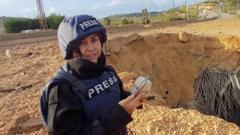
Lebanon accuses Israel of targeting journalist killed in air strike

Lebanon’s prime minister has accused Israel of war crimes after Israeli air strikes killed one journalist and wounded another in southern Lebanon on Wednesday.

The strike killed Amal Khalil, who worked for a Lebanese newspaper, and injured freelance photographer Zeinab Faraj.

Officials in Lebanon say they were deliberately targeted as they sought shelter in a home after an initial air strike hit the vehicle in front of them, killing two men.

The officials also accused the Israel Defense Forces (IDF) of intentionally targeting a marked ambulance as it tried to reach the journalists in the village of Tayri.

The IDF denied that it was preventing rescue teams from reaching the area and mentioned it did not target journalists.

Journalists Khalil, 43, who worked for Lebanese newspaper Al-Akhbar, and Faraj, a freelance photographer, were travelling together. The two men who died have not been named by officials.

Lebanese Prime Minister Nawaf Salam said: “Targeting journalists, obstructing access to them by relief teams, and even targeting their locations again after these teams arrive constitutes described war crimes.”

He accused Israel of repeatedly targeting media workers in southern Lebanon in what he described as “an established approach”.

Salam offered condolences to Khalil’s family and mentioned that Lebanon would “pursue the crimes before the competent international forums”.

In a statement, the IDF stated it “does not target journalists and acts to mitigate harm to them while maintaining the safety and security of its troops”.

The IDF commented it identified two vehicles that had “departed from a military structure used by Hezbollah”.

One of the vehicles had approached Israeli troops in a manner that was an “immediate threat” after crossing a “forward defence line”, violating a ceasefire, the statement noted.

The IDF noted the Israeli Air Force then struck one of the vehicles, and that the “structure from which the individuals had fled was also struck”.

The Lebanese health ministry noted the IDF “pursued” Khalil and Faraj, “who had taken refuge from the first raid in a nearby house, targeting the house where they had sought shelter”.

When a Lebanese Red Cross ambulance arrived to treat the wounded, Israeli forces directed a stun grenade and gunfire toward it, preventing it from reaching them, the ministry noted in a statement.

the health ministry stated, “This constitutes a blatant double violation: obstructing the rescue efforts of a citizen known for her civic media activism, and targeting an ambulance clearly marked with the Red Cross emblem.”

Clayton Weimer, the executive director of Reporters Without Borders, mentioned the IDF had received messages from the organisation, as well as journalists, asking that it allow ambulances to get to Khalil.

“The Red Cross signalled they were unable to get through because of ongoing Israeli bombardment. So that is callous disregard, on top of what appears to be a deliberate and targeted killing of a journalist.”

Faraj was eventually evacuated along with two of the dead, the statement added. Khalil’s body was later recovered by emergency teams, according to Lebanon’s civil defence agency.

Al-Akhbar commented in an article on her death that Khalil “remained steadfast in her humanitarian and professional duty”.

The Guardian’s William Christou, who covers the Middle East for the paper, described her in a post on X as a “professional, kind and dedicated journalist, and always a pleasure to run into in the field”.

The IDF acknowledged reports that two journalists were injured Because of the strikes, but insisted it was not preventing further rescue teams from reaching the area. It has not acknowledged Khalil’s death.

The US-based Committee to Protect Journalists (CPJ) remarked it was “outraged” by Khalil’s death.

“The repeated strikes on the same location, the targeting of an area where journalists were sheltering, and the obstruction of medical and humanitarian access constitute a grave breach of international humanitarian law,” commented CPJ Regional Director Sara Qudah.

In 2024, Khalil noted had been the target of an “Israeli death threat” that warned her to leave southern Lebanon, local media reported. CPJ noted the report raised “serious concerns of deliberate targeting”.

Earlier this month, two journalists were killed in separate Israeli strikes in Lebanon – Ghada Dayekh, a presenter with privately-owned radio station Sawt al-Farah, and Suzan Khalil, a reporter and presenter on Al-Manar TV, which is affiliated with the armed group Hezbollah.

Last month, three Lebanese journalists were killed in a targeted Israeli strike in the town of Jezzine, their employers noted.

Ali Shoeib, a reporter for Hezbollah-affiliated Al Manar TV, and reporter Fatima Ftouni and her brother, cameraman Mohamed Ftouni, both from Al Mayadeen channel, were killed in the strike.

At the time, the IDF confirmed it killed Shoeib and Mohamed Ftouni, describing them as “terrorists” from Hezbollah’s military wing, while saying it was aware of reports a female journalist was also killed.

Lebanese President Joseph Aoun called the killings a “brazen crime” that broke the “most basic rules” of international law by targeting reporters, “who are ultimately civilians performing a professional duty”.

At least 2,475 humans have been killed in Israeli attacks in Lebanon since the latest war began, and more than 7,500 wounded, whose figures do not differentiate between civilians and combatants. The number includes at least 274 women and 177 children.

The Lebanese health ministry mentioned last week that at least 100 medical workers had been killed in Israeli attacks during the war, and that more than 120 Israeli attacks have been recorded on ambulances and medical facilities. Israeli attacks have killed seven journalists In Lebanon, according to the CPJ.

Israeli authorities say Hezbollah attacks have killed two civilians in Israel since 2 March, and that 13 Israeli soldiers have been killed in combat in Lebanon.

Both Hezbollah and Israel have accused each other of violating the ceasefire agreement. The IDF stated earlier on Wednesday that Hezbollah launched an attack on Israeli forces in southern Lebanon.

On the same day, Hezbollah issued four statements saying it had struck Israeli targets in south Lebanon, “in response to the Israeli enemy’s violation of the ceasefire”, according to the AFP news agency.

Last week, a meeting hosted by US Secretary of State Marco Rubio brought Lebanese and Israeli envoys together for the first direct, high, according to the Lebanese authorities-level contact in three decades between the two countries.

Following the talks, their governments agreed to implement a 10-day cessation of hostilities that began on Friday To “enable good-faith negotiations toward a permanent security and peace agreement”, the US state department commented.

Ahead of Thursday’s follow-up talks in Washington, Lebanon’s president confirmed that efforts were under way to extend the ceasefire.

Aoun noted preserving Lebanese sovereignty over all of its territory was his top priority, and that Lebanese negotiators would seek an end to Israeli attacks, the withdrawal of Israeli troops from Lebanon, release of Lebanese prisoners in Israel, deployment of Lebanese troops along the Israeli border, and the beginning of reconstruction process, according to a statement from his office.

A Lebanese official told AFP news agency that Lebanon would request a one-month extension of the ceasefire at the talks.

In a speech to Israeli diplomats, Israel’s foreign minister stated the two countries should “work together against the terror state that Hezbollah built”.

Three Lebanese journalists killed in Israeli strike, say broadcasters This also touches on aspects of international relations.

Israeli triple-tap strike kills three paramedics in Lebanon, officials say

Al Jazeera condemns killing of journalist in Israeli strike in Gaza

AI Disclosure: This article has been generated and curated using advanced AI technology. While we strive for absolute accuracy, some details may be summarized or translated by autonomous systems. Please cross-reference critical financial data with official sources.