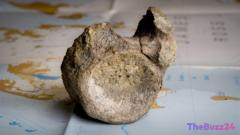
Lost in the Archives: 40-Year-Old Forgotten Fossil Identified as Antarctica’s First Dinosaur Bone
A fossilized bone that sat unnoticed in a storage drawer for nearly four decades has been identified as the first dinosaur bone ever discovered in Antarctica. Originally unearthed in 1985 on James Ross Island, the specimen was stored in the geology collection of the British Antarctic Survey (BAS) in Cambridge because the original expedition team was uncertain of its identity. It was recently rediscovered by Dr. Mark Evans, the BAS collections manager, who noticed its distinct dinosaur-like features while cataloging thousands of polar specimens.
To confirm the identity of the fossil, Evans consulted Professor Paul Barrett from the Natural History Museum. Barrett identified the specimen as a tail vertebra belonging to a Titanosaur, a group of massive, long-necked, plant-eating dinosaurs that includes the largest land animals to have ever lived. The unique ball-and-socket joint structure of the bone made it a definitive match for this specific dinosaur family. Based on the size of the 10-centimeter-wide vertebra, experts estimate this particular dinosaur was roughly 23 feet (7 meters) long, suggesting it was either a juvenile or a smaller-bodied species of the Titanosaur group.
The realization that this bone was collected in December 1985 officially makes it the earliest dinosaur fossil ever found on the Antarctic continent, predating other subsequent discoveries. Geologist Dr. Mike Thomson had originally sketched the fossil in his field notebook, labeling it simply as a “vertebra of large reptile” and assuming it belonged to a marine creature. During the Late Cretaceous Period, approximately 82 million years ago, Antarctica was vastly different from the icy desert of today; it was covered in lush, dense forests that supported a diverse array of prehistoric life.
Finding dinosaur remains in Antarctica is incredibly rare due to the extreme environment and the thick ice sheets covering the bedrock. This rediscovered fossil provides crucial data for paleontologists trying to reconstruct the ancient ecosystems at the bottom of the world. The findings have been officially published in the scientific journal Acta Palaeontologica Polonica, cementing the forgotten bone’s place in the history of polar exploration and paleontology.
Key Takeaways
- A fossil collected in Antarctica in 1985 and stored in a drawer for 40 years has been identified as the first dinosaur bone ever found on the continent.
- The fossil is a tail vertebra belonging to a Titanosaur, a group of herbivorous dinosaurs known for their massive size, though this specimen was a relatively small 23 feet long.
- The discovery confirms that 82 million years ago, Antarctica was a lush, forested environment capable of supporting large reptilian herbivores.
Editor’s Analysis & Impact
The rediscovery of this Titanosaur fossil highlights a persistent phenomenon in modern science: the “drawer discovery.” Natural history museums and geological archives worldwide hold millions of uncataloged or misidentified specimens that contain groundbreaking scientific secrets. This find underscores the critical importance of funding and maintaining physical archives, as well as employing dedicated collections managers. From an evolutionary and paleogeographical standpoint, confirming a Titanosaur in Antarctica during the Late Cretaceous period provides vital pieces to the puzzle of continental drift and prehistoric climate shifts. It proves that despite extreme seasonal light variations, the polar regions once hosted complex, high-biomass terrestrial ecosystems. This discovery will likely spur renewed interest in Antarctic paleontology, prompting researchers to re-examine existing archives and plan targeted expeditions to ice-free corridors of the southern continent.
Frequently Asked Questions
Q: Why did it take 40 years to identify the fossil as a dinosaur bone?
A: When it was first unearthed in 1985, the expedition team was unsure of its identity and assumed it belonged to a prehistoric marine reptile. It was archived in the British Antarctic Survey's vast collection until a collections manager recognized its unique dinosaur-like features during a routine review.
Q: What kind of dinosaur did the bone belong to?
A: The bone is a tail vertebra from a Titanosaur, a diverse group of long-necked, plant-eating sauropod dinosaurs. While some Titanosaurs were the largest animals to ever walk the Earth, this specific individual is estimated to have been a modest 23 feet (7 meters) in length.
Q: What was Antarctica's environment like when this dinosaur was alive?
A: Approximately 82 million years ago, during the Late Cretaceous Period, Antarctica was not the icy wasteland it is today. Instead, it was covered in lush, green forests and experienced a much warmer climate, allowing large herbivores to thrive.
AI Disclosure: This article is based on verified data and official reports. Our Team and AI have cross-referenced every financial detail with primary sources to ensure total accuracy.
More from this Category