Mars Milestone: Curiosity Rover Reaches 5,000 Sols and New Heights in Gale Crater
NASA’s Curiosity rover has achieved a significant milestone on Mars, completing 5,000 Martian days, or sols, since its landing. This remarkable duration, equivalent to over 5,137 Earth days, was celebrated on August 29, 2026. Beyond its longevity, the rover has also become a record-setting explorer, ascending more than 1 kilometer (approximately 0.62 miles) in elevation from its initial landing site on the floor of Gale Crater. This achievement far surpasses previous Martian rover climbs, such as the Spirit rover’s 106-meter ascent of Husband Hill in 2005, highlighting Curiosity’s sustained operational success and engineering prowess.
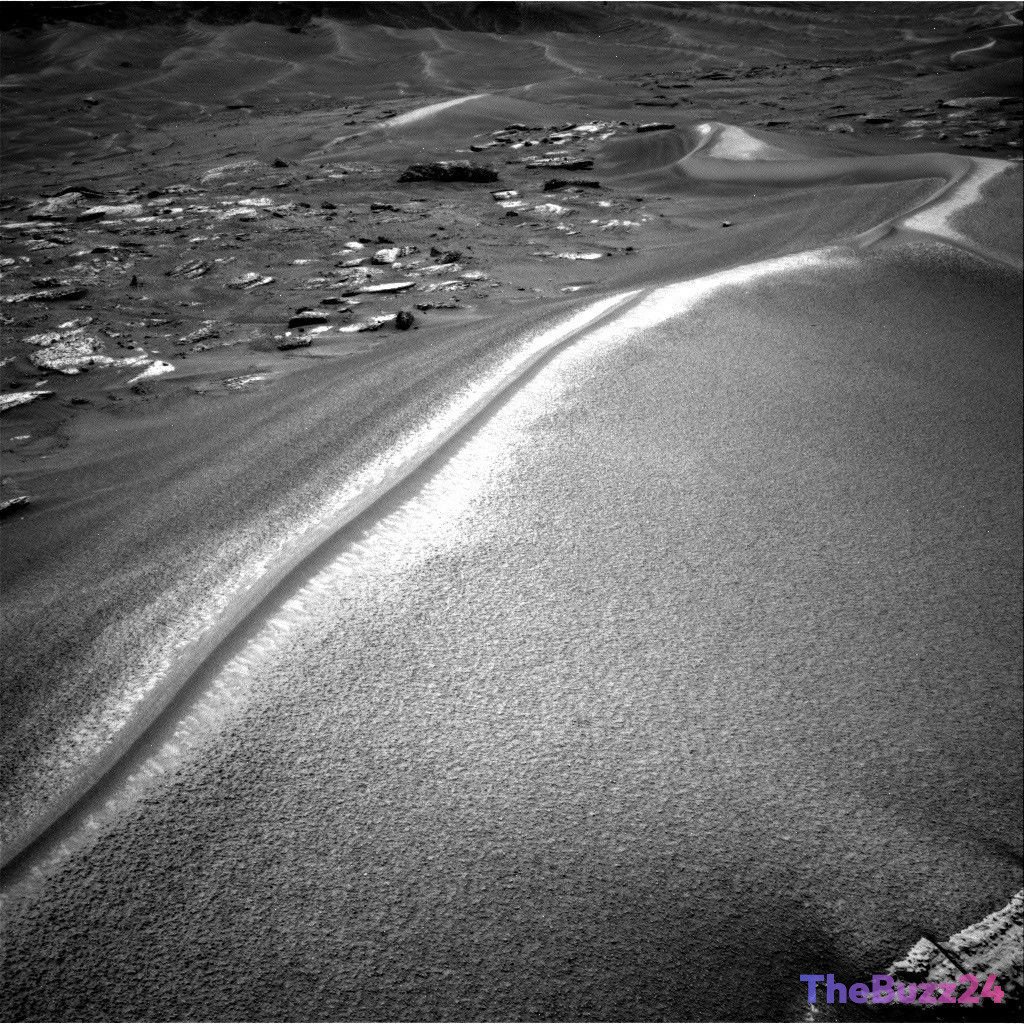
Currently, Curiosity is engaged in detailed scientific investigations of a prominent wind-formed ripple named “Chocolatal.” Scientists are working to determine if this feature can be classified as a “transverse aeolian ridge” (TAR), a type of geological formation observed across the Martian surface through orbital imaging. The long axis of a TAR is typically oriented perpendicular to the prevailing local wind direction. This particular examination is crucial as “Chocolatal’s” higher elevation on Mount Sharp raises questions about its granular composition and layering compared to TARs found at lower altitudes.
The rover’s sophisticated suite of instruments is being deployed to unravel the mysteries of “Chocolatal.” Recent activities included in-situ examinations of light-toned bedrock along its path, with the ChemCam Laser Induced Breakdown Spectroscopy (LIBS) instrument analyzing dark-toned coatings on rocks. Mastcam and ChemCam Remote Micro Imager (RMI) mosaics captured detailed views of layers in nearby buttes and distant sand ripples. The rover strategically drove one of its wheels into “Chocolatal” to enable contact science within the trenched region. Notably, MAHLI mosaics of the trench wall, designed to assess layering and grain size variations, were named in tribute to the late Paul Geissler, a leading expert on Martian TARs. Further LIBS measurements targeted the ripple’s coarse surface and a distinctive “mohawk”-like feature on its crest.
Beyond “Chocolatal,” Curiosity’s extensive planning sessions have included Mastcam mosaics, Navcam surveys for dust devils and suprahorizon views, and APXS atmospheric measurements. The sustained operation and scientific output of the Curiosity mission underscore the dedication of its engineering and science teams. With 5,000 sols of groundbreaking discoveries already under its belt, the mission looks forward to continuing its exploration of Mars, pushing the boundaries of our understanding of the Red Planet’s geological history and potential for past life.
Key Takeaways
- NASA's Curiosity rover has surpassed 5,000 Martian days (sols) on Mars, marking a significant longevity milestone.
- The rover has also achieved a record-breaking ascent, climbing over 1 kilometer in elevation within Gale Crater.
- Curiosity is currently investigating a large wind-formed ripple named "Chocolatal" to understand its geological classification, formation, and composition.
Editor’s Analysis & Impact
The Curiosity rover’s continued operational success, now past 5,000 Martian days and having achieved a record-breaking climb, underscores the remarkable durability and engineering of NASA’s planetary exploration missions. This longevity significantly extends the data collection period, providing an unprecedented long-term view of Martian geology and atmospheric conditions. The ongoing study of features like the “Chocolatal” ripple contributes vital insights into aeolian processes on Mars, which are crucial for understanding the planet’s past climate and potential for habitability. The mission’s sustained performance sets a high bar for future long-duration missions, demonstrating the potential for robotic explorers to yield continuous scientific returns over many years, thereby enriching our understanding of the solar system and informing future human exploration endeavors.
Frequently Asked Questions
Q: What is a "sol" in the context of Mars missions?
A: A "sol" is a Martian day, which is slightly longer than an Earth day. One sol lasts approximately 24 hours and 39 minutes.
Q: What is a "transverse aeolian ridge" (TAR)?
A: A transverse aeolian ridge (TAR) is a type of wind-formed geological feature on planetary surfaces, characterized by a long axis oriented perpendicular to the predominant local wind direction. Scientists study them to understand wind patterns and sediment transport.
Q: What is the significance of Curiosity's 1-kilometer climb?
A: The 1-kilometer elevation gain from its landing site in Gale Crater is a record for a Martian rover, demonstrating Curiosity's ability to traverse challenging terrain and access different geological layers of Mount Sharp, providing a vertical cross-section of Martian history.
AI Disclosure: This article is based on verified data and official reports. Our Team and AI have cross-referenced every financial detail with primary sources to ensure total accuracy.
More from this Category