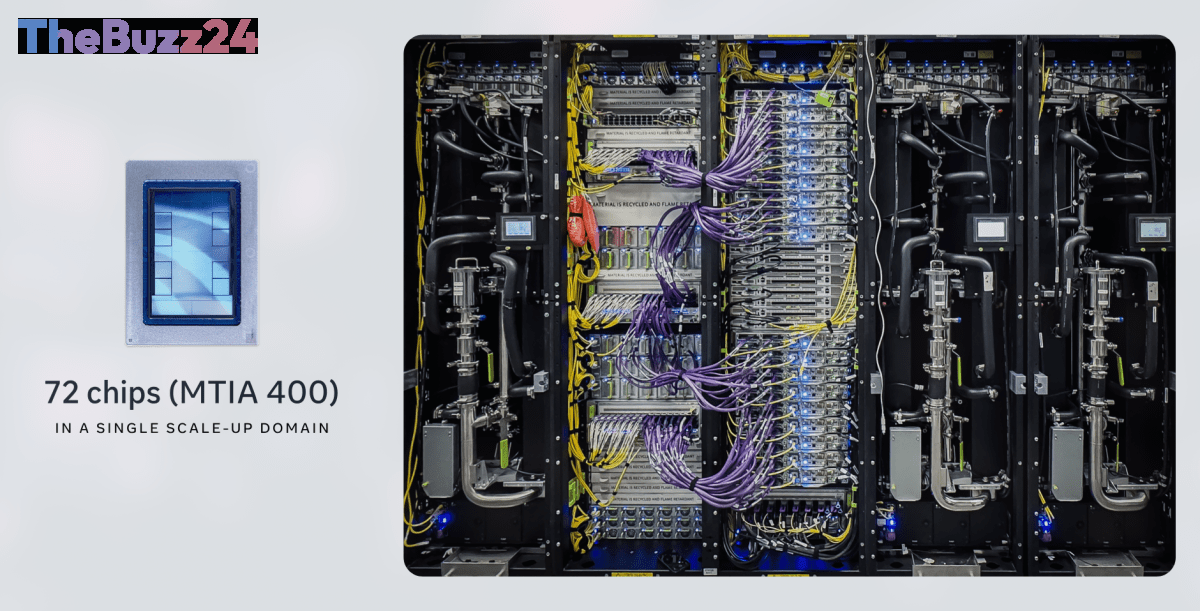
Meta Accelerates AI Chip Production Amidst Compute Demands
Meta is gearing up to commence production of its latest in-house designed artificial intelligence chips in September, a strategic move aimed at mitigating escalating costs associated with high-performance GPUs. This development, detailed in an internal company memo, signifies a significant step in Meta’s ongoing efforts to build a more cost-effective and customized AI infrastructure.
The company’s proprietary chips, developed under the Meta Training and Inference Accelerator (MTIA) program, have undergone rigorous testing, with at least one iteration successfully completing its validation phase in a remarkably short period. Meta is collaborating with industry giants for the manufacturing process, leveraging Taiwan Semiconductor Manufacturing Company (TSMC) for fabrication, while sourcing essential components like RAM from Samsung and storage solutions from SanDisk. Broadcom is also a key partner in the chip design phase.
These new MTIA chips are designed with a modular architecture, allowing for adaptability to the rapidly evolving AI landscape. Meta plans to deploy these chips for a variety of critical functions, including training sophisticated AI models for its recommendation and ranking algorithms, powering broader AI workloads, and enhancing inference capabilities across its social media platforms. This initiative builds upon Meta’s existing strategy of developing custom AI silicon, which began in 2023.
The push for in-house chip production is part of Meta’s broader, substantial investment in AI compute capacity. The company has projected capital expenditures between $125 billion and $145 billion for the current year, with a significant portion allocated to AI infrastructure. This includes securing vast amounts of data center and power resources globally, with plans to deploy 7 gigawatts of compute capacity this year and double that amount in the following year. Meta has also forged strategic partnerships, including a deal with ARM for recommendation system compute and significant agreements with AMD for GPUs and Amazon for cloud-based CPUs.
Key Takeaways
- Meta plans to begin production of its new AI chips in September to reduce reliance on external GPU providers.
- The company is collaborating with TSMC, Broadcom, Samsung, and SanDisk for chip manufacturing and component sourcing.
- These custom-designed MTIA chips are intended for training AI models and improving inference across Meta's platforms, as part of a larger AI infrastructure investment.
Editor’s Analysis & Impact
Meta’s accelerated in-house AI chip production signals a significant industry trend towards vertical integration in the pursuit of AI dominance. By developing its own silicon, Meta aims to gain greater control over its supply chain, optimize performance for its specific workloads, and crucially, reduce its substantial dependency on external chipmakers like Nvidia. This strategy, while capital-intensive, reflects a long-term vision to secure a competitive edge in the AI race. The move also highlights the intense competition and innovation occurring among major tech players, as companies like OpenAI, Anthropic, Amazon, and Google also invest heavily in custom AI hardware, potentially reshaping the semiconductor landscape and driving down costs through increased competition.
Frequently Asked Questions
Q: Why is Meta developing its own AI chips?
A: Meta is developing its own AI chips, part of the MTIA program, to reduce its significant expenses on external GPUs, gain more control over its AI infrastructure, and optimize performance for its specific AI workloads and applications.
Q: Who are Meta's partners in this AI chip initiative?
A: Meta is working with Broadcom on chip design, Taiwan Semiconductor Manufacturing Company (TSMC) for manufacturing, Samsung for RAM, SanDisk for storage, and Sumitomo Electric for fiber-optic equipment.
Q: What is Meta's overall investment in AI compute?
A: Meta expects its capital expenditures to range between $125 billion and $145 billion this year, with a substantial portion dedicated to building out its AI compute capacity, including data centers and power infrastructure.
AI Disclosure: This article is based on verified data and official reports. Our Team and AI have cross-referenced every financial detail with primary sources to ensure total accuracy.
More from this Category