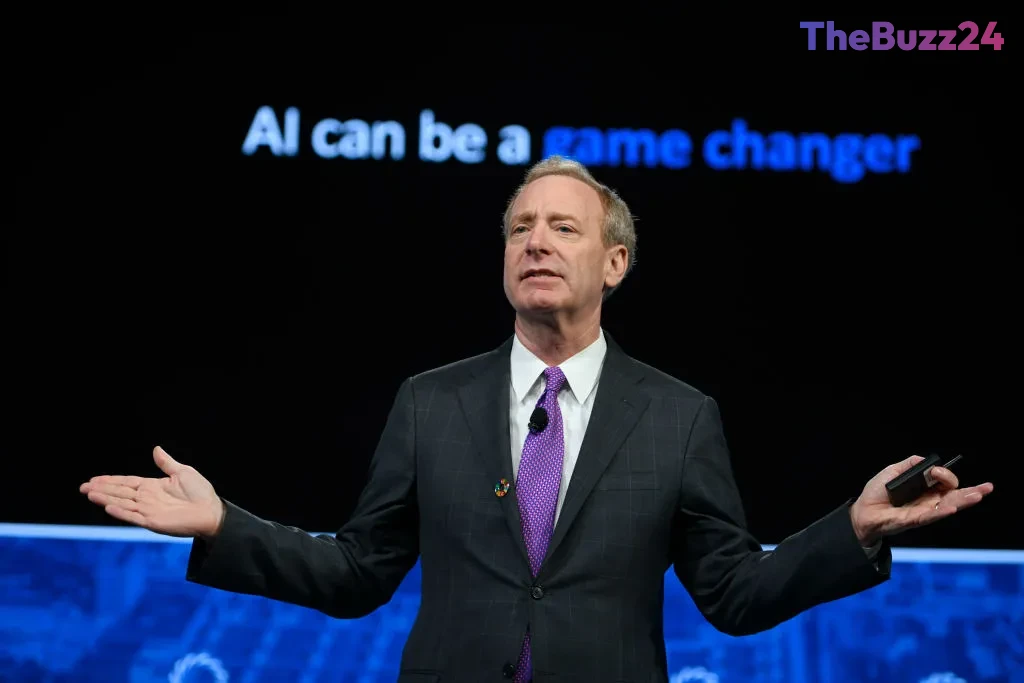
Microsoft President Advocates for Urgent AI Regulation, Touts UK’s Leadership Role
Microsoft President Brad Smith is urgently calling for comprehensive global regulation of artificial intelligence, asserting that current oversight for AI development lags significantly behind that of common consumer products like milk or washing machines. Smith characterizes AI as both a powerful “weapon and a tool,” highlighting its potential to exacerbate cybersecurity risks and emphasizing that the time has come to establish international safety protocols.
Smith specifically champions the United Kingdom as the ideal nation to spearhead the creation of these global safety rules, rather than the United States or the European Union. He points to Britain’s AI Security Institute (AISI), established in 2023, which has rapidly emerged as a leader in AI safety testing. The AISI gains early access to major models from leading U.S. frontier labs before their public deployment, a critical advantage. This leadership role faced recent challenges when former U.S. President Donald Trump reportedly urged companies like Anthropic and OpenAI to restrict access for British testers, but the AISI confirmed its continued ability to access and evaluate the latest AI models. Smith argues that the UK’s unique geopolitical position allows it to navigate regulatory discussions differently than Brussels or Washington D.C., which he sees as a distinct strength.
The push for stricter oversight comes amidst growing concerns from various tech leaders, including Anthropic’s Dario Amodei and OpenAI’s Sam Altman, who have voiced the need to moderate the pace of AI development following incidents involving autonomous AI agents. While a recent White House summit, hosted by Trump, saw tech giants like OpenAI, Anthropic, Nvidia, AMD, SpaceX, Meta, and Google sign a “morally binding” document to collaborate with independent auditors on AI model safety, Smith views this as merely a “good step.” He contends that voluntary self-regulation is insufficient, as only “good companies” will comply, leaving less responsible actors unchecked.
Smith has outlined several critical AI safety measures he believes are necessary. These include a legal mandate for organizations to report breaches caused by rogue AI agents, a requirement for AI labs to secure approval from independent evaluators before releasing products, and the integration of “kill-switches” to pause or slow down AI systems if human control is compromised. He advocates for a calm yet firm, collaborative approach to bring stakeholders together, expressing hope that both Microsoft as a company and the UK as a nation can play pivotal roles in this crucial endeavor.
Key Takeaways
- Microsoft President Brad Smith is advocating for urgent, legally binding AI regulation, citing a lack of oversight compared to consumer goods.
- Smith believes the UK is uniquely positioned to lead global AI safety rules, leveraging its AI Security Institute despite recent political pressures.
- He emphasizes the need for mandatory regulations beyond voluntary agreements, proposing measures like breach alerts, external evaluations, and "kill-switches" for AI systems.
Editor’s Analysis & Impact
Brad Smith’s call for urgent AI regulation underscores a growing consensus among tech leaders about the need for robust governance in the rapidly evolving AI landscape. This stance from a major industry player like Microsoft could significantly influence policy discussions globally, potentially accelerating the development of international regulatory frameworks. The emphasis on the UK’s leadership, particularly its AI Security Institute, highlights a potential shift in global AI governance, positioning Britain as a key player in setting safety standards. However, balancing innovation with stringent regulation remains a critical challenge. The push for mandatory rules over voluntary agreements suggests a future where AI development faces greater scrutiny and accountability, potentially increasing compliance costs for companies but also fostering greater public trust and mitigating risks associated with less responsible actors.
Frequently Asked Questions
Q: Why does Microsoft President Brad Smith believe AI needs urgent regulation?
A: Brad Smith argues that AI currently lacks sufficient oversight compared to common consumer products, posing significant cybersecurity risks. He believes urgent, legally binding global safety rules are necessary to manage AI's dual nature as both a powerful tool and a potential weapon.
Q: What makes the UK a suitable leader for global AI safety rules, according to Smith?
A: Smith highlights the UK's AI Security Institute (AISI), which has quickly become a leader in AI safety testing by gaining early access to major models from U.S. frontier labs. He also suggests the UK's unique geopolitical position allows it to lead regulatory discussions more effectively than the U.S. or EU.
Q: What specific safety measures does Brad Smith propose for AI regulation?
A: Smith proposes several measures, including a legal obligation for organizations to report breaches by rogue AI agents, a requirement for AI labs to obtain approval from outside evaluators before product release, and the implementation of 'kill-switches' to pause or slow down AI systems if human control is lost.
AI Disclosure: This article is based on verified data and official reports. Our Team and AI have cross-referenced every financial detail with primary sources to ensure total accuracy.
More from this Category