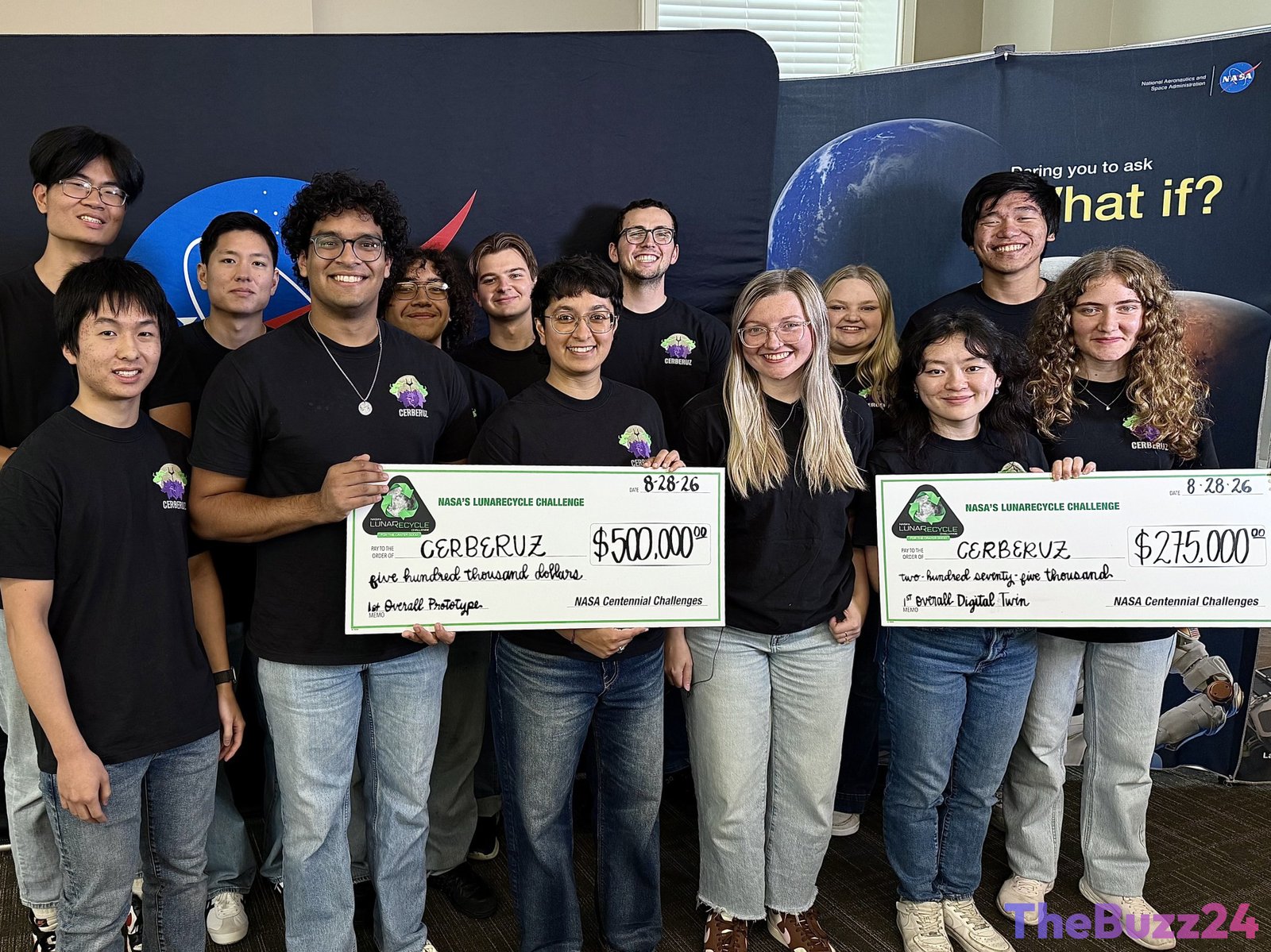
MIT Team Clinches Top Prize in NASA’s LunaRecycle Challenge with Innovative Space Waste Recycling Tech
A student-led team from the Massachusetts Institute of Technology (MIT) has secured the top spot in Phase 2 of NASA’s LunaRecycle Challenge, earning a total of $775,000 in prize money. The competition, designed to address the critical challenge of waste management during long-duration space missions, tasked participants with finding innovative ways to recycle common materials like plastics, fabrics, foam, and metals. The MIT team’s winning project, named CERBERUZ (Composites for Extraterrestrial Recycling By Engineering the Reuse and Upcycling of Zotek), stood out for its highly efficient approach to processing mixed waste.
The CERBERUZ technology works by grinding diverse trash materials into a fine powder. Instead of requiring meticulous sorting to remove contaminants, the system utilizes materials like Zotek foam as structural reinforcement. This processed powder is then converted into feedstock suitable for injection molding or 3D-printing filament, allowing astronauts to manufacture necessary parts and tools directly on the lunar surface or in deep space. MIT’s versatile design excelled in both the physical prototype development track and the digital twin track, which focused on creating virtual models of the recycling systems.
The final stage of the $3 million competition brought 14 finalist teams from across the United States to the University of Alabama’s Lee J. Styslinger Jr. College of Engineering to demonstrate their working prototypes. Other notable winners included Florida-based Terasynth, which took second place overall in the prototype track, and Penn State University’s RECLAIM system, recognized for its innovative microwave-based extraction. The technologies developed during this challenge are expected to have significant dual-use potential, offering sustainable waste-reduction solutions not only for future lunar bases but also for circular economies here on Earth.
Key Takeaways
- MIT's CERBERUZ project won first place and $775,000 in Phase 2 of the LunaRecycle Challenge by turning mixed space trash into 3D-printing filament and injection-molded parts.
- The competition featured 14 finalist teams demonstrating physical prototypes and digital twins at the University of Alabama, showcasing diverse approaches to off-world waste management.
- The recycling technologies developed for deep space missions are designed with dual-use potential, aiming to improve sustainability and waste reduction on Earth as well.
Editor’s Analysis & Impact
As humanity prepares for long-term habitation on the Moon and eventual missions to Mars, logistical self-sufficiency is paramount. Shipping raw materials into space is prohibitively expensive, making in-situ resource utilization (ISRU) and recycling critical pillars of future space exploration. The success of the LunaRecycle Challenge, particularly MIT’s CERBERUZ system, demonstrates that waste can be transformed from a hazard into a valuable resource. By bypassing the need for complex sorting and converting mixed trash directly into manufacturing feedstock, this technology significantly lowers the operational footprint of extraterrestrial habitats. Furthermore, these innovations are poised to disrupt terrestrial recycling industries. The ability to process unsorted, mixed-material waste into high-quality 3D-printing filaments could revolutionize localized manufacturing and waste management in remote or resource-constrained environments on Earth, driving forward the global circular economy.
Frequently Asked Questions
Q: What is the LunaRecycle Challenge?
A: It is a $3 million, multi-phase competition hosted by NASA in partnership with the University of Alabama, aimed at developing innovative technologies to recycle waste materials—such as plastics, metals, and foam—during deep space and lunar missions.
Q: How does MIT's winning CERBERUZ technology work?
A: The CERBERUZ system grinds mixed trash into a fine powder, using materials like Zotek foam as structural reinforcement rather than sorting them out as contaminants. This powder is then used as feedstock for 3D printing or injection molding to create new parts.
Q: Can these space recycling technologies be used on Earth?
A: Yes. While designed for space missions, these technologies have significant terrestrial applications, particularly in improving recycling efficiency, reducing landfill waste, and enabling localized manufacturing in remote areas on Earth.
AI Disclosure: This article is based on verified data and official reports. Our Team and AI have cross-referenced every financial detail with primary sources to ensure total accuracy.
More from this Category