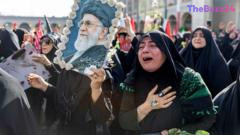
Mojtaba Khamenei Absent as Iran Holds Massive Funeral for Late Supreme Leader
The funeral proceedings for the late Iranian Supreme Leader, Ali Khamenei, have drawn millions of mourners to Tehran, yet the notable absence of his successor, Mojtaba Khamenei, has fueled intense speculation regarding his status. While other family members, including Masoud, Mostafa, and Meysam Khamenei, joined high-ranking officials such as President Masoud Pezeshkian and Revolutionary Guards chief Ahmad Vahidi at the Grand Mosalla complex, Mojtaba has not been seen in public since his appointment in early March. Reports suggest his absence may be linked to security concerns following rumors that he was wounded in the same military strikes that claimed his father’s life.
The ceremonies, described by authorities as the “funeral of the century,” are expected to draw between 12 and 20 million people across Iran and Iraq. The late leader’s body is lying in state ahead of a procession through the capital, with burial scheduled for Thursday in his hometown of Mashhad. The atmosphere at the event has been highly charged, with crowds chanting slogans against the United States and Israel, and some attendees openly calling for retaliation against Western leaders.
International tensions remain a backdrop to the mourning period, as a fragile ceasefire between Iran and its adversaries continues to hold. Despite the ongoing peace negotiations, rhetoric from both sides remains combative. The gathering of Iran’s entire political and military leadership in one location has drawn commentary from global figures, highlighting the precarious nature of the current diplomatic environment as the nation navigates a significant transition of power.
Key Takeaways
- Mojtaba Khamenei remains absent from public view during his father's funeral, sparking rumors about his safety and health.
- The funeral is a massive, multi-day event spanning Iran and Iraq, with millions of mourners expected to participate.
- Geopolitical tensions remain high, with mourners chanting anti-US and anti-Israel slogans despite ongoing ceasefire negotiations.
Editor’s Analysis & Impact
The absence of Mojtaba Khamenei during such a pivotal state event signals a potential crisis of legitimacy or severe security vulnerability within the Iranian leadership. Following the death of a long-standing figurehead who defined Iran’s confrontational foreign policy, the regime is currently in a state of high-stakes transition. The juxtaposition of massive public mourning with aggressive anti-Western rhetoric suggests that while the regime seeks to project strength and unity, internal instability and external threats are creating a volatile environment. The market and diplomatic implications are significant; the stability of the Middle East hinges on whether the new leadership can consolidate power without triggering further military escalation or internal collapse. Future outlooks remain grim as the region watches to see if the transition leads to a shift in policy or a continuation of the late leader’s hardline stance.
Frequently Asked Questions
Q: Why is Mojtaba Khamenei's absence considered significant?
A: As the newly appointed successor to the supreme leadership, his failure to appear at his father's funeral has fueled rumors regarding his health, potential injury from recent military strikes, or extreme security precautions.
Q: Where will the late Ayatollah Khamenei be buried?
A: Following processions in Tehran and Qom, and a visit to a significant Shia site in Iraq, the burial is scheduled to take place in his north-eastern hometown of Mashhad.
AI Disclosure: This article is based on verified data and official reports. Our Team and AI have cross-referenced every financial detail with primary sources to ensure total accuracy.
More from this Category