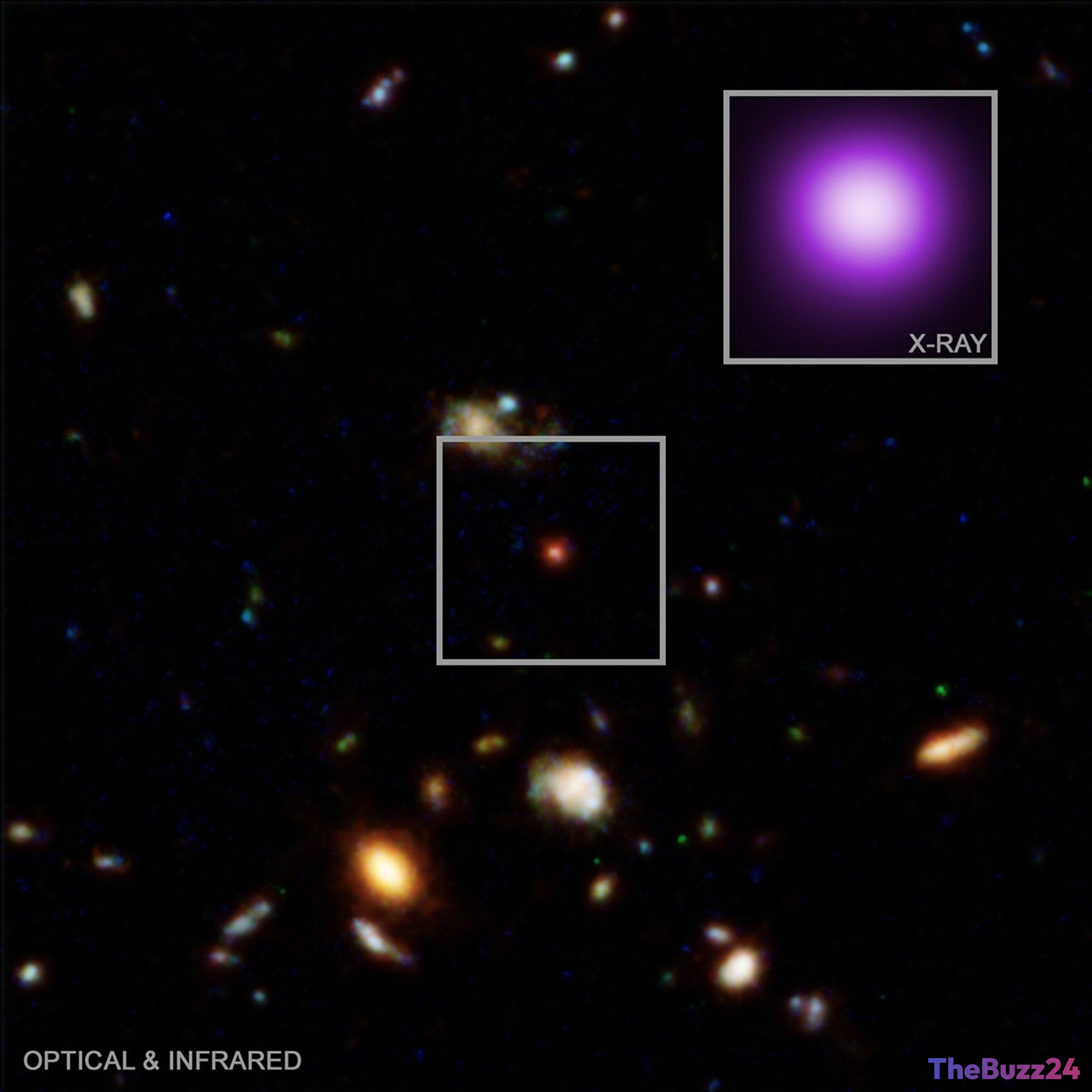
Astronomers Identify ‘X-Ray Dot’ That Unlocks Secrets of the Early Universe
Astronomers have identified a unique celestial object that may serve as the missing link in understanding a mysterious class of phenomena known as “little red dots” (LRDs). These compact, crimson-hued objects, located billions of light-years away, have puzzled the scientific community since they were first observed by the James Webb Space Telescope. While most LRDs appear to lack X-ray emissions, this newly identified object—officially designated 3DHST-AEGIS-12014—stands out because it emits distinct X-ray signals, providing a rare glimpse into the evolution of supermassive black holes in the early universe.
The discovery was made by cross-referencing recent data from the James Webb Space Telescope with archival surveys conducted by the Chandra X-ray Observatory. Researchers believe that 3DHST-AEGIS-12014 represents a critical transition phase. In this scenario, LRDs are essentially supermassive black holes shrouded in dense, obscuring clouds of gas. As these black holes consume their surrounding material, the gas clouds develop gaps, eventually allowing X-rays to escape. This process suggests that the “little red dots” are not a separate category of object, but rather a specific stage in the life cycle of growing supermassive black holes.
Evidence for this theory is bolstered by observed fluctuations in the object’s X-ray brightness, which researchers attribute to varying densities of gas rotating across the black hole’s line of sight. While an alternative theory suggests the object might simply be a standard black hole obscured by an unusual type of dust, the current findings provide the strongest evidence yet that supermassive black hole growth is the primary driver behind the LRD population. Future observations are expected to confirm whether this “X-ray dot” is indeed the key to peering into the heart of these enigmatic early-universe structures.
This breakthrough highlights the power of multi-observatory collaboration, as the object had remained hidden in existing survey data for over a decade before modern infrared technology allowed scientists to recognize its significance. By bridging the gap between obscured black hole stars and typical, bright supermassive black holes, this discovery offers a new framework for mapping the history and development of the most massive objects in the cosmos.
Key Takeaways
- The object 3DHST-AEGIS-12014 acts as a bridge between mysterious 'little red dots' and known supermassive black holes.
- Researchers believe LRDs are actually supermassive black holes in a specific growth phase, obscured by dense gas clouds.
- The discovery was made by combining modern infrared data from the James Webb Space Telescope with archival X-ray data.
Editor’s Analysis & Impact
The identification of 3DHST-AEGIS-12014 marks a significant pivot in observational cosmology. By successfully linking ‘little red dots’ to the evolutionary life cycle of supermassive black holes, researchers have provided a cohesive model for early-universe galactic development. This discovery underscores the immense value of multi-wavelength astronomy, demonstrating that archival data, when paired with next-generation infrared capabilities, can yield transformative insights. Moving forward, this framework will likely accelerate the classification of other enigmatic objects in the deep field, refining our understanding of how the first massive black holes grew so rapidly in the early cosmos. The ability to observe these ‘transition’ phases is crucial for testing current models of galaxy formation and black hole accretion, potentially forcing a revision of existing theories regarding the timeline of the early universe.
Frequently Asked Questions
Q: What are 'little red dots' in the context of space observation?
A: Little red dots are compact, crimson-colored objects observed in the early universe that have puzzled astronomers due to their unique appearance and lack of typical emissions.
Q: Why is the discovery of 3DHST-AEGIS-12014 significant?
A: It is significant because it is the first of these objects found to emit X-rays, suggesting that LRDs are actually supermassive black holes in a specific, gas-shrouded growth phase.
AI Disclosure: This article is based on verified data and official reports. Our Team and AI have cross-referenced every financial detail with primary sources to ensure total accuracy.
More from this Category