NASA’s SPHEREx Mission Maps Massive Water Ice Reserves in Galactic Stellar Nurseries
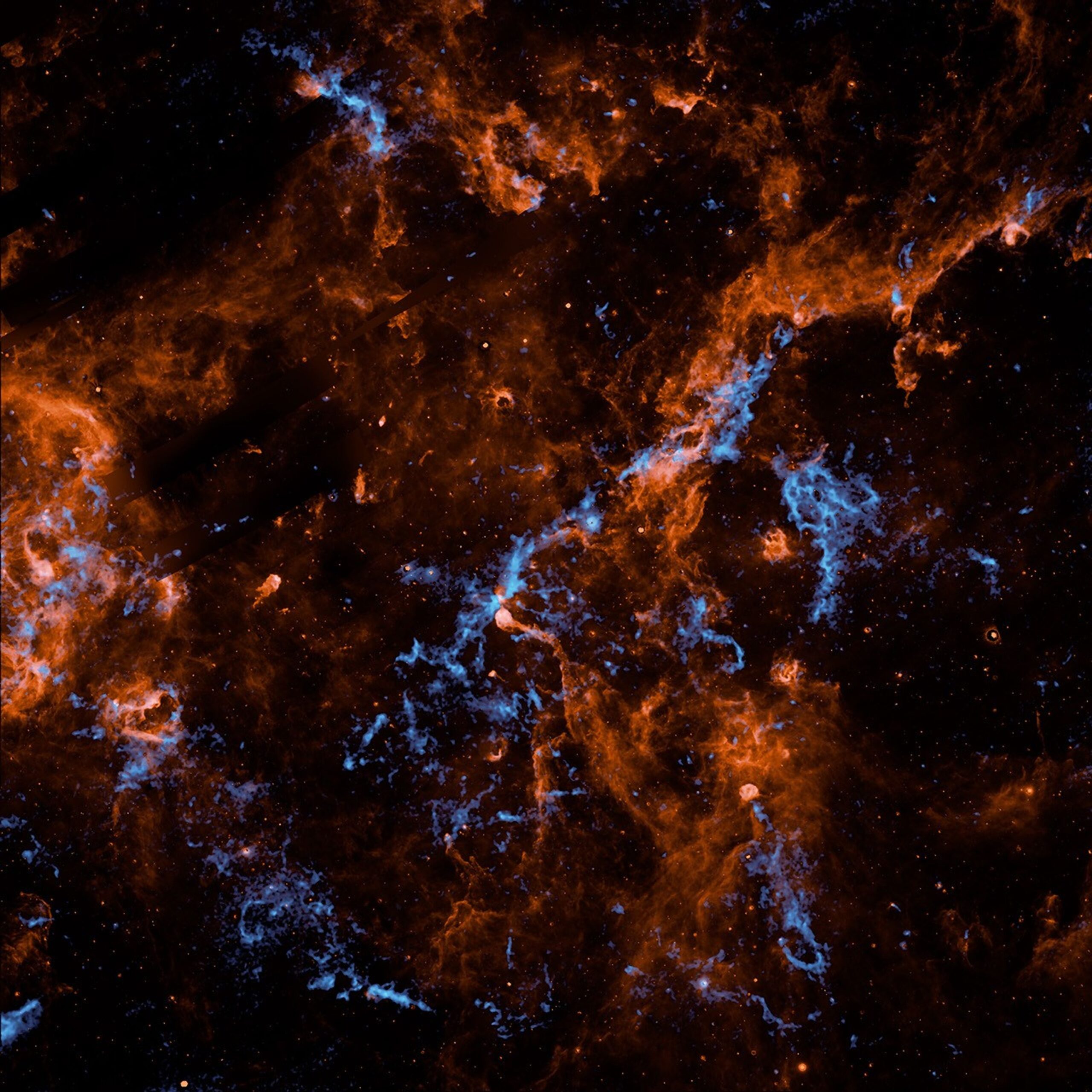
The Spectro-Photometer for the History of the Universe, Epoch of Reionization, and Ices Explorer (SPHEREx) mission has achieved a significant milestone by mapping vast reservoirs of water ice within Cygnus X. As one of the Milky Way’s most active and turbulent stellar nurseries, Cygnus X has provided researchers with a unique laboratory to observe the chemical composition of star-forming regions. Alongside water ice, the mission successfully identified signatures of polycyclic aromatic hydrocarbons, offering a clearer picture of the molecular building blocks present during the birth of new stars.
Data gathered by the mission reinforces the long-standing scientific theory that interstellar ice accumulates on the surfaces of microscopic dust particles, which are comparable in size to smoke. The findings demonstrate a clear correlation between the densest dust lanes and the highest concentrations of ice. This suggests that these dust structures serve as a protective barrier, shielding fragile water molecules from the destructive ultraviolet radiation emitted by young, energetic stars.
Launched in early 2025, SPHEREx distinguishes itself from predecessors like the James Webb Space Telescope by being the first infrared mission designed specifically for a comprehensive, all-sky spectral survey. By observing the cosmos across 102 distinct infrared wavelengths, the observatory has already mapped hundreds of millions of galaxies in three dimensions. Managed by the Jet Propulsion Laboratory and built by BAE Systems, the mission provides an open-access dataset that is currently reshaping our understanding of the origins of water and the chemical foundations of life in the universe.
Key Takeaways
- SPHEREx has successfully mapped extensive water ice reserves within the Cygnus X stellar nursery.
- The mission confirms that dense dust lanes act as a shield, protecting water molecules from intense ultraviolet radiation.
- SPHEREx is the first infrared mission dedicated to an all-sky spectral survey, providing 3D mapping of hundreds of millions of galaxies.
Editor’s Analysis & Impact
The success of the SPHEREx mission marks a pivotal shift in observational astronomy, moving from targeted snapshots to comprehensive, all-sky spectral mapping. By identifying the distribution of water ice and complex hydrocarbons on such a massive scale, the mission provides the empirical data necessary to refine models of planetary formation and the chemical evolution of the galaxy. The ability to map these molecules in 3D across the entire sky will likely accelerate research into how life-essential compounds are distributed throughout the universe. As this data becomes a cornerstone for the global scientific community, it sets a new standard for infrared surveys, potentially influencing the design of future space-based observatories and deepening our understanding of the conditions required for habitable environments to emerge.
Frequently Asked Questions
Q: What makes the SPHEREx mission unique compared to previous telescopes?
A: Unlike previous observatories that focused on specific targets, SPHEREx is the first infrared mission specifically engineered to conduct a comprehensive, all-sky spectral survey, observing the sky in 102 distinct infrared wavelengths.
Q: Why is the discovery of water ice in dust lanes important?
A: The discovery confirms that dense dust lanes protect water molecules from the harsh ultraviolet radiation of newborn stars, which is a critical factor in understanding how these essential molecules survive and contribute to the formation of stars and planetary systems.
AI Disclosure: This article is based on verified data and official reports. Our Team and AI have cross-referenced every financial detail with primary sources to ensure total accuracy.
More from this Category