The Evolution of Onchain Vaults: Professionalizing Decentralized Asset Management
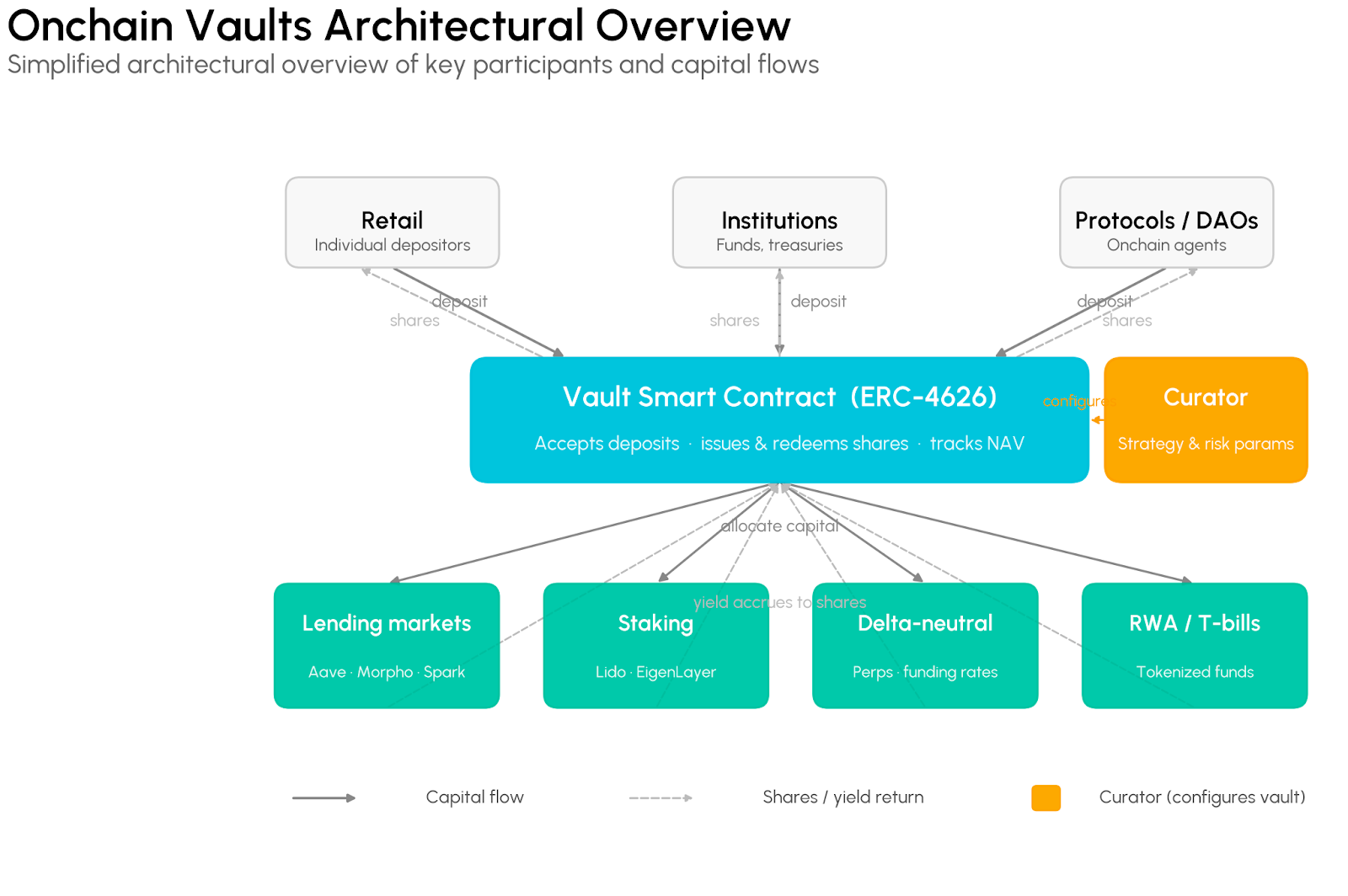
Onchain vaults have emerged as the foundational architecture for decentralized finance, functioning as automated, non-custodial smart contracts that pool capital to execute sophisticated yield-generating strategies. By leveraging the ERC-4626 tokenized vault standard, these platforms have created a unified framework that simplifies the interaction between complex blockchain protocols and end-users. As the ecosystem increasingly integrates tokenized real-world assets and yield-bearing stablecoins, these vaults are rapidly becoming the preferred destination for both retail and institutional capital.
These automated systems are engineered to streamline intricate financial maneuvers, including staking, lending, and delta-neutral trading. By operating on a standardized technical infrastructure, these protocols manage the complexities of capital allocation, allowing participants to seek competitive returns without the need for constant manual intervention. The substantial growth of assets such as sUSDS and sUSDe highlights this expansion, as these instruments now oversee billions of dollars by tapping into diverse revenue streams like decentralized lending markets and funding rates.
A significant shift in the sector is the rise of professional curation, where specialized entities serve as dedicated risk managers. These experts oversee critical parameters, including collateral eligibility, loan-to-value ratios, and oracle configurations. This move toward curated lending models, exemplified by platforms like Morpho, has garnered attention from traditional financial institutions. By providing customizable strategies, these protocols enable organizations to align their risk profiles with specific market requirements, signaling a transition toward a more modular and professionalized financial architecture.
Despite this rapid progress, the sector continues to navigate inherent challenges. Operators must remain vigilant against systemic risks, such as liquidity shortages, oracle malfunctions, and potential flaws in collateral management, all of which could threaten pooled assets. As the industry begins to incorporate more sophisticated off-chain credit instruments, the role of expert curators will become increasingly vital. The long-term success of onchain vaults will depend on the ability to maintain a precise balance between high-yield potential and transparent, robust risk management frameworks.
Key Takeaways
- The ERC-4626 standard is driving interoperability and simplifying complex DeFi strategies for a broader user base.
- Professional curation is transforming decentralized protocols into institutional-grade products by allowing for expert-led risk management.
- The integration of off-chain credit instruments and complex assets necessitates a heightened focus on systemic risk mitigation and transparency.
Editor’s Analysis & Impact
The maturation of onchain vaults marks a fundamental transition in the DeFi sector, moving from experimental, high-risk models toward a structured, institutional-ready environment. The widespread adoption of the ERC-4626 standard acts as a critical catalyst, providing the necessary interoperability for seamless financial integration. The emergence of professional curators is perhaps the most significant development, as it addresses the trust deficit that has historically deterred traditional capital. Looking forward, the industry’s capacity to integrate off-chain credit instruments while maintaining security will be the ultimate test of its resilience. If these vaults can successfully scale while upholding transparency, they are positioned to become the primary infrastructure for digital asset management, potentially challenging traditional banking models through superior efficiency, modularity, and automated oversight.
Frequently Asked Questions
Q: What is an ERC-4626 vault?
A: ERC-4626 is a technical standard for tokenized vaults in DeFi that ensures consistency and interoperability, allowing different applications and protocols to interact with pooled assets more efficiently.
Q: Why is professional curation important for onchain vaults?
A: Professional curation introduces a layer of expert oversight by managing risk parameters such as collateral requirements and oracle settings, which makes decentralized protocols significantly safer and more appealing to institutional investors.
AI Disclosure: This article is based on verified data and official reports. Our Team and AI have cross-referenced every financial detail with primary sources to ensure total accuracy.
More from this Category