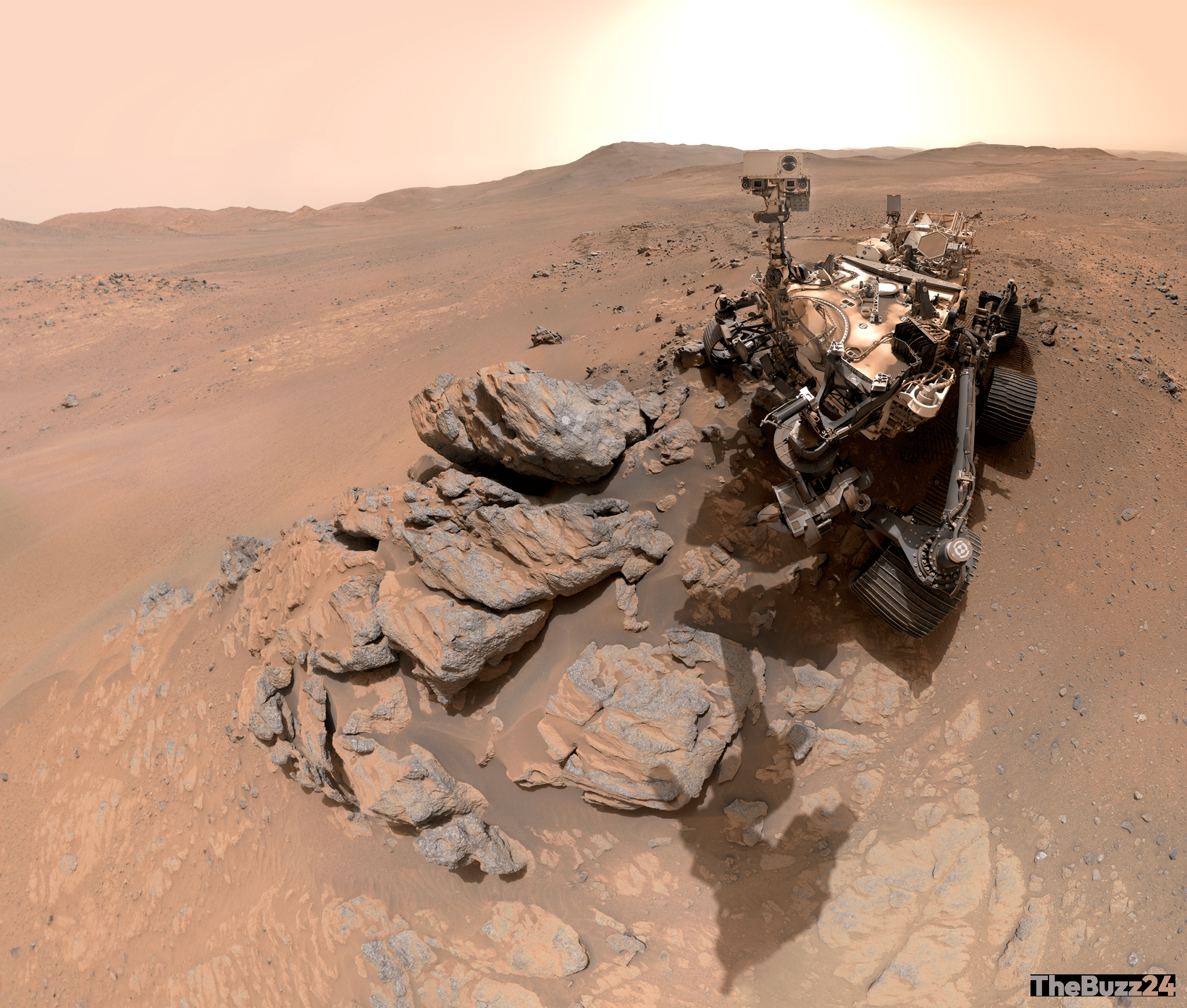
Perseverance Rover Documents Martian Exploration with High-Resolution Self-Portrait
The Perseverance rover has successfully documented its ongoing mission on Mars by capturing a detailed, high-resolution panoramic selfie. Composed of 61 individual images, the photograph captures the robotic explorer stationed at a geological site known as ‘Lac de Charmes.’ The rover is positioned directly beside a rocky outcrop where it recently conducted a circular abrasion, a critical procedure that clears away surface layers to allow for internal geological sampling and analysis.
Captured on the 1,797th sol of the mission, the image offers a clear view of the rover’s complex mechanical structure set against the expansive backdrop of the Jezero Crater’s western rim. This visual documentation serves as more than just a milestone; it provides researchers with a clear assessment of the rover’s physical condition as it navigates the challenging Martian terrain. The site itself is a focal point for the mission team, who are investigating the area for signs of ancient environmental conditions.
As Perseverance continues its journey into the western reaches of the crater, these imaging efforts remain vital to the mission’s broader scientific objectives. By analyzing the abrasion patches and the surrounding geological features, scientists hope to unlock further secrets regarding the planet’s history. These updates act as both a technical health check for the rover and a testament to the persistent efforts to uncover the mysteries of the Red Planet.
Key Takeaways
- The Perseverance rover captured a 61-image panoramic selfie at the 'Lac de Charmes' site on Mars.
- The image highlights a recent abrasion patch, where the rover ground away rock surfaces for geological analysis.
- The mission is currently focused on exploring the western rim of Jezero Crater to study the planet's ancient history.
Editor’s Analysis & Impact
The continued success of the Perseverance mission underscores a significant leap in autonomous planetary exploration. By integrating high-resolution imaging with sophisticated geological sampling, the rover is effectively acting as a remote laboratory, reducing the need for constant human intervention in hazardous environments. The data gathered from the Jezero Crater is instrumental in shaping our understanding of Martian habitability, which has profound implications for future crewed missions. As the rover pushes deeper into unexplored regions, the industry can expect a steady stream of high-fidelity data that will likely refine current models of planetary evolution. The ability to maintain such complex machinery over thousands of sols demonstrates the robustness of modern aerospace engineering and sets a high benchmark for upcoming robotic exploration initiatives across the solar system.
Frequently Asked Questions
Q: How was the Perseverance selfie created?
A: The selfie is a composite image created by stitching together 61 individual photographs taken by the rover's onboard cameras.
Q: Why does the rover perform 'abrasions' on Martian rocks?
A: Abrasion is a process where the rover grinds away the weathered outer surface of a rock to expose fresh material, allowing its internal instruments to analyze the rock's composition more accurately.
AI Disclosure: This article is based on verified data and official reports. Our Team and AI have cross-referenced every financial detail with primary sources to ensure total accuracy.
More from this Category