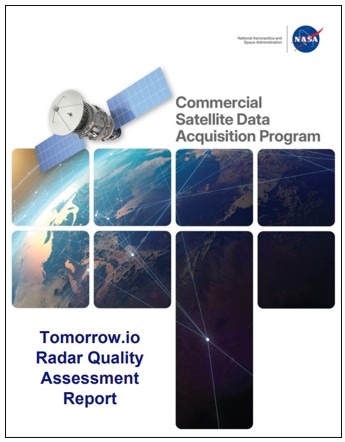
NASA Greenlights Tomorrow.io Satellite Data for Scientific Research
NASA’s Commercial Satellite Data Acquisition (CSDA) program has officially authorized the use of precipitation radar data provided by Tomorrow.io for scientific research purposes. This decision follows an extensive quality assessment of the Ka-band Precipitation Radars currently deployed on the company’s R1 and R2 satellites, marking a pivotal shift in how federal agencies incorporate commercial Earth observation technology into their mission-critical research.
To reach this validation, technical experts performed a deep-dive evaluation of the company’s Level 2 Precipitation products, focusing specifically on geolocation accuracy and data consistency. The review yielded a 0.98 correlation with digital elevation models, demonstrating exceptional spatial precision. Additionally, when benchmarked against established ground-based radar infrastructure, the satellite data achieved correlation coefficients as high as 0.93, proving that these commercial instruments satisfy the rigorous requirements necessary for high-level atmospheric and environmental analysis.
This milestone highlights the growing capability of the private sector to contribute meaningful, high-fidelity data to the global scientific community. By proving that commercial systems can operate at a level comparable to established missions like the Global Precipitation Measurement program, the initiative aims to broaden the scope and availability of environmental monitoring. The CSDA program remains committed to refining its evaluation protocols, ensuring that innovative, privately-sourced data can be seamlessly integrated into future federal research and climate modeling efforts.
Key Takeaways
- NASA has officially validated Tomorrow.io’s satellite precipitation radar data for use in scientific research.
- The data demonstrated high accuracy, with a 0.98 correlation to digital elevation models and a 0.93 correlation against ground-based radar systems.
- This approval signifies a successful integration of commercial space technology into federal scientific missions, potentially increasing the volume of available environmental data.
Editor’s Analysis & Impact
The validation of Tomorrow.io’s data by NASA represents a significant maturation of the ‘NewSpace’ economy. By moving beyond experimental status to become a trusted source for federal scientific research, commercial satellite operators are effectively lowering the barrier to entry for high-quality Earth observation. This shift suggests a future where government agencies rely less on building bespoke, multi-billion-dollar satellites and more on purchasing data-as-a-service from agile private firms. The broader implication is a more dense, frequent, and cost-effective monitoring of global weather patterns. As these commercial constellations grow, we can expect a surge in climate modeling precision, which will have downstream impacts on industries ranging from agriculture and logistics to disaster management and insurance, ultimately accelerating the pace of climate-related scientific discovery.
Frequently Asked Questions
Q: What does it mean for NASA to validate commercial satellite data?
A: It means the data has undergone a rigorous quality assessment and has been proven to meet the high standards required for federal scientific research, allowing researchers to use it in official studies and climate models.
Q: Why is the correlation coefficient important in this validation?
A: The correlation coefficient measures how closely the satellite data matches established benchmarks, such as ground-based radar. High coefficients (0.93 to 0.98) indicate that the commercial data is highly reliable and accurate for scientific use.
AI Disclosure: This article is based on verified data and official reports. Our Team and AI have cross-referenced every financial detail with primary sources to ensure total accuracy.
More from this Category