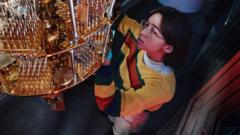
France Solidifies Global Standing as Quantum Computing Hub
France is rapidly establishing itself as a central pillar in the global quantum computing race, driven by a surge in specialized research and significant infrastructure investment. On the outskirts of Paris, the firm Alice & Bob is spearheading this momentum with a $50 million expansion project. This new facility will feature a dedicated clean room designed specifically for the proprietary manufacturing of quantum chips, signaling a shift from experimental research to scalable industrial production.
At the heart of this technological push is the development of ‘cat qubits.’ Unlike traditional quantum bits that are highly susceptible to environmental interference and decoherence, these specialized qubits are designed to autonomously correct errors. By mitigating the need for the massive, complex redundancy systems that have historically plagued quantum hardware, this innovation offers a more efficient path toward building stable, high-performance machines capable of solving problems currently beyond the reach of classical computers.
The broader French quantum ecosystem is flourishing under the support of national initiatives such as the PROQCIMA program. This government backing has created a fertile environment for a cluster of innovative companies, including Pasqal, Quandela, Quobly, and C12. With access to a deep pool of scientific talent and favorable energy costs, these firms are positioning France—and Europe at large—to compete aggressively against international rivals in the next generation of high-performance computing, particularly in sectors like pharmaceutical research and molecular simulation.
Key Takeaways
- Alice & Bob is investing $50 million in a new French facility to scale proprietary quantum chip production.
- The implementation of 'cat qubits' allows for autonomous error correction, addressing the industry's primary challenge of decoherence.
- France is leveraging government programs and a strong academic foundation to become a leading European hub for quantum innovation.
Editor’s Analysis & Impact
The quantum computing sector is currently transitioning from theoretical research to practical, scalable engineering. The French approach, characterized by government-backed ‘national champions’ and a focus on error-correction efficiency, represents a strategic attempt to bypass the ‘brute force’ hardware requirements that have historically hindered the industry. By focusing on cat qubits, Alice & Bob is addressing the primary bottleneck of quantum scaling: decoherence. If successful, this could significantly lower the barrier to entry for commercial quantum applications. The broader implication is a shift in the geopolitical tech landscape, where Europe is actively working to reduce reliance on US and Asian hardware dominance. As these firms move toward commercial deployment, we can expect a surge in demand for specialized quantum software and a transformation in industries reliant on complex molecular modeling, such as materials science and biotechnology.
Frequently Asked Questions
Q: What are 'cat qubits' and why are they important?
A: Cat qubits are a specialized type of quantum bit designed to autonomously correct certain types of errors. They are significant because they reduce the need for the massive, complex redundancy systems typically required to keep quantum computers stable.
Q: Why is France considered a leader in the quantum computing space?
A: France has cultivated a dense ecosystem of quantum startups supported by government initiatives like the PROQCIMA program. Additionally, the country benefits from low energy costs, a strong history of physics education, and a high concentration of specialized firms working on diverse qubit technologies.
AI Disclosure: This article is based on verified data and official reports. Our Team and AI have cross-referenced every financial detail with primary sources to ensure total accuracy.
More from this Category