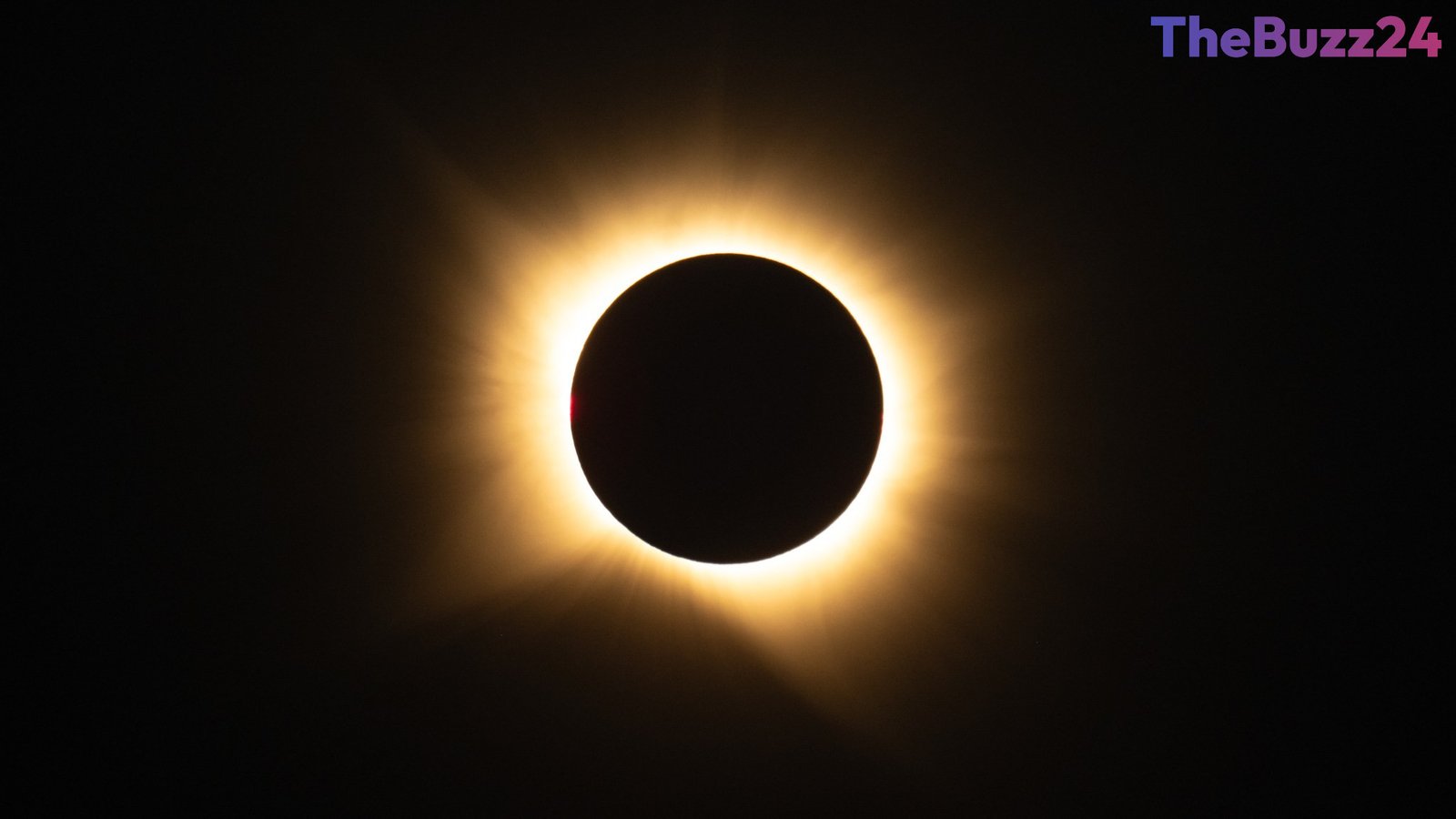
Rare Celestial Spectacle: Total Solar Eclipse Captivates Viewers Across Europe and Beyond
Millions turned their eyes toward the sky as an extraordinary total solar eclipse plunged regions of Northern Europe, the Atlantic, and Southern Europe into temporary daylight darkness. The dramatic astronomical event occurred when the Moon aligned perfectly between the Earth and the Sun, completely obscuring solar light along a narrow path of totality.
Observers in Spain experienced some of the most striking views, with regions like San Millán de los Caballeros witnessing the solar corona fully exposed to skygazers. The full shadow also swept across vast stretches of Greenland, Iceland, northern Russia, and portions of the Atlantic Ocean, while barely brushing the northwestern corner of Portugal.
Beyond the path of total darkness, millions of people were treated to a dramatic partial eclipse. Skywatchers across large sections of North America, including parts of the United States and most of Canada, as well as much of Europe and northwestern Africa, observed the solar disk partially covered during the daytime display.
Astronomy enthusiasts and scientific researchers gathered across key vantage points along the path to observe the unique alignment. The event highlighted a surge in global interest for skywatching phenomena, driving regional tourism and offering unique opportunities to study atmospheric and solar dynamics.
Key Takeaways
- A total solar eclipse carved a path of complete darkness across Greenland, Iceland, Spain, and northern Russia.
- Partial views of the eclipse were visible across vast areas of North America, Europe, and northwestern Africa.
- The event attracted widespread scientific interest and boosted local astro-tourism along the path of totality.
Editor’s Analysis & Impact
Total solar eclipses serve as critical moments for both scientific research and regional economic activity. When the path of totality crosses easily accessible European destinations like Spain, it creates a booming market for astro-tourism, filling hotels and boosting local services. Scientifically, ground-based observations during totality allow solar physics researchers to analyze the faint solar corona, providing valuable insights into solar wind generation and space weather dynamics. As public engagement with astronomical events reaches unprecedented heights, future major celestial events will likely continue to drive significant media attention, travel revenue, and collaborative international scientific initiatives.
Frequently Asked Questions
Q: Where was the total solar eclipse visible?
A: The path of totality stretched across parts of Greenland, Iceland, northern Russia, the Atlantic Ocean, Spain, and a small portion of Portugal.
Q: What happens during a total solar eclipse?
A: A total solar eclipse occurs when the Moon passes directly between the Earth and the Sun, completely blocking the Sun's face and exposing its faint outer atmosphere, known as the corona.
Q: Could people outside the main path still see the eclipse?
A: Yes, millions of viewers across parts of the United States, most of Canada, Europe, and northwestern Africa were able to see a partial solar eclipse.
AI Disclosure: This article is based on verified data and official reports. Our Team and AI have cross-referenced every financial detail with primary sources to ensure total accuracy.
More from this Category