Saudi Arabia Vows “Serious Response” to Escalating Houthi Attacks on Key Infrastructure
Saudi Arabia’s Energy Minister, Prince Abdul Aziz bin Salman, has declared that the kingdom will deliver a “serious” response to the recent deadly attacks targeting its airports and vital oil and gas facilities. Speaking at the WPC Energy Congress in Riyadh, Prince Abdul Aziz stated, “The events of recent weeks are serious. Our response must be equally serious.” This declaration comes in the wake of multiple assaults attributed to Yemen’s Iran-backed Houthi movement.
Sunday saw a Pakistani national killed in an attack on a terminal at King Khalid International Airport in the capital. This incident followed a Houthi missile strike on another terminal the previous day, which resulted in 13 fatalities and necessitated its closure. The Houthis have claimed responsibility for these attacks, framing them as retaliation for what they describe as “brutal Saudi aggression” against areas under their control in western Yemen. In a separate development, the Houthi-run health ministry reported that a child was killed and six others injured in a Saudi airstrike on a residence in the capital, Sanaa, on Sunday.
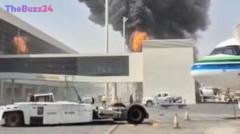
The WPC Energy Congress commenced on Sunday, with its venue located approximately 10 kilometers from Riyadh’s airport, which has been targeted four times in the past week. Last Thursday, two strikes on an airport facility and a grounded aircraft claimed the lives of three Saudis, including a pilot for the national airline. Saturday’s missile attack on Terminal 3 resulted in the deaths of four Saudis, along with individuals from Bangladesh, the United States, Egypt, Jordan, Syria, Palestine, Sudan, and India. On Sunday, a projectile hitting Terminal 4 led to the death of a Pakistani resident, according to aviation authorities. King Fahd International Airport in Dammam also experienced an attack on Sunday evening, though no casualties were reported.
In response to the escalating attacks, the Saudi-led coalition announced the interception of a drone and a missile launched by the Houthis towards the southwestern city of Khamis Mushait. Prince Abdul Aziz acknowledged the challenges posed by these developments, noting that “energy security cannot be taken for granted” and that recent events have “tested our infrastructure, our institutions, our people, and our resilience.” He expressed confidence in the kingdom’s ability to overcome these obstacles, emphasizing the “fearless, combatant and determined” nature of the Saudi people.
Houthi military spokesman Yahya Sarea asserted that their forces had launched missiles and drones at Riyadh and Dammam airports, as well as two oil and gas facilities, in retaliation for numerous Saudi airstrikes in Yemen. He reiterated a warning to airlines and passengers to avoid Saudi airports and airspace, with exceptions for travel to Mecca and Medina. The Houthis vowed to continue their operations deep inside Saudi territory, imposing an “escalation for an escalation” until the “aggression ceases and the siege on our dear people is lifted.”
Key Takeaways
- Saudi Arabia has vowed a "serious response" to recent Houthi attacks on its airports and energy facilities.
- The Houthi movement claims the attacks are retaliation for Saudi airstrikes in Yemen and a blockade.
- The escalating conflict raises concerns about regional stability and energy security.
Editor’s Analysis & Impact
The recent Houthi attacks on Saudi infrastructure, including airports and energy facilities, represent a significant escalation in the ongoing conflict in Yemen. Saudi Arabia’s strong vow of a “serious response” signals a potential for increased military action, which could further destabilize the region. The targeting of critical infrastructure directly impacts global energy markets, underscoring the fragility of energy security. This situation also puts international actors, including the US, in a difficult position, balancing support for allies with the risks of wider conflict. The Houthis’ stated aim of an “escalation for an escalation” suggests a continued pattern of asymmetric warfare, designed to inflict pressure on Saudi Arabia and draw international attention to their grievances.
Frequently Asked Questions
Q: Who are the Houthis?
A: The Houthis, officially known as Ansar Allah, are a Zaydi Shia religious and political movement based in Yemen. They have been engaged in a civil war against the Yemeni government, which is supported by a Saudi-led coalition, since 2014.
Q: What is the context of the attacks?
A: The Houthi attacks are presented as retaliation for the Saudi-led coalition's military intervention and airstrikes in Yemen, as well as an alleged blockade of Houthi-controlled ports and airports. The conflict has devastated Yemen and created a severe humanitarian crisis.
Q: What are the implications for global energy markets?
A: Attacks on Saudi Arabia's oil and gas facilities and infrastructure, including airports crucial for logistics, can disrupt supply chains and create uncertainty, potentially leading to fluctuations in global oil prices and concerns about energy security.
AI Disclosure: This article is based on verified data and official reports. Our Team and AI have cross-referenced every financial detail with primary sources to ensure total accuracy.
More from this Category