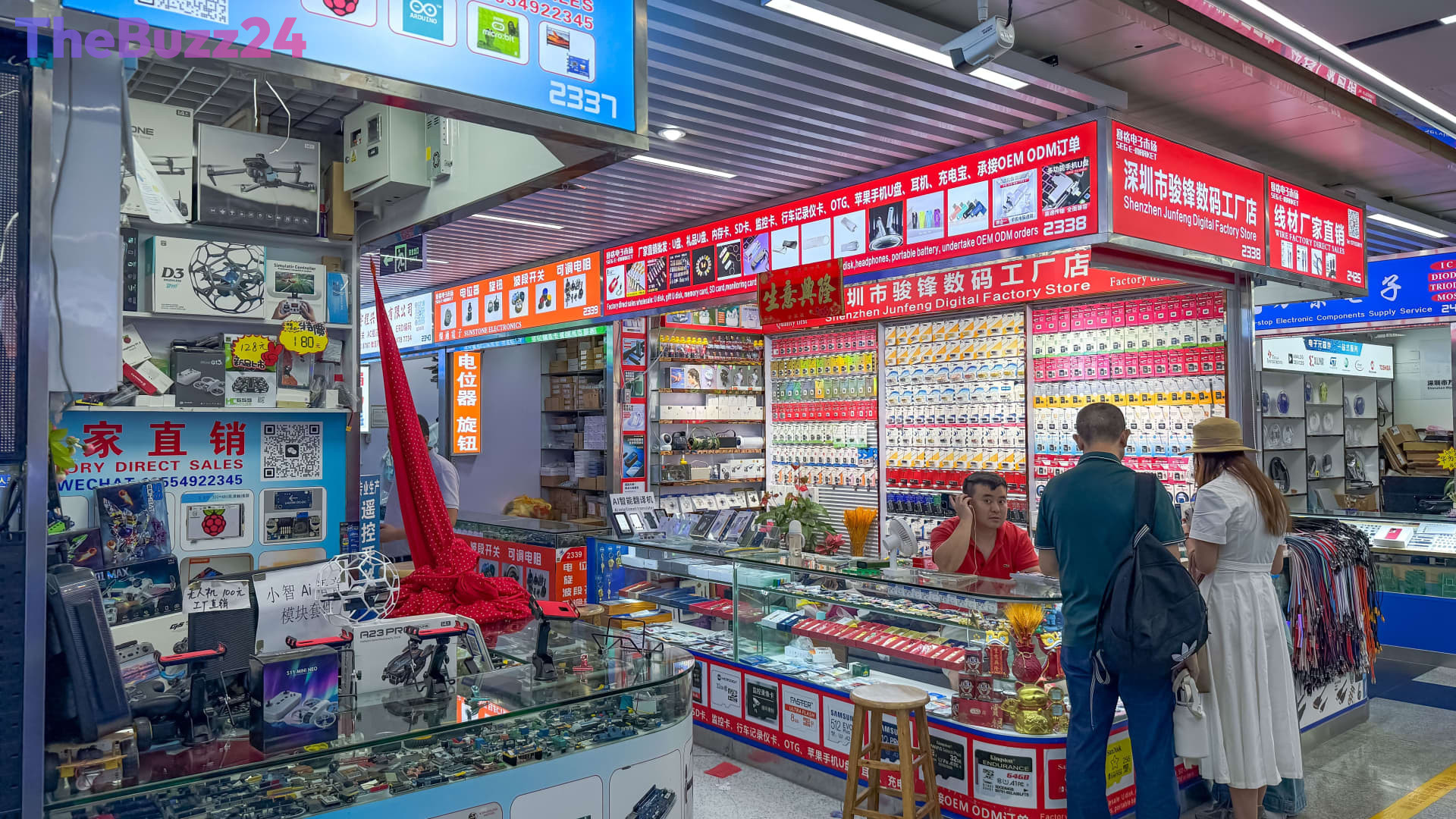
Shenzhen’s Manufacturing Might: Why Tech Giants Are Betting on China Over Silicon Valley
In a significant shift for global technology manufacturing, a growing number of companies are doubling down on Shenzhen, China, as a critical hub for innovation and production, even as geopolitical tensions and trade tariffs loom. This strategic pivot is driven by Shenzhen’s unparalleled integrated supply chain, a dense ecosystem of specialized manufacturers, and a proven track record that has attracted talent and investment for decades.
Joshua Woodard, a former Apple employee and CEO of supply chain management firm The Sparrows, exemplifies this trend. Having left a role at Apple to establish his company in Shenzhen, Woodard is convinced that the city’s manufacturing capabilities will dominate the global tech landscape for the foreseeable future. “A lot of our clients come from the States,” Woodard stated, highlighting the demand for Shenzhen’s production prowess. He further argued that despite geopolitical concerns, the sheer efficiency and infrastructure in China make it the only viable option for building physical products, asserting that neither India nor Vietnam are poised to challenge this dominance soon.
This sentiment is echoed by Will Wang, CEO of Even Realties and another former Apple employee who founded a smart-glasses startup in Shenzhen. Wang emphasized the logistical advantages, noting that “you have all the supply chain around you within probably a two-hour drive.” He believes that for any company aiming to create the “next Apple,” being at the epicenter of hardware innovation, which is Shenzhen, is indispensable. The region’s significance is underscored by the presence of major players like DJI and BYD, alongside a vast network of consumer electronics firms that have benefited from Apple’s early investment in local manufacturing.
Trade data further illustrate Shenzhen’s crucial role. Last year, China remained California’s largest import source, with computer and electronic products constituting the top category. Shenzhen itself accounted for nearly 19% of China’s advanced tech exports, solidifying its position as a powerhouse in specialized technologies, particularly in areas like humanoid robotics hardware. While some industry figures advocate for supply chain diversification and proximity to end-users to mitigate risks, others, like BAI Capital’s Annabelle Yu Long, observe that “supply chain diversification away from China has been slowing down,” with many “counting on China to provide the efficiency on innovation.”
Key Takeaways
- Shenzhen, China, is increasingly favored over Silicon Valley for tech manufacturing due to its highly integrated and efficient supply chain.
- Companies like The Sparrows and Even Realties, founded by former Apple employees, are betting on Shenzhen's long-term dominance in hardware production.
- Despite geopolitical risks and tariffs, the cost and speed advantages of manufacturing in Shenzhen continue to attract significant international business, slowing diversification efforts away from China.
Editor’s Analysis & Impact
The continued reliance on Shenzhen for advanced manufacturing highlights a complex interplay between economic pragmatism and geopolitical concerns. While Western nations push for supply chain diversification, the sheer scale, expertise, and cost-effectiveness of China’s manufacturing ecosystem, particularly in Shenzhen, present a formidable barrier to relocation. This situation poses a strategic challenge for global tech companies, forcing them to balance the immediate benefits of Shenzhen’s infrastructure against long-term risks. The trend suggests that innovation in physical products may continue to be heavily influenced by Chinese manufacturing capabilities, potentially shaping the future of consumer electronics and robotics.
Frequently Asked Questions
Q: What makes Shenzhen a preferred manufacturing hub over Silicon Valley?
A: Shenzhen offers an unparalleled, highly integrated supply chain within a short radius, a deep pool of specialized manufacturing expertise, and significantly lower production costs and faster prototyping times compared to Silicon Valley. This ecosystem has been developed over decades, attracting major tech companies and fostering innovation in hardware.
Q: What are the main arguments against manufacturing in China?
A: The primary concerns against manufacturing in China include geopolitical risks, escalating trade tariffs, and the desire to be closer to end-users. Some companies also advocate for supply chain diversification to mitigate potential disruptions and build resilience.
Q: How is Shenzhen's manufacturing strength impacting specific tech sectors?
A: Shenzhen's manufacturing prowess is particularly evident in consumer electronics and is increasingly dominant in areas like the hardware for humanoid robotics. Its efficiency and innovation capabilities are crucial for companies looking to rapidly develop and scale new products in these sectors.
AI Disclosure: This article is based on verified data and official reports. Our Team and AI have cross-referenced every financial detail with primary sources to ensure total accuracy.
More from this Category