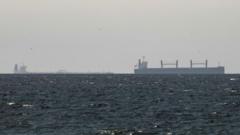
Global Energy Markets on Edge as Strait of Hormuz Closure Disrupts Shipping
The Strait of Hormuz has been closed to commercial shipping once again, marking a significant escalation in Middle Eastern maritime tensions. The Islamic Revolutionary Guard Corps (IRGC) has issued a stern warning, declaring that any vessel attempting to enter the critical waterway will be targeted. This move is framed by regional authorities as a direct response to the ongoing naval blockade enforced by the United States, which has effectively restricted Iranian port access.
This latest closure follows a brief period of relative stability where the lane had been reopened to international traffic. The situation has been exacerbated by a series of violent maritime incidents, including attacks on a tanker by Iranian gunboats and a container ship struck by an unidentified projectile near the coast of Oman. Multiple merchant vessels have reported being fired upon, prompting urgent diplomatic interventions from nations like India, which has seen its own flagged ships caught in the crossfire.
The closure of this vital chokepoint carries profound implications for global energy security, as approximately 20% of the world’s oil and liquefied natural gas supply passes through the strait. The resulting uncertainty has pushed global energy prices upward, with oil benchmarks briefly surging past $100 per barrel. While a temporary ceasefire is scheduled to hold until April 22, the standoff remains precarious as the United States maintains its blockade policy under President Donald Trump.
Despite the military posturing, diplomatic efforts are continuing behind the scenes. The Iranian Supreme National Security Council is currently evaluating new peace proposals submitted by the United States. While previous attempts at a resolution have stalled, officials remain engaged in discussions, hoping to find a path toward de-escalation before the current ceasefire expires.
Key Takeaways
- The Strait of Hormuz is closed to commercial traffic, with the IRGC threatening to target any vessels entering the area.
- The closure is a direct response to the U.S.-led naval blockade of Iranian ports, causing global oil prices to spike above $100 per barrel.
- Diplomatic negotiations are ongoing, with Iran currently reviewing new peace proposals ahead of an April 22 ceasefire deadline.
Editor’s Analysis & Impact
The closure of the Strait of Hormuz represents a critical stress test for the global economy. Because this waterway serves as the primary artery for Middle Eastern oil exports, any prolonged disruption creates an immediate supply shock that ripples through global energy markets. The current volatility is compounded by the intersection of military brinkmanship and high-stakes diplomacy. If the current ceasefire fails to yield a formal agreement, the resulting supply chain bottlenecks could lead to sustained inflationary pressure on energy costs worldwide. Investors and policymakers are closely watching the negotiations, as the outcome will determine whether this remains a localized maritime conflict or escalates into a broader geopolitical crisis with long-term consequences for global trade stability and energy security.
Frequently Asked Questions
Q: Why is the Strait of Hormuz considered so important?
A: The Strait of Hormuz is a critical maritime chokepoint through which approximately 20% of the world's total oil and liquefied natural gas supply is transported, making it essential for global energy security.
Q: What is the current status of the conflict?
A: There is a temporary ceasefire in place until April 22, while the Iranian Supreme National Security Council reviews new peace proposals submitted by the United States.
AI Disclosure: This article is based on verified data and official reports. Our Team and AI have cross-referenced every financial detail with primary sources to ensure total accuracy.
More from this Category