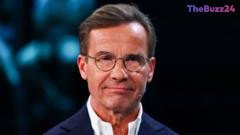
Swedish Prime Minister Ulf Kristersson Steps Down Following Narrow Election Defeat
Swedish Prime Minister Ulf Kristersson has officially announced his resignation following a razor-thin defeat of his ruling right-wing coalition in the nation’s general election. The conservative leader made public his decision via social media, pointing to preliminary vote tallies that separated the opposing political blocs by approximately 50,000 ballots in a country of roughly 10 million residents.
The preliminary counts indicate that the centre-left opposition, spearheaded by Magdalena Andersson and her Social Democrats, is positioned to secure 176 seats in the 349-seat Riksdag. Meanwhile, the incumbent right-wing alliance, which governed with the external backing of the anti-immigration Sweden Democrats, is projected to claim 173 seats. Final certification of the election results is anticipated shortly over the weekend.
Following the formal resignation, the Speaker of the Riksdag will initiate formal consultations with all party leaders to nominate a candidate for the next administration. Andersson, who previously led the country before spending four years in opposition, has already commenced discussions with potential coalition partners, including the Left Party, Centre Party, and Green Party. However, political analysts note that forming a cohesive government could prove challenging due to policy divergences on critical matters like taxation.
Key Takeaways
- Swedish Prime Minister Ulf Kristersson resigned after his right-wing bloc lost a narrow election to the centre-left opposition.
- Magdalena Andersson and the Social Democrats are projected to secure 176 seats in the 349-seat Riksdag.
- The Speaker of Parliament will now lead talks with political parties to form a new coalition government.
Editor’s Analysis & Impact
The narrow defeat of Ulf Kristersson’s administration marks another chapter in Sweden’s history of complex coalition politics. While the Social Democrats are poised to take the reins, the path to a stable government remains fraught with friction. Ideological divides among the left-leaning parties on economic policy and taxation could lead to protracted negotiations, echoing the lengthy government-formation periods seen after the 2018 and 2022 elections. For international markets and European Union policy, a centre-left government under Magdalena Andersson signals a continuity of traditional Nordic social democratic policies, alongside potential shifts in domestic legislative priorities regarding social welfare and immigration enforcement.
Frequently Asked Questions
Q: Why did Prime Minister Ulf Kristersson resign?
A: Kristersson resigned after preliminary election results showed his right-wing governing coalition was narrowly defeated by the centre-left opposition bloc led by Magdalena Andersson.
Q: What happens next in Sweden's government formation process?
A: Following the prime minister's resignation, the Speaker of the Riksdag will hold consultations with all political parties to propose a candidate for the next head of government, who must then win a vote among members of parliament.
Q: Who is expected to become the next prime minister?
A: Magdalena Andersson, leader of the Social Democrats, is widely expected to return to power and has already started coalition talks with other left-leaning opposition parties.
AI Disclosure: This article is based on verified data and official reports. Our Team and AI have cross-referenced every financial detail with primary sources to ensure total accuracy.
More from this Category