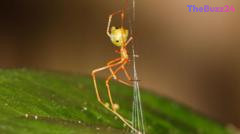
The Ballista Spider: Nature’s Master of High-Velocity Hunting
In the dense, tropical rainforests of northern Queensland, Australia, researchers have identified a remarkable new spider species that utilizes a sophisticated, spring-loaded trap to capture its prey. Dubbed the ‘ballista’ spider, this nocturnal arachnid has evolved a unique hunting mechanism that allows it to snare aggressive green tree ants with extreme precision and speed. By constructing a complex scaffold of tension lines, the spider creates a catapult-like snare that launches its prey into a secondary web at forces exceeding those experienced by jet pilots.
The hunting strategy is highly specialized, as the spider appears to target only the green tree ant, Oecophylla smaragdina. Scientists observed that the spider spends hours meticulously crafting its trap, which is triggered by the ant itself rather than the predator. This behavior is considered unprecedented in the arachnid world, as the trap is specifically designed to neutralize the chemical and physical defenses of these territorial ants, which are typically avoided by other predators due to their ability to swarm and sting.
Researchers from Macquarie University utilized high-speed infrared cameras to document the spider’s behavior over ten nights of field study. Their findings suggest that the spider may even use pheromones to lure and agitate the ants, ensuring they interact with the trap. By launching the prey away from the main ant trails, the spider can safely consume its meal without the risk of being overwhelmed by the colony. This discovery highlights the extraordinary evolutionary adaptations that allow specialized predators to thrive in competitive ecosystems.
Key Takeaways
- The newly discovered 'ballista' spider uses a spring-loaded silk trap to launch prey at extreme g-forces.
- The spider exclusively targets aggressive green tree ants, using a mechanism triggered by the prey itself.
- Researchers believe the spider may use pheromones to lure its specific prey into the trap, a behavior previously unseen in other spider species.
Editor’s Analysis & Impact
The discovery of the ballista spider provides a fascinating case study in evolutionary specialization. By developing a trap that effectively ‘outsources’ the capture mechanism to the prey’s own movements, the spider minimizes its exposure to the significant risks posed by aggressive ant colonies. From an ecological perspective, this highlights how intense competition for resources in tropical environments drives the development of highly specific, energy-efficient hunting tools. Future research into the chemical composition of the spider’s silk and potential pheromone use could have broader implications for biomimicry and material science, particularly in the development of high-tension, rapid-response synthetic materials. This finding serves as a reminder of the vast, untapped biological complexity remaining in remote ecosystems.
Frequently Asked Questions
Q: Why is the spider nicknamed 'ballista'?
A: It is named after the ancient military weapon used to hurl stones, reflecting the spider's ability to launch its prey through the air using a high-tension silk snare.
Q: Is this spider dangerous to humans?
A: The research focuses on the spider's specialized hunting of green tree ants; there is no indication that this tiny species poses a threat to humans.
AI Disclosure: This article is based on verified data and official reports. Our Team and AI have cross-referenced every financial detail with primary sources to ensure total accuracy.
More from this Category