The Cosmic Geology of Vasquez Rocks: How Tectonic Forces Created Hollywood’s Favorite Alien Landscape
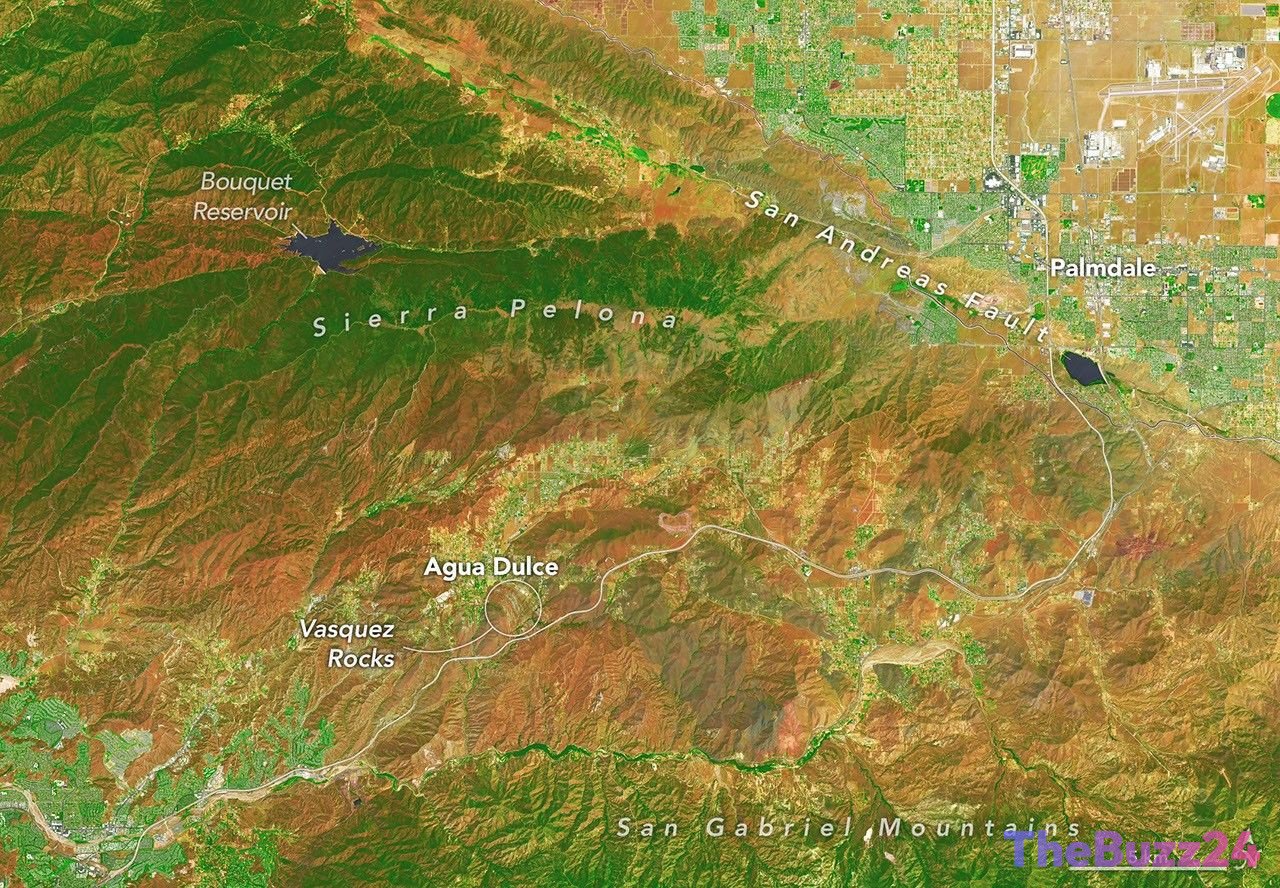
Nestled within Southern California’s Soledad Basin, the dramatic sandstone formations of Vasquez Rocks Natural Area present a striking, gravity-defying landscape. Recent satellite observations captured by the Landsat 9 spacecraft highlight the stark contrast between the arid, tilted rock strata and the surrounding chaparral and sage scrub vegetation. Angled at a steep average of 50 degrees, these jagged sedimentary outcrops appear to point directly toward the heavens, making them one of the most recognizable geological features in the region.
The origin of these otherworldly formations dates back roughly 25 million years. Initially, rapid streams deposited sediment onto flat plains, forming massive alluvial fans. Over millions of years, these deposits were buried, compacted, and cemented into thick layers of sandstone and conglomerate rock. The dramatic tilting seen today is the result of intense tectonic activity along the nearby plate boundary where the Pacific and North American plates grind past each other along the San Andreas Fault. This ongoing tectonic pressure uplifted and deformed the Soledad Basin, while subsequent wind and water erosion carved away softer materials to leave behind the resilient sandstone fins.
Beyond their geological significance, the Vasquez Rocks have secured a legendary status in pop culture. Thanks to their proximity to Los Angeles, the dramatic formations have served as the quintessential backdrop for alien worlds in the entertainment industry. Most famously, the site hosted Captain James T. Kirk’s iconic battle with a reptilian Gorn in the original Star Trek series, and later represented the planet Vulcan in multiple franchise films. The rugged terrain has also been featured in numerous other major productions, including Westworld, For All Mankind, and Battlestar Galactica, cementing its role as Hollywood’s go-to destination for cosmic adventures.
Key Takeaways
- Vasquez Rocks features dramatic sedimentary strata tilted at an average angle of 50 degrees, sculpted by millions of years of tectonic activity and erosion.
- The formations originated 25 million years ago as alluvial fan deposits before being uplifted by forces associated with the nearby San Andreas Fault.
- Due to its unique appearance and proximity to Los Angeles, the site has served as a famous filming location for iconic sci-fi franchises like Star Trek and Westworld.
Editor’s Analysis & Impact
The enduring appeal of Vasquez Rocks highlights a unique intersection between geological science, environmental preservation, and the entertainment industry. From a geological perspective, the site offers an accessible, real-world laboratory demonstrating the immense power of tectonic deformation and erosion. For the film and television industry, such natural landmarks are irreplaceable assets that provide authentic, otherworldly aesthetics that digital effects often struggle to replicate cheaply. As satellite imaging technology like Landsat 9 continues to advance, researchers can better monitor how climate change, wildfires, and human foot traffic impact these delicate ecosystems. Protecting these natural parks is vital not only for scientific study and ecological health but also for preserving cultural touchstones that have shaped modern science fiction storytelling for generations.
Frequently Asked Questions
Q: How did the Vasquez Rocks get their steep, tilted appearance?
A: The rocks were tilted by powerful tectonic forces generated by the movement of the Pacific and North American plates along the nearby San Andreas Fault, followed by millions of years of erosion that wore away softer surrounding sediment.
Q: Why are the Vasquez Rocks so popular in movies and TV shows?
A: Their highly unusual, angular rock formations naturally mimic alien landscapes, and their close proximity to major Hollywood studios in Los Angeles makes them an ideal and cost-effective filming location.
Q: What famous franchises have filmed at Vasquez Rocks?
A: The site is most famous for its multiple appearances in the Star Trek franchise, but it has also featured in Westworld, Battlestar Galactica, and For All Mankind.
AI Disclosure: This article is based on verified data and official reports. Our Team and AI have cross-referenced every financial detail with primary sources to ensure total accuracy.
More from this Category