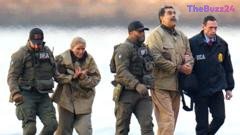
Strategic Blow to Extremism: Top ISIS Commander Neutralized in Joint US-Nigeria Operation
A high-ranking Islamic State commander, Abu-Bilal al-Minuki, was killed during a precision military operation conducted by Nigerian and United States forces. The strike, which targeted a fortified base in Metele, Borno State, also resulted in the deaths of several of al-Minuki’s top lieutenants. Officials confirmed that the mission was executed without any casualties or loss of equipment for the coalition forces, marking the successful conclusion of months of intensive intelligence gathering.
Al-Minuki was a central figure in the extremist landscape of the Lake Chad Basin, a region spanning Nigeria, Chad, Niger, and Cameroon that has long served as a hub for militant activity. Before his alignment with the Islamic State in 2015, he held a senior leadership role within Boko Haram. He was officially designated as a Specially Designated Global Terrorist by the United States in 2023 and was linked to numerous violent acts, including the 2018 abduction of the Dapchi schoolgirls.
The operation is viewed as a significant disruption to the Islamic State’s command structure in West Africa. With sub-Saharan Africa now accounting for roughly 90 percent of the group’s global attacks, the success of this mission highlights the strengthening security partnership between Washington and Abuja. By targeting the leadership responsible for coordinating operations across the Sahel, the coalition aims to dismantle the logistical and financial networks that have allowed extremist groups to thrive in the region.
Key Takeaways
- Senior ISIS leader Abu-Bilal al-Minuki was killed in a joint US-Nigerian precision strike in Borno State.
- The operation was completed successfully with zero coalition casualties, following months of strategic reconnaissance.
- The death of al-Minuki significantly disrupts the Islamic State's operational command in sub-Saharan Africa, a region currently central to the group's global activities.
Editor’s Analysis & Impact
The neutralization of Abu-Bilal al-Minuki marks a critical juncture in the evolving landscape of global counter-terrorism. As the Islamic State has faced territorial losses in the Middle East, it has increasingly shifted its focus to sub-Saharan Africa, exploiting regional instability and porous borders to expand its influence. This joint operation demonstrates the efficacy of deep intelligence-sharing and tactical coordination between Western and African military forces. While the removal of a high-level commander like al-Minuki creates a temporary leadership vacuum and disrupts operational cohesion, it is not a panacea for regional militancy. The underlying socio-economic conditions that fuel extremism remain, and long-term stability will depend on a combination of sustained military pressure, improved regional governance, and economic development to prevent new leaders from rising to fill the void.
Frequently Asked Questions
Q: Who was Abu-Bilal al-Minuki?
A: Abu-Bilal al-Minuki was a senior Islamic State commander and a former leader within Boko Haram. He was a designated global terrorist known for his role in regional insurgencies and high-profile kidnappings.
Q: Why is the Lake Chad Basin significant in this context?
A: The Lake Chad Basin is a strategically complex region bordering Nigeria, Chad, Niger, and Cameroon that has served as a primary stronghold for extremist groups like Boko Haram and ISWAP.
Q: What does this operation signal for future counter-terrorism efforts?
A: It signals a shift in focus toward sub-Saharan Africa, where the majority of Islamic State-related attacks now occur, and emphasizes the necessity of international military cooperation to dismantle extremist leadership networks.
AI Disclosure: This article is based on verified data and official reports. Our Team and AI have cross-referenced every financial detail with primary sources to ensure total accuracy.
More from this Category