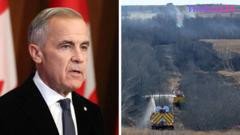
Tragedy at Alberta Military Base: Fire Claims Four Lives and Injures Dozens
A devastating fire at a major military installation in Alberta has claimed the lives of four Canadian service members and left dozens of others injured, prompting a massive emergency response. The blaze erupted in a grassy training sector of Canadian Forces Base Wainwright and escalated rapidly, fueled by unusually fierce winds that caught personnel off guard during live-munition exercises.
Officials confirmed that the victims included Sgt Morgan Wong, Pte Shaun Farrell, Pte Aidan Goulding, and Pte Hayden Lykkemark. Dozens of injured personnel were rushed to hospitals across the region, with nearly half of them admitted in critical condition. Healthcare facilities in the surrounding area faced immense strain, triggering emergency disaster-response protocols as medical teams worked through the night to stabilize the wounded.
Investigators have stated that there is currently no indication of foul play, terrorism, or external interference, ruling out any connection to nearby oil and gas infrastructure. The incident occurred while infantry troops were conducting high-intensity combat drills involving heavy munitions. Authorities continue to investigate the exact ignition point of the grass fire as the nation mourns one of its deadliest peacetime military accidents.
Key Takeaways
- A fast-moving grass fire at Canada's CFB Wainwright resulted in the deaths of four military personnel and dozens of injuries.
- Unusually strong winds caused the flames to shift rapidly toward the active training and administrative ranges.
- Local hospitals were overwhelmed by the sudden influx of casualties, requiring extensive air and ground ambulance deployments.
Editor’s Analysis & Impact
This catastrophic incident at CFB Wainwright highlights the inherent risks associated with high-intensity live-fire training exercises, even during peacetime. Beyond the profound human toll and national mourning, the event places an intense spotlight on military safety protocols, emergency preparedness, and infrastructure resilience at major defense installations. The sudden surge of casualties severely tested Alberta’s regional healthcare network, demonstrating the critical need for robust inter-agency coordination between military commands and civilian emergency medical services. In the wake of this disaster, defense officials will likely face rigorous scrutiny regarding environmental risk management during training operations, potentially leading to stricter guidelines for live-munitions exercises in dry or windy conditions across North American military bases.
Frequently Asked Questions
Q: What caused the fire at the Canadian military base?
A: The incident began as a grass fire about a kilometer away from an active attack range, which spread rapidly due to unusually strong winds while troops were conducting live-munitions training.
Q: Are there any suspicions of foul play or terrorism?
A: No, military and government officials have explicitly stated that there are no indications of terrorist activity, external interference, or links to oil and gas infrastructure.
Q: How were the injured personnel handled by medical facilities?
A: Dozens of injured soldiers and reservists were transported to various hospitals, prompting local facilities to briefly declare disaster-response protocols due to the overwhelming volume of patients.
AI Disclosure: This article is based on verified data and official reports. Our Team and AI have cross-referenced every financial detail with primary sources to ensure total accuracy.
More from this Category