UK and Japan Forge Historic £18 Billion Investment Alliance to Boost Infrastructure and Green Energy
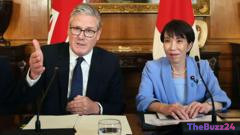
The United Kingdom and Japan have solidified a massive £18 billion investment partnership aimed at fostering a new era of bilateral cooperation. Following a productive meeting in London between UK Prime Minister Sir Keir Starmer and Japanese Prime Minister Sanae Takaichi, the landmark agreement is set to channel substantial capital into the UK’s infrastructure, real estate, and renewable energy sectors. Under the terms of the deal, prominent Japanese firms—including Mitsubishi Estate, Mitsui Fudosan, and Nomura Real Estate—will deploy over £9 billion into infrastructure and financial services over the next five years, while an additional £9 billion is earmarked for offshore wind projects, potentially generating tens of thousands of new jobs.
Beyond real estate and green energy, the bilateral agreement strengthens strategic ties in defense and high-tech innovation. Both nations reaffirmed their commitment to the Global Combat Air Programme (GCAP), a joint initiative with Italy to develop next-generation fighter jets. Furthermore, engineering giant Rolls-Royce is slated to partner with Japan’s Atomic Energy Agency to pioneer advanced nuclear technologies. This is complemented by a new technology agreement designed to bridge the UK’s research, development, and software capabilities with Japan’s world-class manufacturing expertise.
This major capital injection arrives at a critical juncture for the British economy, which has experienced sluggish growth and faces mounting external pressures. Analysts warn that escalating geopolitical tensions in the Middle East could disproportionately impact the UK, with potential worst-case scenarios pushing inflation up to 6%. While opposition politicians have welcomed the foreign investment, critics argue that domestic tax hikes and regulatory burdens continue to threaten long-term job creation. Nonetheless, proponents of the deal emphasize that these long-term investments will provide a vital buffer and stimulate sustainable economic growth.
Key Takeaways
- The UK and Japan have secured an £18 billion investment deal spanning infrastructure, real estate, and offshore wind energy.
- Strategic collaborations were reinforced in defense via the GCAP fighter jet program and in energy through a Rolls-Royce nuclear partnership.
- The massive capital influx comes as the UK economy faces headwinds from global geopolitical conflicts and rising inflation risks.
Editor’s Analysis & Impact
This £18 billion bilateral agreement represents a strategic triumph for the UK as it seeks to anchor its post-Brexit economy through deep-tech and green energy partnerships. By securing commitments from Japanese conglomerates like Mitsui Fudosan and Mitsubishi Estate, the UK stabilizes its commercial real estate and infrastructure sectors during a period of high interest rates. More importantly, the offshore wind and nuclear collaborations with Rolls-Royce position the UK as a primary destination for clean energy capital. However, the true efficacy of this deal will depend on execution speeds and whether these investments can offset the broader macroeconomic drag caused by global geopolitical instability. For Japan, the deal secures a foothold in European defense and green tech, cementing a mutually beneficial geopolitical alliance.
Frequently Asked Questions
Q: What sectors will benefit most from the UK-Japan investment deal?
A: The primary beneficiaries are the infrastructure, real estate, and green energy sectors, with £9 billion allocated to offshore wind projects and another £9 billion dedicated to financial services and infrastructure development. Defense and nuclear technology will also see significant boosts.
Q: How does this deal impact the UK's defense and technology sectors?
A: The deal solidifies the UK's commitment to the GCAP fighter jet program alongside Japan and Italy. Additionally, it establishes a partnership between Rolls-Royce and Japan's Atomic Energy Agency to develop next-generation nuclear technologies, while linking UK software R&D with Japanese manufacturing.
Q: Why is this investment critical for the UK economy right now?
A: The UK economy is currently experiencing slow growth and faces external economic pressures, including potential inflation spikes driven by global conflicts. This long-term capital injection is expected to create jobs and stimulate economic resilience.
AI Disclosure: This article is based on verified data and official reports. Our Team and AI have cross-referenced every financial detail with primary sources to ensure total accuracy.
More from this Category