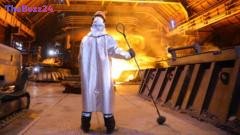
Ukraine’s Industrial Heartbeat Silenced: Russian Strikes Devastate Steel Sector
Ukraine’s vital steel industry, a cornerstone of its economy and a significant employer, has been brought to its knees by a relentless campaign of Russian missile strikes. Major facilities, including the Zaporizhstal steelworks, have suffered catastrophic damage, halting production indefinitely and casting a shadow over the nation’s economic future.
Zaporizhstal, once the lifeblood of the city of Zaporizhzhia and employing 8,500 people, has been targeted multiple times by Russian forces. The attacks have left blast furnaces ruined, equipment destroyed, and the entire complex inoperable. “All the equipment has been almost completely destroyed. There are no windows left, and there are holes in the roofs,” lamented Denys Maksyshko, a long-time employee. The strikes have not only crippled infrastructure but also claimed lives, with eight workers killed and 31 injured at Zaporizhstal alone, according to Metinvest, the plant’s owner.
The impact extends far beyond individual factories. Prior to the full-scale invasion, Ukraine’s metallurgy and mining sector accounted for approximately 10% of its GDP and a third of its exports, providing livelihoods for over half a million people. Now, with all major steelworks affected, this contribution has dwindled to near zero. Oleksandr Myronenko, chief operating officer of Metinvest, stated that Russia’s objective is clear: to cripple Ukraine’s economy, cut off export revenues, and destabilize the nation.
The devastation is not confined to Zaporizhzhia. Other key industrial centers, including Kryvyi Rih, President Zelensky’s hometown, have also been severely hit. Arcelor Mittal Kryvyi Rih, Ukraine’s largest steelworks, announced it could not reopen after weeks of attacks, resulting in job losses and a significant blow to the local economy. The loss of tax revenue from these plants threatens the very survival of these cities, impacting everything from infrastructure maintenance to social services.
The implications of this industrial collapse are profound. Steel is crucial for both defense and reconstruction efforts, essential for producing military hardware, building shelters, and repairing war-torn infrastructure. Russia’s targeting of these plants, which it claims were producing military hardware, highlights the strategic importance of the sector. The disruption to transportation networks, including railways and ports, further complicates any potential recovery, making both domestic distribution and international exports perilous endeavors.
Key Takeaways
- Russian missile strikes have caused extensive damage to Ukraine's major steelworks, including Zaporizhstal and Arcelor Mittal Kryvyi Rih, halting production.
- The devastation of the steel industry, a key sector for Ukraine's GDP and exports, has severe economic consequences, potentially leading to widespread job losses and humanitarian crises.
- The destruction of steel plants impacts Ukraine's defense capabilities and reconstruction efforts, as steel is vital for military equipment and infrastructure repair.
Editor’s Analysis & Impact
The systematic targeting of Ukraine’s steel industry represents a significant strategic move by Russia to cripple the nation’s economic resilience and war-making potential. The damage inflicted goes beyond immediate production losses; it threatens the long-term viability of key industrial hubs, potentially triggering mass unemployment and migration. This assault on heavy industry underscores the interconnectedness of economic stability, defense capabilities, and social welfare in wartime. The future outlook for Ukraine’s steel sector is bleak, contingent not only on the cessation of hostilities but also on massive reconstruction efforts and international support. The loss of this industrial backbone could have ripple effects across global supply chains and Ukraine’s post-war recovery trajectory.
Frequently Asked Questions
Q: Why is the steel industry so important to Ukraine's economy?
A: Before the full-scale invasion, Ukraine's metallurgy and mining sector was a major contributor to its GDP, accounting for about 10%, and a significant portion of its exports. It also provided employment for over half a million people, making it a critical engine for economic growth and stability.
Q: What are the broader consequences of the damage to Ukrainian steel plants?
A: The damage has far-reaching consequences, including potential mass job losses, economic destabilization, and a humanitarian crisis due to migration. Furthermore, steel is essential for Ukraine's defense industry and for rebuilding infrastructure destroyed by the conflict, so its loss hampers both current defense efforts and future reconstruction.
Q: What is Russia's stated reason for targeting these steel plants?
A: Russia has claimed that the steel plants in Zaporizhzhia and Kryvyi Rih were producing military hardware, justifying the attacks on these grounds. However, the widespread destruction suggests a broader aim to damage Ukraine's industrial capacity and economy.
AI Disclosure: This article is based on verified data and official reports. Our Team and AI have cross-referenced every financial detail with primary sources to ensure total accuracy.
More from this Category