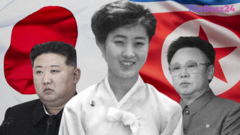
Unveiling the Secret: Kim Jong Un’s Mother and the Myth of North Korea’s Sacred Bloodline
North Korea’s foundational narrative, and the legitimacy of its leadership, rests heavily on the revered “Mount Paektu” bloodline—a lineage purportedly tied to the mythical founder of the Korean people and later, to the nation’s revolutionary leaders. This sacred ancestry is paramount in a society that values hereditary purity above all else. However, the true identity and background of Kim Jong Un’s mother, Ko Yong Hui, have been meticulously concealed by state media, as her origins pose a significant threat to this carefully constructed dynastic myth.
Contrary to the regime’s narrative, Ko Yong Hui was not born on the sacred slopes of Mount Paektu. Instead, she was born in Osaka, Japan, in 1952, to parents who had emigrated from Jeju Island, now part of South Korea. Her family belonged to the “Zainichi Koreans,” a community of immigrants who moved to Japan during its colonial rule of the Korean peninsula. When Ko was approximately ten years old, her family relocated to North Korea, lured by promises of a better life. Despite initial envy from some citizens, Zainichi Koreans were often disparagingly labeled “jjaepo”—a term for those considered tainted by foreign ideologies. Within North Korea’s rigid social hierarchy, known as “songbun,” jjaepo were relegated to the “wavering class,” a stark contrast to the divine status attributed to the Paektu bloodline.
Despite her challenging background, Ko Yong Hui’s life took an unexpected turn when she caught the attention of Kim Jong Il, who was already being groomed for succession. A talented member of the elite Mansudae Art Troupe, her beauty and dancing skills reportedly captivated him. Although Kim Jong Il was officially married and had other mistresses, he developed a passionate relationship with Ko, with whom he had three children, including Kim Jong Un. Given the severe stigma associated with children born out of wedlock in North Korea, Ko and her children lived away from the capital, and her union with Kim Jong Il was never officially acknowledged by the regime. Nevertheless, after Kim Il Sung’s death, Ko became the de-facto first lady, accompanying Kim Jong Il on official duties, though her name and true background remained a closely guarded secret.
Kim Jong Un’s path to power was not straightforward, as he bypassed older siblings who either questioned the hereditary succession or struggled with personal issues. It is believed that Ko Yong Hui actively championed her second son, Kim Jong Un, for the leadership role. Since ascending to power in 2011, Kim Jong Un has continued the tradition of secrecy surrounding his mother’s past. Analysts suggest this is why his birthday is not a national holiday, unlike his father’s and grandfather’s, to avoid drawing attention to his birth and the sensitive questions about his mother’s origins. His swift public presentation of his wife, Ri Sol Ju, who hails from a more acceptable Pyongyang background, is also seen as an effort to bolster his legitimacy. Should the truth about Ko Yong Hui’s Japanese-Korean heritage ever become widely known within North Korea, experts warn it could profoundly destabilize the regime and its hereditary system.
Key Takeaways
- Kim Jong Un's regime relies on the 'Mount Paektu' bloodline for legitimacy, a narrative contradicted by his mother's true origins.
- His mother, Ko Yong Hui, was a 'Zainichi Korean' born in Japan, a background considered 'contaminated' and belonging to a lower social class within North Korea's strict 'songbun' system.
- The secrecy surrounding Ko Yong Hui's lineage influenced Kim Jong Un's succession and public image, and its full revelation could severely destabilize the North Korean hereditary system.
Editor’s Analysis & Impact
This article sheds light on the critical role of fabricated history and information control in maintaining the North Korean regime’s power. The meticulous suppression of Ko Yong Hui’s true background underscores the fragility of the ‘Mount Paektu’ myth, which is central to the Kim dynasty’s legitimacy. For the regime, any deviation from this sacred narrative poses an existential threat, as it could undermine the very foundation of hereditary rule. The continued efforts to control this information highlight the internal vulnerabilities of a totalitarian state. Should this truth ever become widely accepted within North Korea, it could ignite significant social and political instability, potentially challenging the cult of personality and the entire ‘songbun’ caste system. This situation also offers a unique lens through which to understand the regime’s public actions, such as Kim Jong Un’s strategic presentation of his wife and daughter, as attempts to project an image of unblemished legitimacy.
Frequently Asked Questions
Q: Who was Kim Jong Un's mother?
A: Kim Jong Un's mother was Ko Yong Hui, a dancer and performer who became a mistress of Kim Jong Il. She was never officially recognized as his wife by the regime.
Q: Why is Ko Yong Hui's background controversial in North Korea?
A: Ko Yong Hui was a 'Zainichi Korean' born in Osaka, Japan. This background contradicts the regime's 'Mount Paektu' bloodline narrative, which emphasizes a pure, revolutionary Korean lineage, and places her in a lower social class ('wavering class') within North Korea's strict 'songbun' system.
Q: How has the secrecy around his mother's origins impacted Kim Jong Un's rule?
A: The secrecy has influenced Kim Jong Un's public image and actions, such as the absence of a national holiday for his birthday and his early public appearances with his wife, Ri Sol Ju, who has a more 'acceptable' background. This is seen as an effort to reinforce his legitimacy and prevent questions about his own lineage from arising.
AI Disclosure: This article is based on verified data and official reports. Our Team and AI have cross-referenced every financial detail with primary sources to ensure total accuracy.
More from this Category