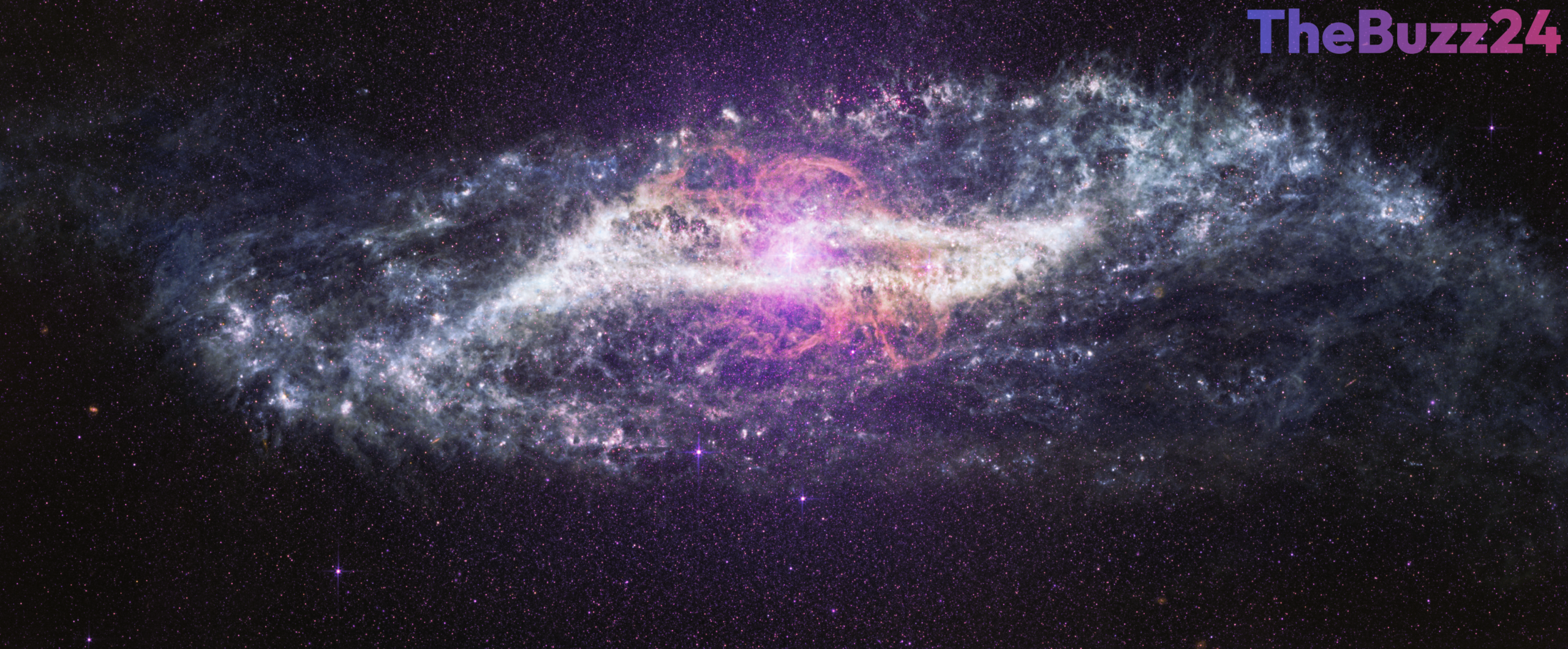
Webb Telescope Reveals Hidden Secrets of the Chaotic Centaurus A Galaxy
To mark its fourth anniversary of scientific operations, the James Webb Space Telescope has captured unprecedented imagery of Centaurus A, a nearby active galaxy located 11 million light-years away. By utilizing advanced near- and mid-infrared sensors, the telescope has successfully pierced through dense dust lanes that previously obscured the galaxy’s core in visible light, revealing a complex, star-filled environment that provides a clearer picture of galactic evolution.
Centaurus A is recognized by astronomers as a vital laboratory for studying the interplay between supermassive black holes and their host galaxies. The galaxy bears the distinct scars of a massive cosmic collision that occurred approximately two billion years ago, an event that continues to influence its current structure and star formation rates. Webb’s high-resolution data allows researchers to perform ‘galactic archaeology,’ mapping the history of the galaxy by analyzing individual stars and the movement of gas near its central black hole.
The imagery reveals unusual structures, including a warped, parallelogram-shaped band and an enigmatic ‘S’ shaped feature that challenges existing models of galactic development. These findings suggest that the central black hole plays a dual role in the galaxy’s life cycle: it can trigger the birth of new stars by compressing surrounding gas, while simultaneously limiting star formation by ejecting material outward. This delicate balance of destruction and creation remains a primary focus for ongoing astrophysical research.
By combining the capabilities of the Near-Infrared Camera (NIRCam) and the Mid-Infrared Instrument (MIRI), scientists are now able to observe the galaxy with a level of detail that was previously impossible. This data not only helps reconstruct the timeline of Centaurus A’s turbulent past but also offers broader insights into how galaxies grow, evolve, and interact with the supermassive black holes at their centers.
Key Takeaways
- The James Webb Space Telescope used infrared technology to see through dense dust, revealing the internal structure of the Centaurus A galaxy for the first time.
- Data confirms that Centaurus A is still shaped by a major galactic collision that occurred roughly two billion years ago.
- The central supermassive black hole is actively influencing the galaxy by both fueling star formation and pushing material away, demonstrating a complex cosmic feedback loop.
Editor’s Analysis & Impact
The latest observations of Centaurus A represent a significant milestone in observational astronomy, demonstrating the shift from broad-scale imaging to high-resolution ‘galactic archaeology.’ By resolving individual stars within a previously obscured region, the James Webb Space Telescope is enabling researchers to move beyond theoretical models of galaxy formation toward empirical, star-by-star timelines. The industry impact is profound; as we gain a better understanding of the feedback mechanisms between black holes and their host galaxies, we refine our broader models of the universe’s evolution. This capability to peer into the ‘dusty’ history of galaxies will likely drive the next decade of astrophysical research, forcing a re-evaluation of how mergers and black hole activity dictate the life cycles of galaxies across the cosmos.
Frequently Asked Questions
Q: Why is Centaurus A considered an 'active' galaxy?
A: Centaurus A is classified as active because it contains a supermassive black hole at its center that is actively consuming material, which in turn powers high-energy jets and influences the surrounding galactic environment.
Q: How does infrared light help the James Webb Space Telescope see through dust?
A: Visible light is easily scattered or absorbed by dust particles in space. Infrared light, however, has longer wavelengths that can pass through these dust clouds, allowing the telescope to capture images of the stars and structures hidden behind them.
AI Disclosure: This article is based on verified data and official reports. Our Team and AI have cross-referenced every financial detail with primary sources to ensure total accuracy.
More from this Category