XRISM Observatory Captures Pulsar Feeding on Giant Star’s Stellar Wind
Astronomers utilizing data from the advanced X-ray Imaging and Spectroscopy Mission (XRISM) have documented a giant star’s stellar wind being reeled in by a compact stellar companion. This cosmic feeding frenzy acts as the power source behind intense X-ray flares, offering unprecedented insights into high-mass X-ray binary systems and the complex mechanisms governing matter accretion in extreme environments.
The focal point of the research is the BP Crucis system, situated approximately 13,000 light-years away in the constellation Crux. The primary star, Wray 977, is a blue hypergiant dwarfing our Sun with roughly 40 times its mass and 60 times its size. Due to its immense heat and luminosity, ionized gas continuously streams away from its surface. Orbiting this hypergiant is GX 301-2, a dense neutron star compressed to a mere 12 miles across, which rotates as a pulsar and sweeps X-ray beams across space.
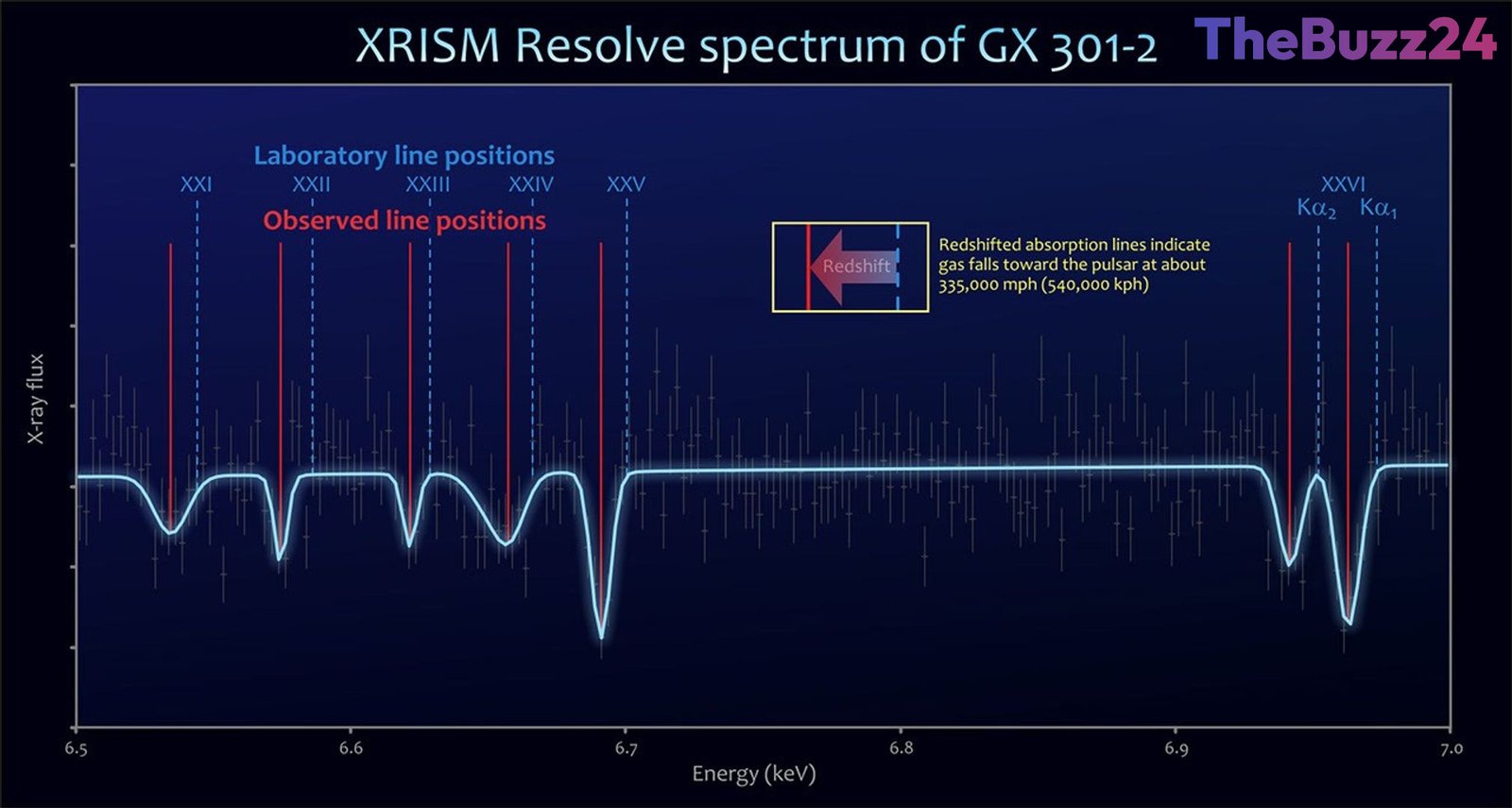
As the pulsar navigates its 41.5-day orbit, its gravitational pull interacts with the stellar wind, creating a dense stream of plasma that triggers powerful multi-day X-ray flares. During a recent observation window, the collaborative observatory’s Resolve instrument captured hyper-detailed X-ray spectra. These readings revealed shifting iron absorption lines, indicating that gas was plunging toward the neutron star at speeds reaching approximately 335,000 mph (540,000 kph).
Researchers discovered that as the pulsar plunges through the dense stellar outflow, it initially forms a turbulent accretion disk that eventually breaks apart due to changing angular momentum dynamics. This causes plasma to stream directly onto the pulsar’s surface. Experts believe that studying systems like BP Crucis will unlock fundamental knowledge regarding cosmic plasma dynamics and stellar evolution, validating theoretical models with empirical data previously thought impossible to capture.
Key Takeaways
- Astronomers used the XRISM observatory to observe a stellar wind being captured by a compact pulsar for the first time.
- The target system, BP Crucis, features a blue hypergiant star and a neutron star interacting over a 41.5-day orbit.
- Data revealed plasma racing toward the pulsar at around 335,000 mph, forming and breaking turbulent accretion disks.
Editor’s Analysis & Impact
The successful observation by the XRISM mission marks a significant milestone in high-energy astrophysics. By capturing high-resolution X-ray spectra of wind-fed accretion in binary systems, researchers can now empirically test long-standing theoretical models regarding plasma behavior near compact objects. This breakthrough not only enhances our comprehension of neutron stars and stellar winds but also demonstrates the immense utility of advanced spectroscopy in modern space exploration. As observatories continue to probe extreme cosmic environments, insights gained from systems like BP Crucis will pave the way for a deeper understanding of stellar lifecycles and the fundamental forces shaping our universe.
Frequently Asked Questions
Q: What is the BP Crucis system?
A: BP Crucis is a high-mass X-ray binary system located 13,000 light-years away, consisting of a blue hypergiant star and a rotating neutron star (pulsar).
Q: How does the pulsar generate X-ray flares?
A: The pulsar's gravity captures dense streams of plasma from the hypergiant star's stellar wind, forming an accretion disk that powers strong X-ray flares as the matter falls onto the neutron star.
Q: What instrument was used to make these groundbreaking observations?
A: The observations were made using the Resolve instrument aboard the XRISM (X-ray Imaging and Spectroscopy Mission) observatory.
AI Disclosure: This article is based on verified data and official reports. Our Team and AI have cross-referenced every financial detail with primary sources to ensure total accuracy.
More from this Category