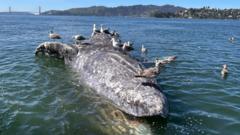
Tragedy in the Bay: Why Starving Gray Whales Are Dying in San Francisco’s Busy Shipping Lanes
San Francisco Bay, known for its bustling maritime traffic and iconic Golden Gate Bridge, has increasingly become a temporary refuge—and a hazardous trap—for Eastern North Pacific gray whales. Historically, these massive mammals bypassed the bay during their grueling 15,000-to-20,000-kilometer annual migration between breeding grounds in Baja California and feeding grounds in the Arctic. However, since 2018, researchers have documented a dramatic shift in behavior, with starving whales entering the estuary in search of food, leading to a spike in mortality rates.
A recent study led by Josephine Slaathaug of Sonoma State University reveals a grim reality: nearly one-fifth of the gray whales entering San Francisco Bay have died there. In 2025, a record 21 dead gray whales were documented in the broader bay area, and seven deaths have already been recorded this year. While a severe lack of prey in the Arctic—exacerbated by climate change—is driving these undernourished whales into the bay, the immediate cause of death is frequently human-related. The study highlights that these weakened animals are highly vulnerable to being struck by large commercial ships and ferries navigating the crowded 4,140-square-kilometer estuary.
The broader Eastern North Pacific gray whale population has suffered a devastating decline, plummeting from approximately 27,000 individuals in 2016 to just 12,500 in 2025. This sharp drop, coupled with historically low calf counts, suggests the species is struggling to recover. Marine biologists like Kathi George and Moe Flannery emphasize that these whales act as ecological sentinels, signaling profound disruptions beneath the ocean’s surface. The fact that strandings are occurring earlier in the season this year further underscores the urgency of the crisis.
In response, a coalition of conservationists, industry leaders, and government agencies are scrambling to implement protective measures. Gary Reed of the U.S. Coast Guard in San Francisco noted that ferry operators and ship captains are undergoing training to slow down and give whales space, while plans are underway to install infrared monitoring cameras on Angel Island to detect whales at night. Despite the grim statistics, wildlife experts like Michelle Barbieri Lino of the SeaDoc Society offer a glimmer of hope, noting that if adequate protections are established, the bay could eventually serve as a safe, novel foraging stopover that helps the resilient species survive their epic migrations.
Key Takeaways
- Gray whales are increasingly entering San Francisco Bay due to severe food shortages in their Arctic feeding grounds, driven by climate change.
- Nearly 20% of the whales entering the bay die there, with vessel strikes from heavy maritime traffic being a primary cause of death.
- The Eastern North Pacific gray whale population has plummeted by over 50% since 2016, dropping from 27,000 to 12,500.
Editor’s Analysis & Impact
The crisis unfolding in San Francisco Bay is a stark indicator of how climate change is disrupting marine ecosystems on a global scale. As warming Arctic waters deplete the primary food sources of gray whales, these marine giants are forced to adapt by seeking alternative foraging grounds, bringing them into direct conflict with human industrial activity. The high rate of ship strikes in one of the West Coast’s busiest shipping hubs highlights the urgent need for dynamic ocean management. Implementing mandatory vessel speed reductions, utilizing advanced detection technologies like infrared cameras, and establishing temporary exclusion zones during peak migration periods are critical steps. This situation serves as a test case for how modern maritime economies can co-exist with migrating wildlife. If successful, these conservation strategies could provide a blueprint for protecting marine biodiversity worldwide as climate pressures continue to shift wildlife habitats.
Frequently Asked Questions
Q: Why are gray whales entering San Francisco Bay instead of continuing their migration?
A: Due to climate change and dwindling prey availability in the Arctic, many gray whales lack the energy reserves needed to complete their long migration. Hunger drives them into the bay in search of alternative food sources.
Q: What is the main cause of death for the whales once they enter the bay?
A: While starvation drives them into the bay, the leading cause of death inside the estuary is vessel strikes. The busy shipping lanes, ferries, and recreational boats in the crowded bay pose a severe collision hazard to the weakened whales.
Q: How much has the gray whale population declined in recent years?
A: The Eastern North Pacific gray whale population has experienced a dramatic decline, falling from an estimated 27,000 individuals in 2016 to approximately 12,500 in 2025.
AI Disclosure: This article is based on verified data and official reports. Our Team and AI have cross-referenced every financial detail with primary sources to ensure total accuracy.
More from this Category