Trump ballroom unlikely to get White House Correspondents' dinners or end president's off-site events, critics say
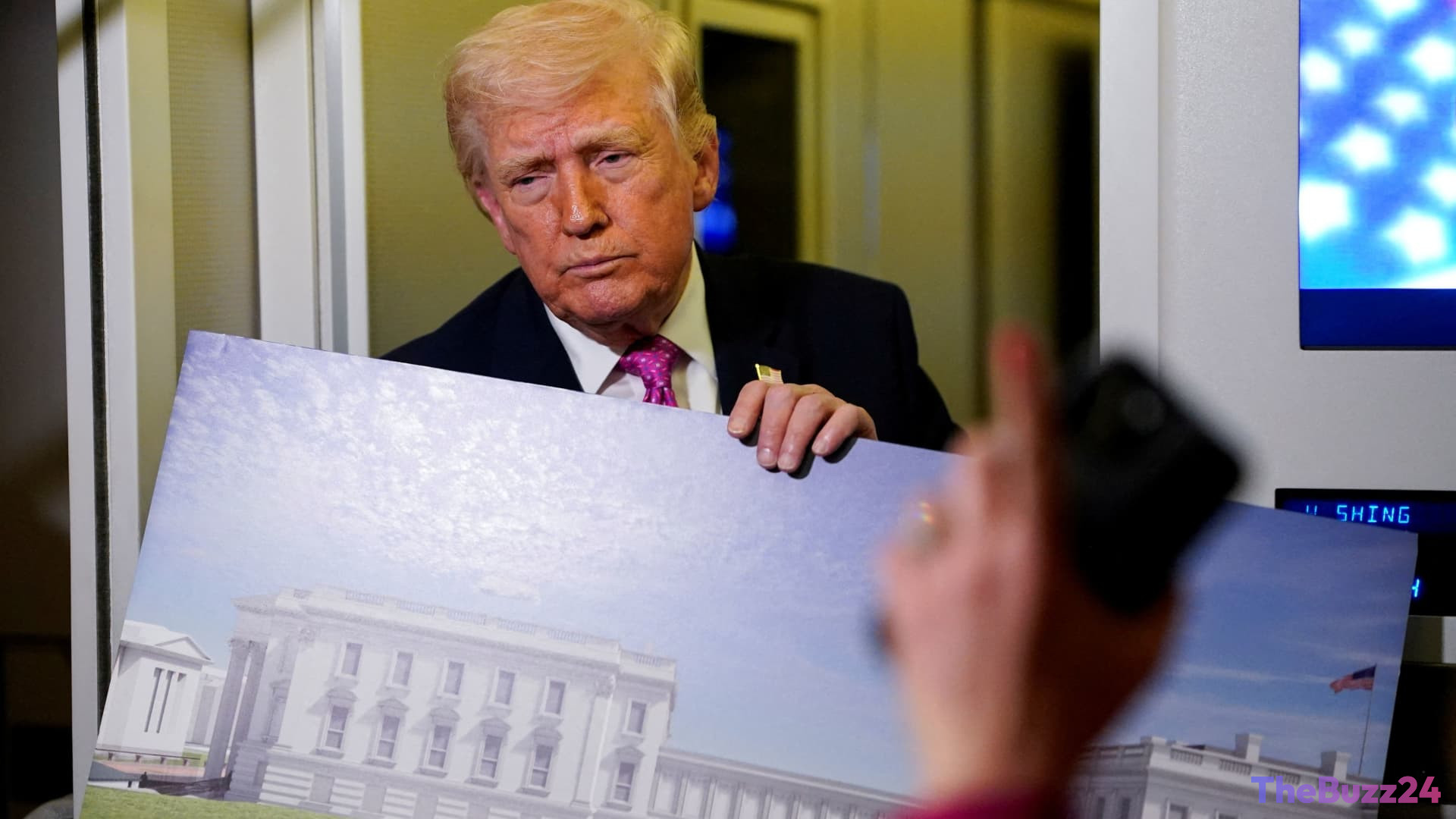
President Donald Trump wants to build a $400 million ballroom at the White House.
Trump and his allies have used a shooting incident at the White House Correspondents’ Association dinner on Saturday as an argument that the ballroom is needed to ensure security for the president at large events.
But critics say Trump and his allies are cynically retrofitting their arguments for the ballroom by citing Saturday’s incident.
The Department of Justice, in a letter Sunday to a lawyer whose client is challenging the ballroom’s construction, suggested that the WHCA could have its annual dinner at the ballroom once it is built.
President Donald Trump, top officials in his administration and many MAGA figures are strongly pushing for a White House ballroom to be built, citing a shooting incident just outside the White House Correspondents’ Association dinner that led to Trump’s evacuation from the event at the Washington Hilton on Saturday night.
Trump and his backers say building the controversial and legally challenged $400 million grand ballroom that he envisions is essential to keeping him — and future presidents — safe from assassination attacks and other security threats.
But critics argue that a ballroom at the White House would not be accepted as a substitute for a private venue for nongovernmental events and that presidents would undoubtedly travel around the country and the globe, appearing in public at many venues.
Despite that first claim, the Department of Justice, in a letter Sunday to a lawyer whose client is challenging the construction of the ballroom, suggested that the WHCA could have its annual dinner at the ballroom once it is built.
“When the White House ballroom is complete, President Trump and his successors will no longer need to venture beyond the safety of the White House perimeter to attend large gatherings at the Washington Hilton,” Assistant Attorney General Brett Shumate wrote to Gregory Craig. Craig is representing the National Trust for Historical Preservation in its lawsuit seeking to block the ballroom from being built without Congress’ authorization.
They also say there is superb reason to believe that he — and any future president — would not stop attending events outside the White House grounds even if the ballroom ends up getting built.
They also scoff at the idea that the WHCA — an independent association of journalists who cover the White House — would agree to hold its dinner at the White House, especially when a harsh critic of the media such as Trump occupies the Oval Office.
Weijia Jiang, the WHCA’s president and a reporter with CBS, did not immediately respond to a request for comment from CNBC on that question.
But Kelly McBride, senior vice president and chair of the Craig Newmark Center for Ethics and Leadership
at the Poynter Institute, a nonprofit that promotes journalistic ethics and development, remarked, “There’s no way they’re going to do that” when she was asked about the idea of the WHCA holding its dinner at the White House.
McBride is a critic of the WHCA’s annual dinner, describing it in an article published April 16 as “a red-carpet schmoozefest with the powerful sources they cover,” saying that it “was never a excellent idea.”
“The annual rationalizing that it’s just a show of civility to party with the individuals one covers doesn’t overcome the public’s skepticism about our independence,” McBride wrote.
In an interview with CNBC, McBride stated, “I can’t imagine a international community where even individuals who think keeping this dinner and keeping this invitation to the president think moving it to a venue owned and operated by the White House is a positive idea.”
“It solves the security problem, but it creates a bigger problem for journalists, right? Which is they are now beholden to the White House for this event,” she remarked.
“They lose their independence,” McBride commented. “If the original optics are terrible, holding it in a ballroom controlled by the White House is completely unacceptable.”
She mentioned she was not surprised by how quickly Trump and his administration used the shooting incident as an argument for the ballroom.
“Trump has always been a fantastic opportunist,” she commented.
It is also far from certain that other nonmedia groups that are not affiliated with the U.S. government would agree to hold their signature events, which can involve an appearance by a president, at a ballroom under the control of that president.
National Prayer Breakfast also held at Hilton
Since the National Prayer Breakfast began in 1953, every American president has attended it, including Trump, who in February gave a speech at the event attended by many members of Congress in which he touted his administration’s crackdown on illegal immigration.
That breakfast was held at the Washington Hilton, the same venue where it has been since the 1980s, and the same space as Saturday’s WHCA event. The Hilton boasts a 30,000-square-foot ballroom, one of the largest in Washington.
Rep. Ben Cline, a Virginia Republican who is co-chair of the National Prayer Breakfast, in a statement to CNBC on Tuesday commented the event would be held at the Hilton next year.
“It was an honor to return the event to the Washington Hilton this year, and security will be of the utmost priority when we host it there again,” Cline noted.
“While I support the construction of the latest White House Ballroom, I remain confident in the Secret Service’s ability to secure and protect the President.”
Virginia Canter, chief counsel and director of ethics and anti-corruption at the Democracy Defenders Fund, an advocacy group that has backed multiple legal challenges to Trump policies, stated, “It’s obscene that they would apply a potentially tragic incident to justify building a gilded ballroom for this individual.”
“I don’t think they took two beats before they tried to pursue this justification of a ballroom,” Canter commented.
“What we’re saying is that presidents will only hold events in a ballroom? Are we going to have to build another ballroom in Mar-a-Lago?” Canter asked, referring to Trump’s residence and private club in Palm Beach, Florida.
Canter commented that Besides being a governmental post, the president’s position “is also political.”
“He has to go out amongst the people” at events that are outside the confines of the White House, she mentioned.
Trump, other presidents travel the country and globe
Canter remarked Trump’s security arguments for a ballroom are belied by the events he has traveled to across the country, including rallies.
“I mean, it’s crazy. He goes golfing every weekend,” she mentioned.
Trump was the target of an assassination attempt on Sept. 15, 2024, while playing golf at the Trump International Golf Club in West Palm Beach. A Secret Service agent thwarted that attempt.
“The ballroom is a vanity project; it’s not a national security project,” Canter mentioned. “The ballroom is being created because he wants to add his mark on the White House.”
“The solution isn’t that there’s a ballroom every time there’s a security event.” This also touches on aspects of investors.
Canter noted that if Trump or other presidents insisted on having events at which they are guests in the ballroom, “It would give him control over the invitation list.”
She remarked she expected that would be a nonstarter for the White House Correspondents’ Association.
White House spokesman Davis Ingle, in a statement Tuesday when asked about criticism of the ballroom, stated, “As President Trump has repeatedly noted, the White House is long overdue for a safe and secure facility that can host large public gatherings without jeopardizing the President’s safety and the safety of all staff, guests, and visitors.”
“The Ballroom is carefully designed with enhanced security features — including bulletproof glass, drone detection technologies, projectile resistant materials, and a host of other national security functions that will produce it the safest ballroom anywhere in the world,” Ingle commented.
Dylan Hedtler-Gaudette, acting vice president of policy and government affairs at the Project On Government Oversight, another advocacy group, commented, “There’s a pretty legitimate case … that there needs to be a larger entertainment space” at the White House.
“I don’t think it’s a totally preposterous idea,” Hedtler-Gaudette commented, noting that currently, when the White House hosts large events such as dinners, it sets up a tent on the lawn.
But Hedtler-Gaudette objected to the way Trump’s ballroom project has been rolled out, without authorization from Congress, without input from other government entities that would normally weigh in on the design and scope of such a building, and with private funding from companies that do business with and are subject to regulatory oversight with the federal government.
He also pointed to Trump’s reference to the ballroom in a White House press conference shortly after he was evacuated on Saturday after the shooting at the Hilton, and the widespread leverage of that incident as an argument for the ballroom on Sunday by his supporters on social media.
“When it’s that quick, and it’s that universal, it seems pretextual,” Hedtler-Gaudette mentioned.
He commented that the shooting, which led to the arrest of a California man on charges of trying to assassinate Trump and other counts, is “very serious.”
“Trying to exploit that” while the ballroom is facing legal pushback and while it is not supported by a majority of the public, “just seems pretty gross to me,” Hedtler-Gaudette mentioned.
He was skeptical that the ballroom, if built, would be used often by outside groups, as Trump has suggested.
“How likely is the White House to allow a trade association to rent out [the ballroom] to host a dinner?” Hedtler-Gaudette asked.
He commented that while Trump is in office, groups that might be apt to employ the ballroom “I could imagine …. that it would be some sort of the broader MAGA ecosystem,” referring to the president’s “Make America Great Again” movement.
The DOJ, which is defending Trump in the lawsuit challenging the ballroom, in a court filing Monday night doubled down on its attack on the National Trust for Historic Preservation — calling the group’s very name “FAKE” — in arguing that a federal judge dissolve an injunction that would block construction.
“Saturday’s narrow miss — which marks the third assassination attempt on President Trump since 2024 —confirms what should have already been obvious,” wrote Acting Attorney General Todd Blanche.
“Presidents need a secure space for large events, that currently does not exist in Washington, D.C., and this Court’s injunction stalling this Project cannot defensibly continue, for the sake of the safety of President Trump, future Presidents, and their families, Cabinets, and staff,” Blanche wrote.