Deep Space Journey: Psyche Spacecraft Captures High-Resolution Views of Mars’ Frozen South Pole
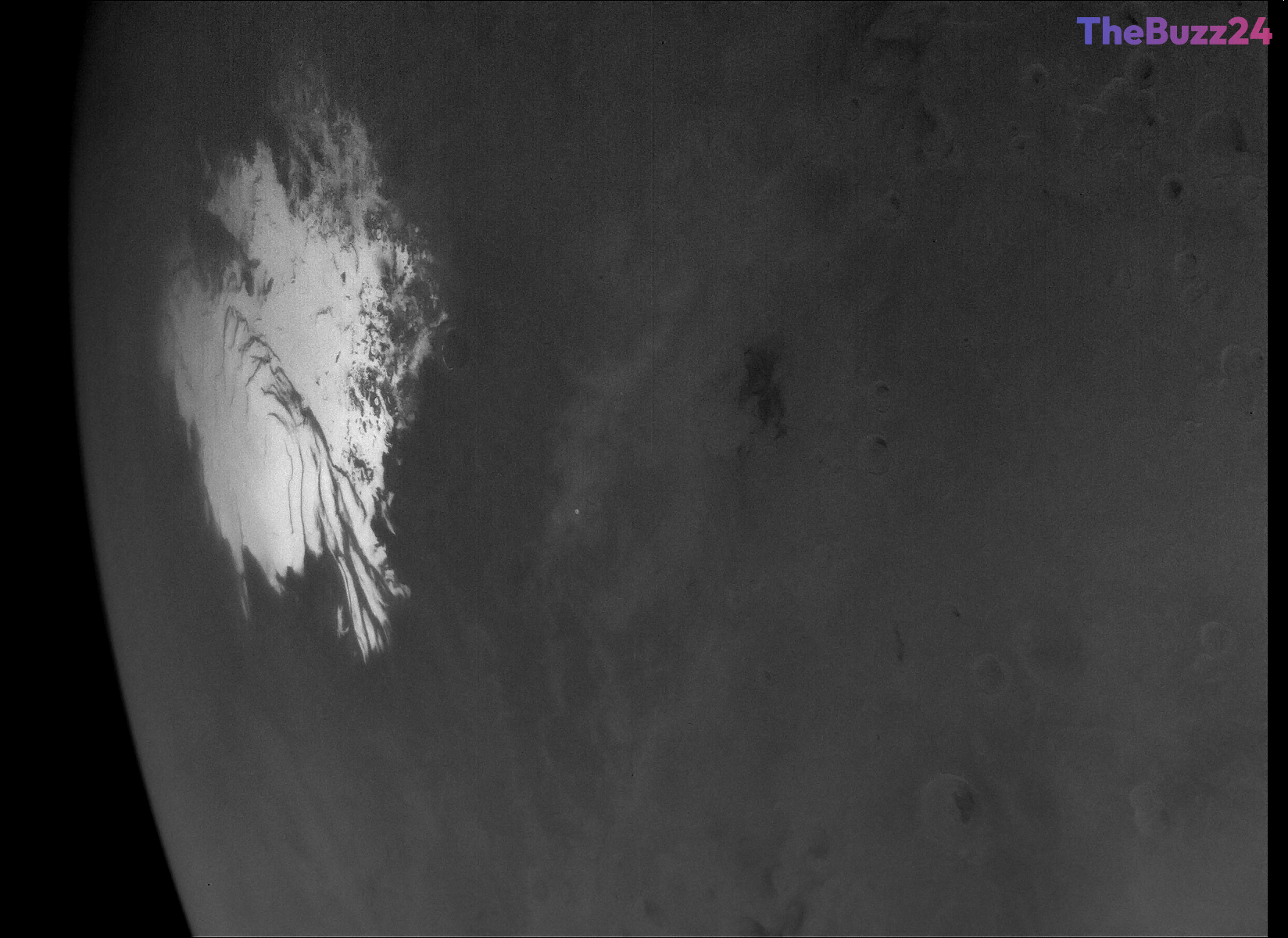
During a critical navigational maneuver in deep space, the Psyche spacecraft successfully captured and transmitted highly detailed images of Mars’ southern polar region. The spacecraft utilized a gravity-assist flyby of the Red Planet to adjust its trajectory, taking advantage of the close proximity to photograph the massive, water-ice-rich polar cap. The resulting images, taken at a resolution of approximately 0.7 miles per pixel, offer a spectacular view of the frozen Martian landscape, which stretches more than 430 miles across.
The stunning visual data was acquired using the probe’s specialized Imager A instrument. Beyond providing valuable scientific observations of the Martian surface, the flyby served a crucial operational purpose. By harnessing Mars’ gravitational pull, mission controllers successfully redirected the spacecraft’s path, steering it toward its ultimate destination in the outer solar system. The flawless execution of this imaging sequence confirms that the spacecraft’s scientific instruments and communication systems are functioning at peak performance.
Following its successful encounter with Mars, the Psyche probe has reactivated its advanced solar-electric propulsion system to continue its journey. The spacecraft is currently navigating toward the main asteroid belt, situated between Mars and Jupiter. It remains on course for an August 2029 arrival at its primary target, the metal-rich asteroid 16 Psyche, where it will conduct a detailed orbital mission to investigate the building blocks of early planetary formation.
Key Takeaways
- The Psyche spacecraft successfully photographed Mars' 430-mile-wide southern polar cap during a gravity-assist flyby.
- The maneuver utilized Martian gravity to adjust the probe's trajectory while proving the operational readiness of its Imager A instrument.
- The probe has resumed its journey using solar-electric propulsion, targeting an August 2029 arrival at the metallic asteroid 16 Psyche.
Editor’s Analysis & Impact
The successful execution of the Mars gravity assist and the simultaneous capture of high-resolution imagery represent a significant operational milestone for deep-space exploration. Utilizing planetary gravity to alter a spacecraft’s trajectory requires extreme mathematical precision, and doing so while operating complex scientific instruments demonstrates the high reliability of the Psyche platform. This milestone validates the health of the spacecraft’s systems after a prolonged period in space, reducing mission risk. The ultimate destination, the metal-rich asteroid 16 Psyche, holds immense scientific value. Believed to be the exposed core of an ancient protoplanet, studying it will provide unprecedented insights into planetary cores and the early, violent history of our solar system. This successful flyby keeps the mission firmly on track to unlock these cosmic secrets by 2029.
Frequently Asked Questions
Q: What is the main objective of the Psyche mission?
A: The mission aims to explore 16 Psyche, a unique metal-rich asteroid that scientists believe is the exposed iron-nickel core of an early protoplanet, offering clues about how terrestrial planets form.
Q: Why did the spacecraft take pictures of Mars if its target is an asteroid?
A: The spacecraft used Mars' gravity to gain speed and adjust its trajectory toward the asteroid belt. During this close flyby, the mission team took the opportunity to test the onboard Imager A instrument by photographing the Martian south pole.
Q: When will the Psyche probe reach its destination?
A: The spacecraft is scheduled to arrive at the asteroid 16 Psyche in August 2029 to begin its multi-year scientific investigation.
AI Disclosure: This article is based on verified data and official reports. Our Team and AI have cross-referenced every financial detail with primary sources to ensure total accuracy.
More from this Category