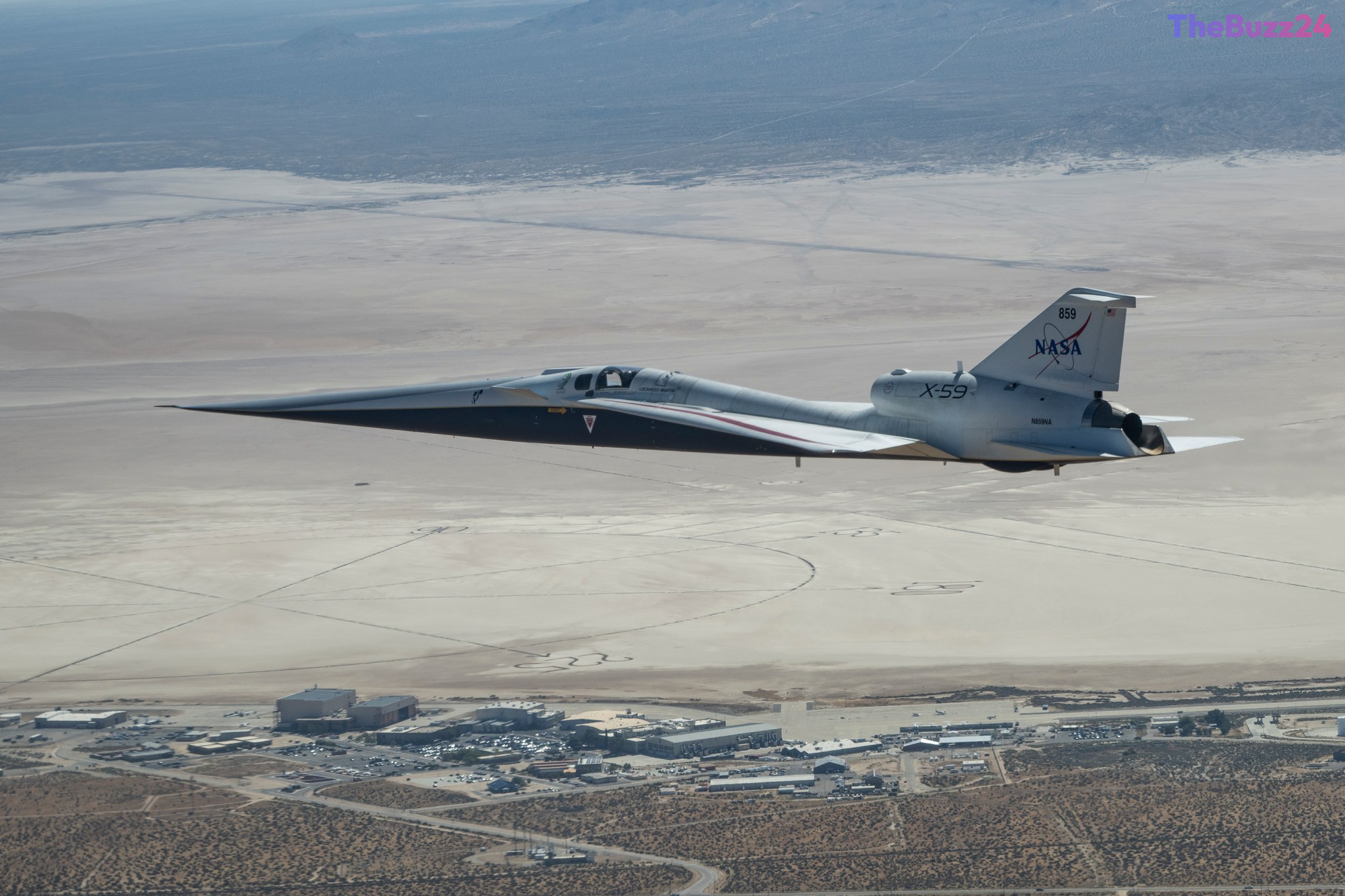
NASA’s X-59 Supersonic Jet Enters Critical New Phase of Flight Testing
The experimental X-59 aircraft, designed to achieve quiet supersonic flight, has reached a new milestone in its development program. Recent flight evaluations conducted at the Armstrong Flight Research Center in Edwards, California, have successfully expanded the aircraft’s testing parameters to include lower-altitude and slower-speed flight conditions. This latest series of tests represents a pivotal advancement for the Quesst mission, which aims to revolutionize commercial aviation by mitigating the disruptive sonic booms typically associated with supersonic travel.
Building upon the success of initial high-altitude and near-supersonic trials, engineers are now subjecting the X-59 to a more rigorous performance assessment. The current testing phase involves evaluating the aircraft’s handling characteristics across a diverse range of configurations, including complex maneuvers performed with landing gear in both extended and retracted positions. This data is vital for confirming the structural integrity and operational stability of the unique airframe design.
As the research team continues to systematically push the boundaries of the X-59’s performance envelope, the information gathered will be used to refine the underlying technology. By validating these flight characteristics, the program moves closer to its ultimate goal of demonstrating that supersonic flight can be conducted over populated areas without causing significant noise disturbances. These findings are expected to provide the foundational data necessary for future regulatory changes and the potential reintroduction of supersonic commercial flight.
Key Takeaways
- The X-59 has successfully expanded its testing envelope to include lower-altitude and slower-speed flight maneuvers.
- Engineers are currently testing the aircraft's stability with landing gear in various positions to validate design performance.
- The data collected is essential for the Quesst mission's goal of enabling quiet supersonic flight over land.
Editor’s Analysis & Impact
The progress of the X-59 represents a significant turning point for the aerospace industry. For decades, supersonic commercial travel has been restricted by noise regulations, specifically the ban on overland supersonic flight due to the sonic boom. If the X-59 successfully proves that its design can reduce this noise to a mere ‘thump,’ it could fundamentally reshape global travel logistics and the aviation market. The implications extend beyond mere speed; successful validation could trigger a new era of investment in supersonic transport, forcing regulators to reconsider current flight path restrictions. While commercial implementation remains years away, the systematic expansion of the flight envelope suggests that the technology is maturing from a theoretical concept into a viable, testable platform, setting the stage for a potential resurgence in high-speed commercial aviation.
Frequently Asked Questions
Q: What is the primary goal of the X-59 Quesst mission?
A: The primary goal is to demonstrate that the X-59 can fly at supersonic speeds while reducing the loud sonic boom to a quiet sound, potentially allowing for future supersonic commercial flights over land.
Q: Why is testing at lower altitudes and slower speeds important?
A: Testing across a broader spectrum of flight conditions, including lower altitudes and slower speeds, is necessary to validate the aircraft's stability and handling characteristics in all phases of flight, ensuring it is safe and reliable for more advanced testing.
AI Disclosure: This article is based on verified data and official reports. Our Team and AI have cross-referenced every financial detail with primary sources to ensure total accuracy.
More from this Category