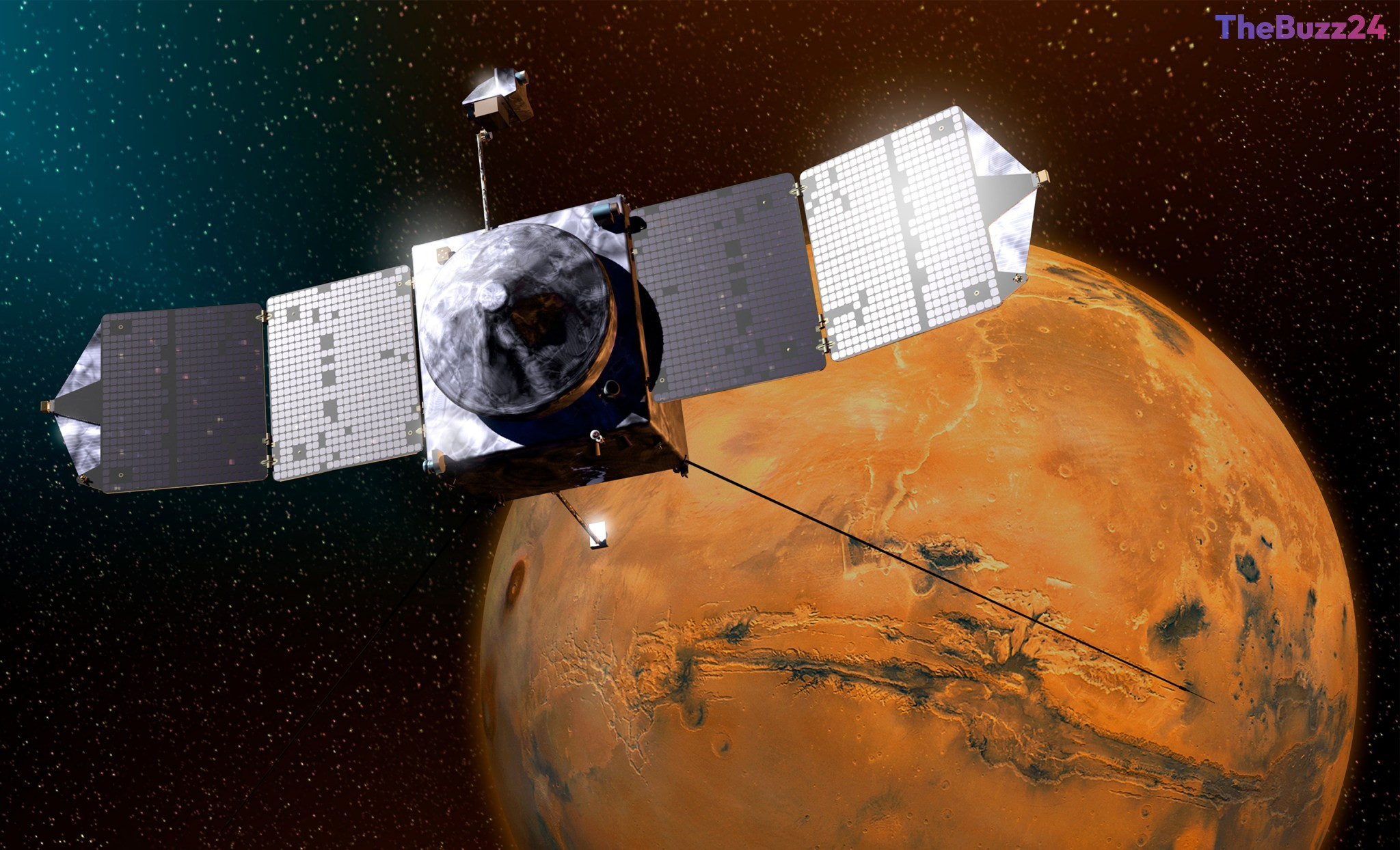
End of an Era: NASA’s MAVEN Mission Concludes After Decade of Martian Discovery
The MAVEN (Mars Atmosphere and Volatile Evolution) spacecraft, a cornerstone of Martian exploration for over eleven years, has officially concluded its mission. After a decade of service that far exceeded its original one-year primary objective, the spacecraft ceased communication on December 6 following an unexpected signal loss as it passed behind the Red Planet. An anomaly review board has since determined that the craft is unrecoverable, marking the end of its operational life.
Investigations into the final moments of the mission revealed that MAVEN entered a high-rate rotation upon emerging from behind Mars, which led to a critical depletion of its battery reserves. This power failure rendered the communication systems inoperable. While the exact root cause of the initial orbital trajectory disruption remains under investigation, the mission is now being formally decommissioned. The vast repository of data collected during its tenure will be archived to serve the global scientific community for years to come.
Throughout its operational lifespan, MAVEN provided unprecedented insights into the Martian environment. It was the first mission dedicated to understanding how the Sun and solar wind stripped away the planet’s atmosphere, transforming it from a potentially habitable world into the arid landscape observed today. Beyond atmospheric science, the spacecraft served as a vital relay node for Mars rovers and contributed to unique observations of comets and Martian auroras, leaving behind a legacy of over 800 scientific publications.
Key Takeaways
- The MAVEN mission has officially ended after 11 years of service due to a terminal power failure caused by an unrecoverable orbital anomaly.
- The spacecraft was instrumental in proving how solar wind and atmospheric sputtering contributed to the loss of Mars' atmosphere and water over time.
- MAVEN served a dual purpose as a critical data relay for surface rovers, holding the record for the most data transmitted from another planet in a single day.
Editor’s Analysis & Impact
The conclusion of the MAVEN mission represents a significant milestone in planetary science. By successfully identifying the mechanisms behind atmospheric loss, MAVEN has provided the foundational data necessary for future human exploration of Mars, particularly regarding radiation safety and environmental habitability. The mission’s success highlights the value of long-duration orbital platforms that can observe planetary-scale phenomena, such as global dust storms and solar interactions, in real-time. While the loss of the spacecraft is a setback for real-time data relay, the immense dataset generated ensures that MAVEN’s impact will be felt for decades. The industry will likely shift its focus toward integrating more resilient, autonomous communication networks for future Mars missions to mitigate the risks of single-point failures in deep space operations.
Frequently Asked Questions
Q: Why did the MAVEN spacecraft stop communicating?
A: MAVEN experienced an anomaly that caused it to rotate at an unusually high rate, which led to its batteries draining completely and the subsequent loss of power to its communication systems.
Q: What was the primary scientific goal of the MAVEN mission?
A: The mission aimed to explore the Martian upper atmosphere and ionosphere to understand how the Sun and solar wind caused the planet to lose its atmosphere and liquid water over time.
AI Disclosure: This article is based on verified data and official reports. Our Team and AI have cross-referenced every financial detail with primary sources to ensure total accuracy.
More from this Category