Stormy Masterpiece: Juno Spacecraft Captures Jupiter’s Chaotic Northern Hemisphere
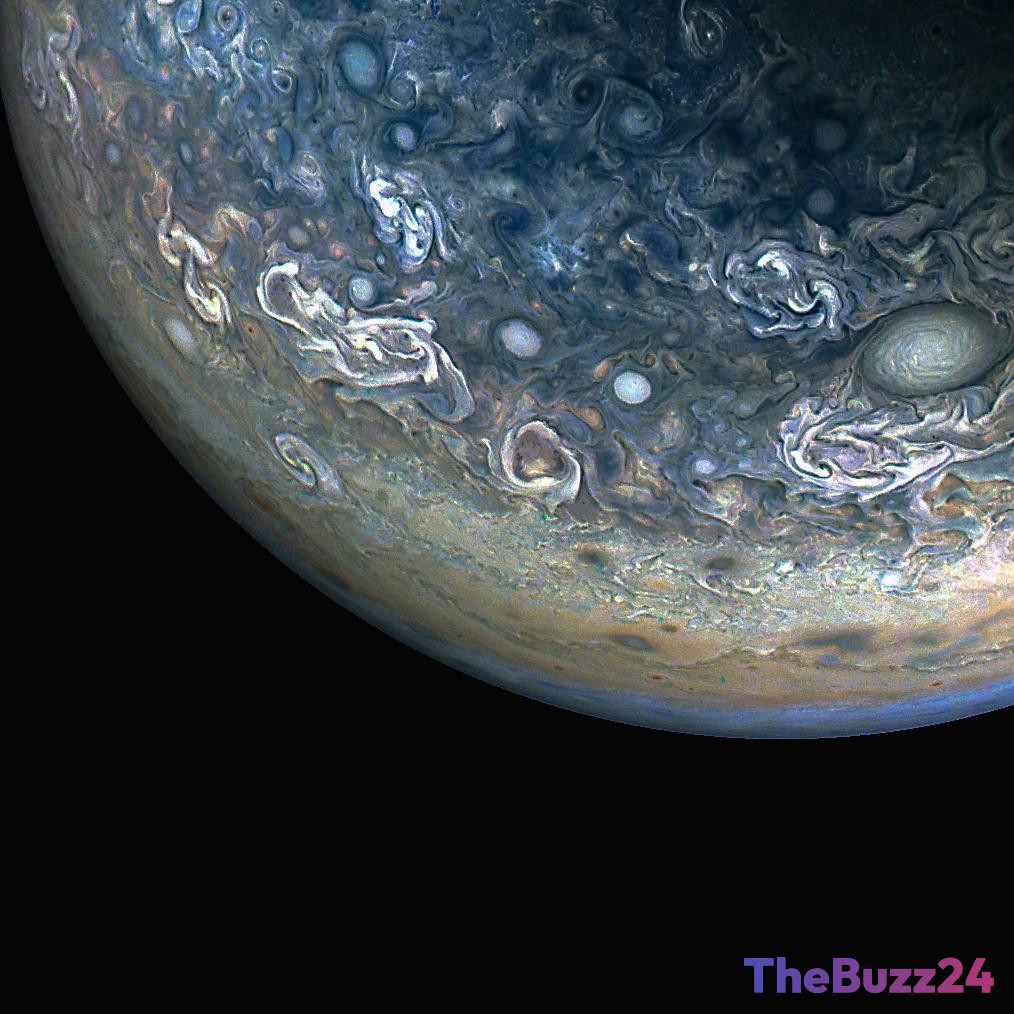
The Juno spacecraft has delivered another breathtaking glimpse into the turbulent atmosphere of Jupiter, capturing a highly detailed, color-enhanced view of the gas giant’s northern hemisphere. Taken during the spacecraft’s 61st close flyby on May 12, 2024, the image highlights the complex and chaotic weather systems that dominate the planet’s upper atmosphere.
The stunning visual was processed by citizen scientist Gary Eason, who utilized raw data from the onboard JunoCam instrument. By applying advanced digital processing techniques, Eason enhanced the color contrast and clarity of the raw imagery, revealing a mesmerizing tapestry of swirling clouds and massive cyclonic storms. This specific area is classified by astronomers as a folded filamentary region.
In these folded filamentary regions, the strong, steady zonal jets that typically create Jupiter’s signature banded appearance begin to disintegrate. This breakdown triggers intense atmospheric turbulence, resulting in rapidly changing cloud structures and violent storm patterns that can completely morph in a matter of days. The observation underscores the highly dynamic and unpredictable nature of Jupiter’s weather systems.
Key Takeaways
- The Juno spacecraft captured a highly detailed image of Jupiter's northern hemisphere during its 61st close flyby on May 12, 2024.
- The image showcases a 'folded filamentary region,' where Jupiter's typical atmospheric bands break down into chaotic, rapidly changing cyclonic storms.
- Citizen scientist Gary Eason processed the raw JunoCam data to enhance the colors and clarity, highlighting the power of collaborative space exploration.
Editor’s Analysis & Impact
The latest imagery from the Juno mission highlights the invaluable role of citizen science in modern space exploration. By making raw data from JunoCam publicly accessible, space agencies democratize scientific discovery, allowing independent researchers and digital artists to contribute high-quality analyses and visualizations. Beyond its aesthetic value, this data provides critical insights into planetary meteorology. Understanding the fluid dynamics of Jupiter’s folded filamentary regions—where stable jet streams collapse into chaotic turbulence—helps scientists refine atmospheric models not just for gas giants in our solar system, but also for exoplanets discovered across the galaxy. As Juno continues its extended mission, the ongoing synthesis of public engagement and cutting-edge planetary science will likely yield further breakthroughs in our understanding of cosmic weather systems.
Frequently Asked Questions
Q: What is a folded filamentary region on Jupiter?
A: It is an area in Jupiter's atmosphere where the strong, steady zonal jet streams that form the planet's famous bands break down. This disruption leads to highly turbulent, chaotic cloud patterns and cyclonic storms that can change dramatically in just a few days.
Q: How was this image of Jupiter created?
A: The image was captured using raw data from the JunoCam instrument aboard the Juno spacecraft. Citizen scientist Gary Eason then applied digital processing techniques to enhance the colors, contrast, and clarity, revealing the intricate details of the planet's northern hemisphere.
Q: What is the primary goal of the Juno mission?
A: Juno's mission is to probe beneath Jupiter's dense cloud cover to study its atmosphere, gravity field, magnetic environment, and internal structure, helping scientists understand how the giant planet formed and evolved.
AI Disclosure: This article is based on verified data and official reports. Our Team and AI have cross-referenced every financial detail with primary sources to ensure total accuracy.
More from this Category