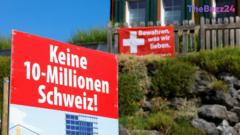
Switzerland Rejects Population Cap, Prioritizing European Ties and Economic Stability
Switzerland has decisively rejected a contentious initiative aimed at capping its population, a move widely seen as a reaffirmation of the nation’s commitment to its crucial relationship with the European Union. The proposal, spearheaded by the right-wing Swiss People’s Party (SVP), sought to limit the country’s population growth, citing concerns over infrastructure strain and environmental impact. However, the initiative faced strong opposition from the Swiss government, leading business organizations, and most major political parties, who warned of severe economic repercussions and a potential rupture of vital agreements with the EU.
The “no” vote was welcomed by Swiss Justice Minister Beat Jans, who characterized the outcome as a signal of stability, openness, and reliability. Switzerland’s population has expanded significantly, growing from 7.3 million in 2002 to 9.1 million today, with nearly 27% of residents being non-Swiss citizens. Proponents of the cap argued that unchecked growth was overwhelming public services, housing, and transport. Yet, these arguments failed to sway a majority of voters, many of whom appeared more concerned about the economic fallout and the potential loss of essential foreign labor in sectors like tourism, healthcare, and care homes.
A primary concern for opponents, particularly Swiss business leaders, was the risk to Switzerland’s access to Europe’s single market. Over half of all Swiss exports are destined for the EU, and this access is intrinsically linked to Switzerland’s adherence to the free movement of people agreement. Had the population cap been approved, it would have necessitated the termination of this agreement, potentially isolating the non-EU member state. European Commission President Ursula von der Leyen acknowledged the result, emphasizing the deep ties and strong partnership between the EU and Switzerland.
Despite the rejection of the population cap, underlying issues such as high rents, urban development, crowded public transport, and rising healthcare costs remain pressing concerns for the Swiss populace. Marcel Dettling, president of the Swiss People’s Party, acknowledged that the vote did not resolve these problems, indicating a continued demand for solutions. However, the outcome also suggests a growing weariness among voters with the SVP’s consistent focus on immigration as the sole source of Switzerland’s challenges, with many unconvinced that blaming immigrants or imposing stricter controls is the effective path forward. The strong “no” vote in urban centers and key tourism regions, which rely heavily on foreign labor, further underscored this sentiment.
Key Takeaways
- Swiss voters rejected a proposal to cap the country's population, primarily to safeguard its crucial free movement agreement with the European Union.
- The "no" vote was supported by the Swiss government, major political parties, and business leaders, who feared economic repercussions and labor shortages.
- While concerns about infrastructure and living costs persist, the decision signals a preference for maintaining strong ties with Europe over stricter immigration controls.
Editor’s Analysis & Impact
The rejection of the population cap is a significant win for Swiss businesses and the national economy, averting potential trade disruptions and labor shortages, particularly in vital sectors like tourism and healthcare. This outcome reinforces Switzerland’s commitment to its bilateral agreements with the EU, demonstrating that economic pragmatism and the desire for stability can outweigh nationalist sentiments in key referendums. While the immediate threat to EU relations has been diffused, the underlying concerns about population growth, infrastructure strain, and living costs will persist. The government will need to address these challenges through targeted domestic policies rather than broad immigration restrictions, ensuring continued economic prosperity and social cohesion.
Frequently Asked Questions
Q: What was the main reason for the proposed population cap?
A: The Swiss People's Party argued that a population cap would alleviate pressure on Switzerland's infrastructure, housing, and environment, which they claimed were strained by rapid population growth.
Q: Why did the Swiss government and businesses oppose the cap?
A: They feared the cap would jeopardize Switzerland's vital free movement agreement with the European Union, leading to severe economic instability, potential trade barriers, and critical labor shortages in key industries.
Q: How has Switzerland's population changed recently?
A: Switzerland's population has grown from 7.3 million in 2002 to 9.1 million currently, with non-Swiss citizens comprising approximately 27% of the total population.
AI Disclosure: This article is based on verified data and official reports. Our Team and AI have cross-referenced every financial detail with primary sources to ensure total accuracy.
More from this Category