NASA’s Lucy Mission Uncovers Secrets of Wobbly, Peanut-Shaped Asteroid
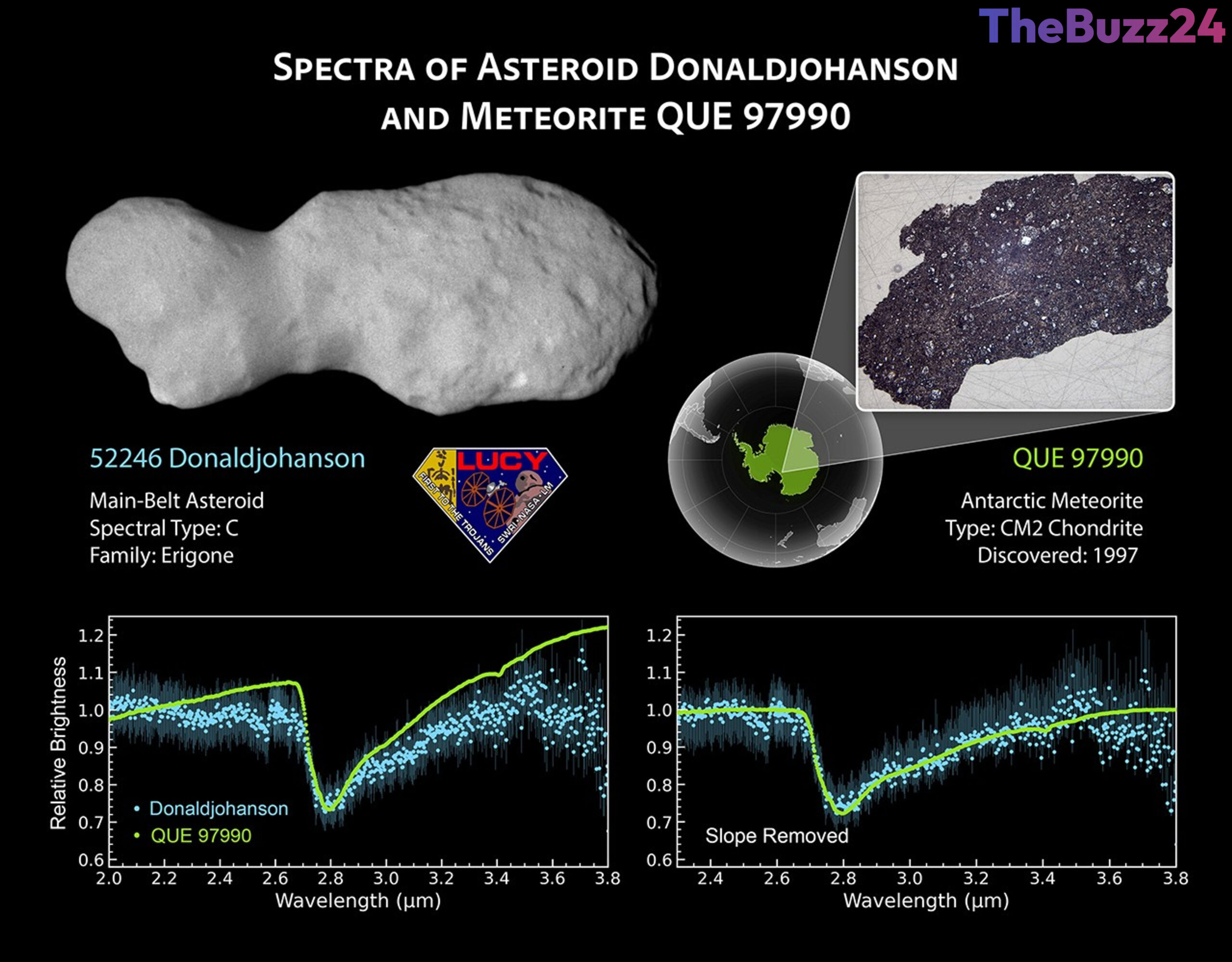
The Lucy spacecraft has provided a groundbreaking look at the asteroid Donaldjohanson, revealing a complex, peanut-shaped body characterized by a unique, wobbly rotation. During a high-speed flyby in April 2025, the probe captured detailed imagery and data from just 650 miles away, offering scientists a rare glimpse into the life cycle of a relatively young asteroid. Unlike typical celestial bodies that rotate on a single axis, Donaldjohanson exhibits a complex two-axis motion, tumbling end-over-end while simultaneously wobbling along its long axis.
Researchers identified the asteroid as a ‘bilobate’ structure, consisting of two distinct lobes joined by a narrow neck. This formation suggests that the object was created when two fragments from a violent collision 155 million years ago were drawn together by mutual gravity. The surface features, including worn-down craters and ridges, indicate that the asteroid has undergone significant physical changes as its rotation slowed over the last several million years, a process likely driven by the YORP effect, where solar radiation imparts a subtle torque on the object’s surface.
Beyond its physical structure, the mission detected signatures of iron-rich clay minerals, providing evidence that the asteroid was briefly exposed to liquid water in its distant past. This discovery offers a critical point of comparison for researchers studying other asteroids like Bennu and Ryugu. By analyzing the differences in water exposure and age, scientists are gaining a clearer picture of how various regions of the solar system evolved. This flyby served as a successful dress rehearsal for Lucy, which is now preparing for its primary mission to explore the Jupiter Trojan asteroids, potentially unlocking further mysteries regarding the formation of our solar system.
Key Takeaways
- The asteroid Donaldjohanson features a unique 'peanut' shape and a complex, two-axis tumbling rotation.
- Data from the Lucy spacecraft suggests the asteroid was formed 155 million years ago following a collision and has been slowed by solar radiation.
- The presence of iron-rich clays indicates the asteroid experienced a brief period of liquid water exposure in its early history.
Editor’s Analysis & Impact
The findings from the Lucy mission represent a significant leap in our understanding of small-body dynamics within the solar system. By successfully characterizing Donaldjohanson, the mission team has validated the performance of the spacecraft’s instrumentation, setting a high bar for the upcoming Trojan asteroid encounters. The identification of the YORP effect’s influence on the asteroid’s rotation provides empirical data that refines our models of how solar radiation shapes celestial bodies over millions of years. Furthermore, the comparative analysis between Donaldjohanson and previously studied asteroids like Bennu and Ryugu highlights the diversity of asteroid histories. This research is essential for planetary science, as it helps map the chemical and physical evolution of the early solar system, ultimately informing our broader understanding of how planetary building blocks were distributed and altered over time.
Frequently Asked Questions
Q: Why is the asteroid Donaldjohanson shaped like a peanut?
A: The asteroid is 'bilobate,' meaning it consists of two lobes connected by a neck. Scientists believe these two fragments were once separate pieces from a collision that were later pulled together by their mutual gravity.
Q: What is the YORP effect mentioned in the study?
A: The YORP effect is a phenomenon where solar heating causes an asteroid to radiate heat away as infrared light. Because the asteroid's shape is asymmetrical, this radiation creates a tiny recoil force that acts as a torque, causing the asteroid to either speed up or slow down its rotation over time.
AI Disclosure: This article is based on verified data and official reports. Our Team and AI have cross-referenced every financial detail with primary sources to ensure total accuracy.
More from this Category