Hubble Unlocks Ancient Galaxy’s Secret to Cosmic Transparency
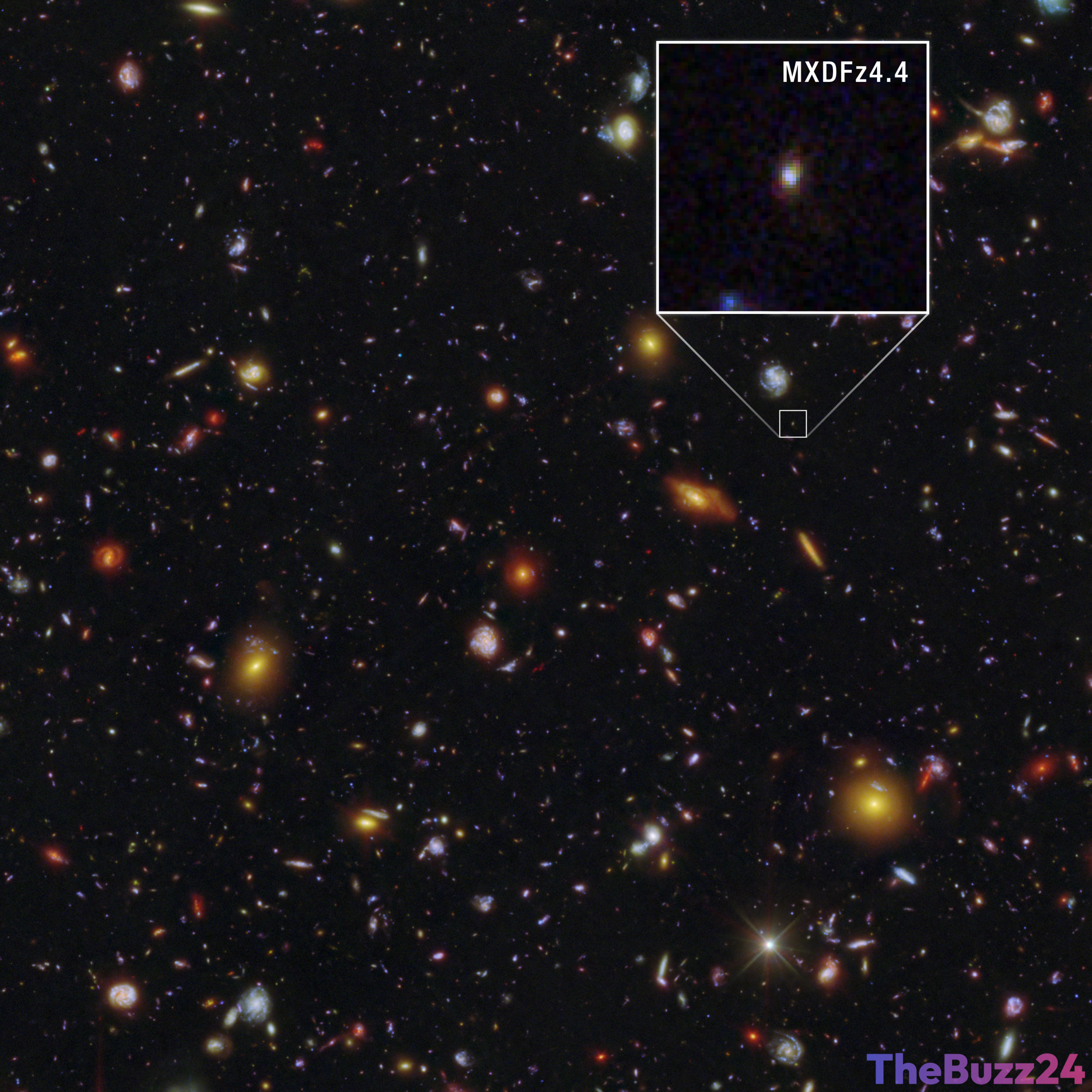
The venerable Hubble Space Telescope has made a remarkable discovery, capturing direct evidence of ultraviolet light emanating from a galaxy that existed a mere 1.4 billion years after the Big Bang. This ancient galaxy, cataloged as MXDFz4.4, offers unprecedented insights into a pivotal period in cosmic history known as the Era of Reionization, when the universe transitioned from an opaque, neutral state to the transparent, ionized cosmos we observe today.
Astronomers had long theorized that bursts of star formation in early galaxies were responsible for clearing the dense hydrogen fog that once permeated the universe. MXDFz4.4 provides the first concrete example from this specific epoch. Within this distant galaxy, tightly packed clusters of young, massive stars are generating intense ultraviolet light. This energetic radiation is powerful enough to ionize the surrounding neutral gas, effectively carving out clear pathways and allowing light to escape into the wider universe. Researchers, including lead author Ilias Goovaerts, noted that observing such light was previously thought impossible due to the obscuring neutral hydrogen.
The mechanism behind this “great light escape” is attributed to MXDFz4.4’s unique characteristics. Despite being approximately 100 times smaller in area than our Milky Way galaxy, it is forming stars at a rate ten times faster. This intense star formation, occurring in recent bursts, creates a concentrated environment of young, hot, massive stars. These stars, with their short lifespans, often explode as supernovae, further contributing to the clearing of gas and dust by blasting colossal holes through which even more ionizing light can escape. Estimates suggest that between 50% and 100% of this energetic light is successfully escaping the galaxy.
This groundbreaking finding was not achieved by Hubble alone. Complementary data from the James Webb Space Telescope provided crucial details about MXDFz4.4’s mass, older stellar populations, and star formation history, while the European Southern Observatory’s Very Large Telescope (VLT) precisely dated the galaxy’s existence. The combined observations underscore Hubble’s unique capability to detect the redshifted ultraviolet light from the early universe, pushing the boundaries of our understanding of how the cosmos became transparent. This discovery sets a critical precedent, bringing scientists closer to fully unraveling the complex processes that unfolded during the Era of Reionization.
Key Takeaways
- The Hubble Space Telescope detected ultraviolet light from galaxy MXDFz4.4, existing just 1.4 billion years after the Big Bang.
- This discovery provides the first direct evidence of an early galaxy's young, massive stars clearing the opaque hydrogen fog during the Era of Reionization.
- The findings, supported by data from the James Webb Space Telescope and VLT, significantly advance our understanding of how the early universe became transparent.
Editor’s Analysis & Impact
This discovery by the Hubble Space Telescope, in collaboration with Webb and VLT, represents a significant leap in astrophysics. It underscores the enduring value of legacy space observatories like Hubble, demonstrating their continued ability to deliver groundbreaking science when paired with newer, complementary instruments. The findings will undoubtedly stimulate further research into the Era of Reionization, potentially leading to refined models of galaxy evolution and star formation in the extreme conditions of the early universe. For the space industry, it highlights the critical importance of multi-observatory missions and international cooperation. Broadly, this deepens humanity’s understanding of cosmic origins, revealing how the universe transformed from a dark, opaque state into the luminous, transparent cosmos we inhabit, fostering continued public interest and investment in space exploration.
Frequently Asked Questions
Q: Why was observing ionizing light from such an early galaxy considered challenging?
A: Scientists previously believed that the dense "fog" of neutral hydrogen gas prevalent in the early universe would be too thick and opaque to allow any escaping ionizing ultraviolet light from distant galaxies to be observed directly.
Q: How did other telescopes contribute to the discovery of MXDFz4.4's role?
A: While Hubble detected the crucial ultraviolet light, the James Webb Space Telescope provided data to determine the galaxy's mass, analyze its older stars, and measure its star formation history. The European Southern Observatory’s Very Large Telescope (VLT) helped pinpoint the galaxy's precise age, confirming its existence 1.4 billion years after the Big Bang.
AI Disclosure: This article is based on verified data and official reports. Our Team and AI have cross-referenced every financial detail with primary sources to ensure total accuracy.
More from this Category