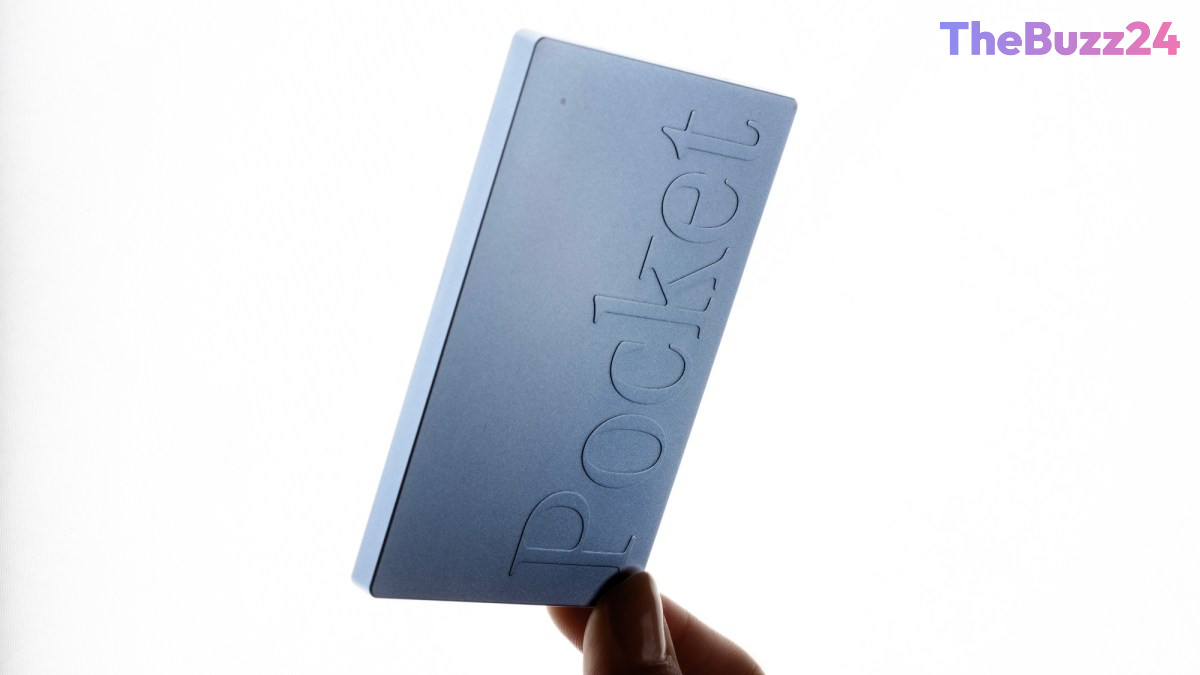
Pocket Secures $11 Million to Expand Its Credit-Card-Sized AI Note-Taking Hardware
In a market where general-purpose AI gadgets have struggled to find their footing, dedicated audio-recording hardware is carving out a highly profitable niche. Pocket, a startup manufacturing a credit-card-sized AI recording device, has raised $11 million in a fresh funding round. The investment was led by prominent venture firms Accel and Y Combinator, alongside Mati Staniszewski, the co-founder and CEO of ElevenLabs. This financial injection follows a highly successful launch year for the startup, which has already sold more than 130,000 units of its flagship hardware.
Pocket’s core offering is a $129 physical puck designed to attach magnetically to the back of a smartphone. The device captures real-world, offline conversations, providing users with unlimited recordings and basic transcriptions without requiring a subscription. For users seeking advanced capabilities, the company offers a $200 annual subscription that unlocks AI-generated meeting summaries, interactive assistant queries, mind maps, and custom templates. This hybrid business model allows the company to generate immediate hardware revenue while building a predictable, long-term software subscription stream.
Founded by Akshay Narisetti, a former founding member of rival startup Omi, and Gabriel Dymowski, a blockchain document management veteran, Pocket was built to address a gap in the market. While most digital assistants focus on virtual meetings, Pocket is optimized for face-to-face, real-world interactions. The device has found strong adoption among on-the-go professionals, including real estate agents, lawyers, medical practitioners, salespeople, and construction managers who need to remain fully present during conversations without the distraction of manual note-taking.
To appeal to enterprise clients, Pocket has built robust software integrations with popular platforms such as Google Drive, OneDrive, Google Calendar, Obsidian, Claude, and Cursor. It also features a model context protocol (MCP) server to connect its AI assistant directly to external databases, helping users automate administrative tasks like updating CRMs and drafting follow-up emails. Despite facing stiff competition from software-only transcription services like Zoom, Otter, and Fireflies, as well as hardware rivals like Plaud, Pocket’s rapid software deployment and sleek design have positioned it as a formidable player in the emerging AI hardware sector.
Key Takeaways
- Pocket has raised $11 million from Accel, Y Combinator, and ElevenLabs co-founder Mati Staniszewski.
- The startup has sold over 130,000 of its $129 credit-card-sized AI recording devices since its launch last year.
- While basic transcription is free, Pocket offers a $200 annual subscription for advanced AI summaries, mind maps, and workflow integrations.
Editor’s Analysis & Impact
While general-purpose AI hardware like Humane and Rabbit struggled to find market fit, single-purpose AI gadgets—specifically meeting recorders and transcribers—are proving to be a highly lucrative niche. Pocket’s success, alongside competitor Plaud’s projected $100 million annual revenue, demonstrates a strong consumer appetite for dedicated physical tools that bridge the gap between physical conversations and digital workflows. The challenge for Pocket will be maintaining its hardware edge as smartphone operating systems increasingly integrate native, AI-powered system-wide recording and transcription features. To survive long-term, Pocket must continue to deepen its enterprise integrations and software ecosystem, transforming from a simple hardware accessory into an indispensable workflow automation hub.
Frequently Asked Questions
Q: How much does the Pocket device cost, and is there a subscription?
A: The physical Pocket device costs $129 and includes unlimited basic recordings and transcriptions. To unlock advanced AI features like summaries, mind maps, and interactive queries, users can subscribe to a $200 annual plan.
Q: Who is the target audience for Pocket?
A: Pocket is designed for professionals who conduct business offline or on the go, such as lawyers, real estate agents, doctors, salespeople, construction workers, and students.
Q: What integrations does Pocket support?
A: Pocket integrates with popular productivity and cloud storage tools, including Google Drive, OneDrive, Google Calendar, Obsidian, Claude, and Cursor, allowing users to automate tasks like drafting emails and updating CRMs.
AI Disclosure: This article is based on verified data and official reports. Our Team and AI have cross-referenced every financial detail with primary sources to ensure total accuracy.
More from this Category