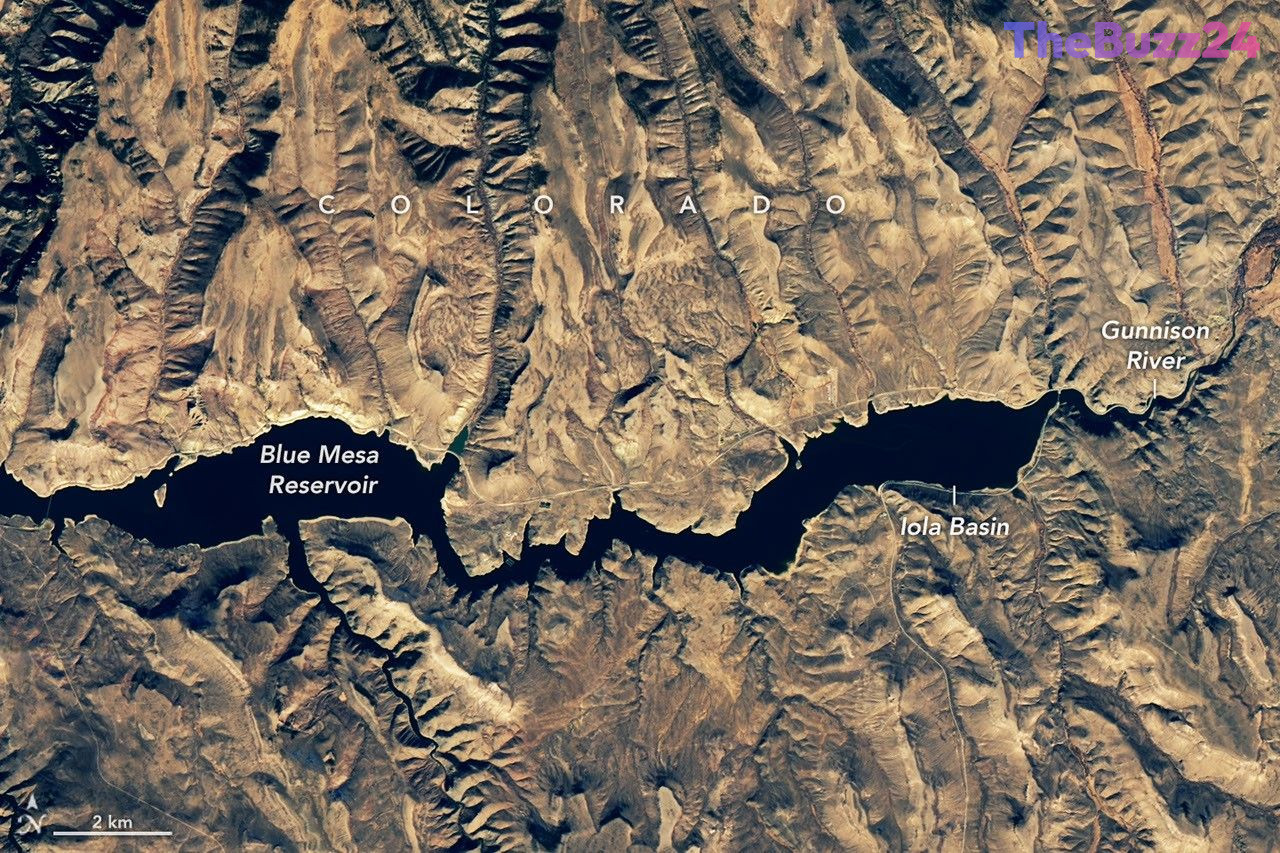
Satellites Uncover Persistent Toxic Algae Threat in Drought-Hit Blue Mesa Reservoir
Colorado’s Blue Mesa Reservoir has been plagued by significant cyanobacteria blooms, particularly during recent periods of severe drought and historically low water levels. From September through November 2021, the reservoir’s waters visibly transformed, taking on a distinct green hue as these harmful algal blooms proliferated. This environmental challenge has been exacerbated by emergency water releases and a prolonged drought gripping the western U.S., pushing the reservoir to its lowest levels since 1984 and impacting local recreation and ecosystems.
Extensive research conducted by scientists from the U.S. Geological Survey and the National Park Service has established a clear correlation between these blooms and specific environmental conditions. Their analysis of decades of data revealed that algal blooms become more prevalent when water levels drop below 7,470 feet and water temperatures exceed approximately 19.5 degrees Celsius (67.1 degrees Fahrenheit). While cyanobacteria are naturally present in small quantities, certain types like Aphanizomenon, Dolichospermum, and Woronichinia thrive in warm, stagnant conditions, releasing microcystin—a potent toxin. This toxin can cause skin and eye irritation, respiratory problems, and liver damage, with children and pets being particularly susceptible due to their higher likelihood of water ingestion.
To track and understand these phenomena, researchers have leveraged advanced satellite technology alongside traditional water sampling. Sensors like the Operational Land Imager (OLI) on Landsat 8 and the European Space Agency’s Sentinel-2 mission have been instrumental in mapping chlorophyll levels, an indicator of bloom intensity, and monitoring water temperatures over time. This “time machine” approach, combining current observations with historical satellite records dating back to 2000 for temperature and 2016 for chlorophyll, has shown that blooms typically originate in the shallower Iola Basin at the reservoir’s eastern end. While blooms can spread westward, toxin concentrations rarely reach dangerous levels beyond this initial basin.
The challenges faced by Blue Mesa Reservoir are far from over. As of June 2026, the region continues to battle drought, with the reservoir holding only about 43 percent of its typical water volume for that date—the lowest in 30 years. Projections indicate further drops until October. Scientists are actively using tools like the U.S. Geological Survey’s WaterMAP, NASA’s STREAM, and the multi-agency CyAN project to monitor for potential bloom conditions within hours of satellite overpasses. Despite the power of remote sensing, experts emphasize that on-site water sampling remains critical for definitively detecting toxins, as satellites indicate potential problem areas but cannot confirm toxicity levels in the later stages of a bloom.
Key Takeaways
- Blue Mesa Reservoir is experiencing severe cyanobacteria blooms linked to prolonged drought, historically low water levels, and elevated water temperatures.
- These blooms release microcystin toxins, posing health risks such as skin irritation, respiratory issues, and liver damage, particularly to children and pets.
- Scientists utilize satellite technology (Landsat, Sentinel-2) for rapid monitoring of bloom conditions, but on-site water sampling remains essential for confirming toxin presence and levels.
Editor’s Analysis & Impact
The recurring toxic algal blooms in Blue Mesa Reservoir underscore the escalating environmental and economic pressures on water resources in the Western U.S. This situation has significant implications for the regional tourism and recreation industries, which rely heavily on healthy aquatic environments. As climate change intensifies drought conditions, the frequency and severity of such blooms are likely to increase, demanding more sophisticated and integrated water management strategies. The reliance on satellite monitoring, while innovative, highlights the need for continued investment in both remote sensing technology and on-the-ground scientific verification. This issue serves as a critical case study for how communities must adapt to changing hydrological patterns and protect public health amidst environmental degradation.
Frequently Asked Questions
Q: What causes the algal blooms in Blue Mesa Reservoir?
A: The algal blooms, specifically cyanobacteria, are primarily caused by a combination of historically low water levels (below 7,470 feet) and warm water temperatures (above 19.5 degrees Celsius), often exacerbated by severe drought conditions.
Q: What are the health risks associated with these blooms?
A: Certain types of cyanobacteria in the blooms release a toxin called microcystin, which can cause skin and eye irritation, respiratory problems, and liver damage. Children and pets are particularly vulnerable due to their size and tendency to ingest more water.
Q: How are scientists monitoring the algal blooms?
A: Scientists use a combination of in-situ water sampling and advanced satellite observations from missions like Landsat and Sentinel-2. These satellites help map chlorophyll levels (an indicator of bloom intensity) and water temperatures, providing rapid assessments of potential bloom conditions.
AI Disclosure: This article is based on verified data and official reports. Our Team and AI have cross-referenced every financial detail with primary sources to ensure total accuracy.
More from this Category