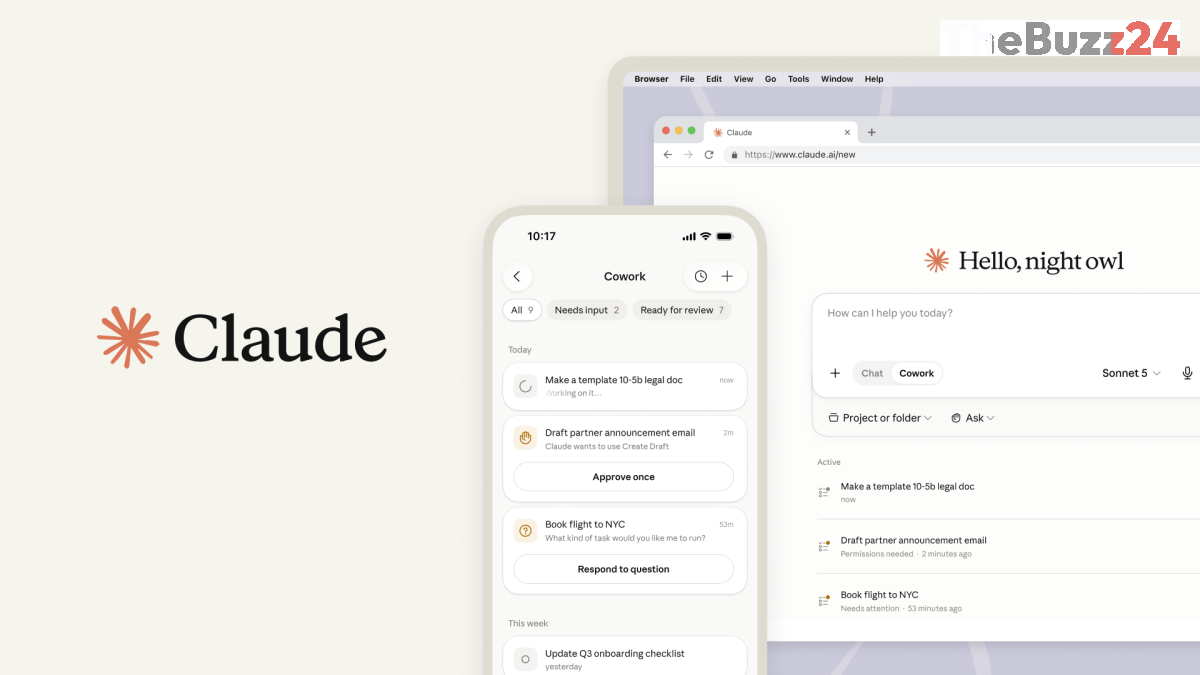
Anthropic Expands Claude Cowork to Web and Mobile, Shifting AI Focus to Everyday Office Tasks
Anthropic has officially expanded its Claude Cowork platform to web and mobile interfaces, making the tool accessible to Max tier subscribers. Originally launched as a desktop-only application in January, this update allows users to seamlessly transition tasks across multiple devices. For instance, a user can initiate a complex administrative task on their office desktop, monitor its progress via a mobile device, and retrieve the completed output later, even if their primary computer has been shut down.
This multi-platform expansion signals a strategic shift for Anthropic, positioning Claude Cowork as an autonomous administrative assistant rather than a specialized tool for developers. By enabling background processing that runs independently of an active device connection, the system can manage multi-step workflows—such as synthesizing email threads and drafting morning briefings—without constant user supervision. This move intensifies the competition among major artificial intelligence laboratories, including OpenAI, as they vie to integrate AI agents directly into daily workplace environments rather than relying solely on traditional chat interfaces.
Alongside the rollout, Anthropic released usage data analyzed from over 1.2 million sessions across 600,000 organizations. The findings highlight a growing demand for AI in routine administrative duties, often described as the “work around the work.” Business process operations, such as compiling reports and organizing spreadsheets, emerged as the largest use case at 33.4%. Content creation and copywriting followed at 16.4%, while software development accounted for just 8.7% of total usage. This data underscores a broader trend of non-technical professionals adopting AI agents to streamline daily administrative burdens.
Key Takeaways
- Anthropic has launched Claude Cowork on web and mobile for Max subscribers, enabling cross-device task continuity and background processing.
- Usage data reveals that administrative tasks (33.4%) and content creation (16.4%) far outpace software development (8.7%) in Claude Cowork utilization.
- The expansion intensifies the competition in the AI sector to transition from simple chatbots to integrated, autonomous workplace agents.
Editor’s Analysis & Impact
The expansion of Claude Cowork to web and mobile platforms marks a pivotal moment in the evolution of enterprise AI. By shifting the focus from conversational chatbots to background-running “agentic” workflows, Anthropic is directly targeting the friction points of daily office administration. The usage data released by the company confirms a crucial market reality: the true volume of AI adoption lies not in specialized coding, but in the mundane, time-consuming administrative tasks that keep businesses running. As Anthropic and rivals like OpenAI race to dominate the digital workspace, the competitive moat will no longer be defined solely by raw model intelligence, but by how seamlessly these agents integrate into existing multi-device workflows. This transition will likely accelerate the normalization of AI teammates in corporate environments, redefining productivity standards across HR, finance, and marketing sectors.
Frequently Asked Questions
Q: Who can access the new web and mobile versions of Claude Cowork?
A: The web and mobile versions of Claude Cowork are currently available to Anthropic's Max subscription tier users.
Q: How does the background processing feature in Claude Cowork work?
A: Because Claude Cowork now operates as a multi-platform cloud agent, it can continue executing tasks, compiling data, and drafting documents in the background even if the user's computer or mobile device is completely offline.
Q: What are the most common tasks performed using Claude Cowork?
A: According to recent usage data, the most common tasks are business process operations (such as spreadsheet reconciliation and report building) at 33.4%, followed by content creation at 16.4%, and software development at 8.7%.
AI Disclosure: This article is based on verified data and official reports. Our Team and AI have cross-referenced every financial detail with primary sources to ensure total accuracy.
More from this Category