Striking New Monkey Species with Orange Lips Discovered in DR Congo’s Dense Forests
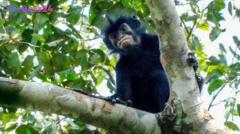
Scientists have officially identified a previously unknown species of monkey, distinguished by its vibrant pinkish-orange lips and dark facial features, inhabiting the dense tropical forests of the Democratic Republic of Congo. The primate, characterized by its black fur, was first observed and photographed in the upper canopy of Lomami National Park, a remote region in the central-east of the country.
Conservationists initially noted the presence of this distinctive animal in 2008, capturing only a single, indistinct photograph. A decade later, a subsequent sighting prompted an international team of researchers to embark on a dedicated mission to study and confirm the monkey’s unique status. This discovery marks a significant event, as it is only the fifth new African monkey species to be scientifically described in the past 75 years.
Leading the extensive research effort was Junior Amboko, a PhD student at Florida Atlantic University, who utilized a combination of audio recordings, photography, and detailed genetic analysis. The findings, published in the journal PLoS One, highlight the profound experience of uncovering an animal known to so few. Local communities have long been aware of the monkey, referring to it as ‘Likweli,’ but its elusive nature, preferring to stay high in the trees, meant sightings were rare, even among nearby villagers.
The newly classified species has been given the scientific name *Colobus congoensis*, honoring the rich biodiversity of the Democratic Republic of Congo. This primate belongs to the colobus monkey family, known for their lack of thumbs and their crucial role as herbivores in the forest ecosystem, aiding in seed dispersal and germination. Researchers speculate that the monkey’s striking facial coloration may serve as a visual communication tool, potentially for attracting mates or for species recognition. Its distinctive roaring vocalization, often heard but rarely seen, further adds to its enigmatic profile. Conservationists are hopeful that the official classification will pave the way for enhanced protection measures, particularly as the species is known to be hunted for meat.
Key Takeaways
- A new monkey species, *Colobus congoensis* (Likweli), has been discovered in the Democratic Republic of Congo.
- The species is characterized by its orange lips, black fur, and a distinctive roaring call, and was previously known only to some local communities.
- This discovery is significant as it's the fifth new African monkey species identified in the last 75 years, and researchers hope it will lead to better conservation efforts.
Editor’s Analysis & Impact
The discovery of *Colobus congoensis* underscores the vast, unexplored biodiversity that still exists in remote regions like the DR Congo. In an era where habitat loss and climate change pose significant threats, such findings are critical for conservation efforts. The classification of the Likweli monkey as a distinct species provides a stronger basis for advocating for its protection against threats like hunting. This event highlights the ongoing importance of field research and genetic studies in understanding and preserving our planet’s natural heritage. The future outlook for this species hinges on effective conservation strategies and continued research into its population dynamics and ecological role.
Frequently Asked Questions
Q: What are the key distinguishing features of the new monkey species?
A: The newly discovered monkey species, *Colobus congoensis* or Likweli, is primarily identified by its striking pinkish-orange lips, black fur, and a distinctive roaring vocalization. It also belongs to the colobus monkey group, which notably lacks thumbs.
Q: Why is this discovery considered significant?
A: This discovery is significant because it is only the fifth new African monkey species to be scientifically identified in the last 75 years. It highlights the potential for undiscovered biodiversity and emphasizes the need for conservation in regions like the Democratic Republic of Congo.
Q: What are the conservation concerns for this new species?
A: The Likweli monkey is vulnerable to hunting for meat, and its restricted habitat is crucial for its survival. Researchers hope that its official classification as a distinct species will lead to enhanced protection measures and further studies to estimate its population and ensure its long-term survival.
AI Disclosure: This article is based on verified data and official reports. Our Team and AI have cross-referenced every financial detail with primary sources to ensure total accuracy.
More from this Category