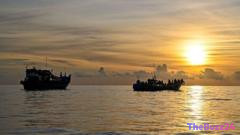
Tragic Silence: Over 500 Rohingya Asylum Seekers Feared Dead After Boats Vanish in Rough Seas
A devastating maritime tragedy is feared in the Bay of Bengal after two vessels carrying an estimated 530 Rohingya asylum seekers vanished without a trace. The boats departed from the conflict-torn Rakhine State in Myanmar on June 29, just as the treacherous monsoon season began. Given the severe weather, rough seas, and the notoriously unseaworthy nature of the converted fishing trawlers used by human smugglers, experts believe both vessels capsized, leaving little to no hope of survivors.
Piecing together the timeline of the tragedy has been exceptionally difficult due to ongoing warfare and telecommunication blackouts in Rakhine State. However, monitoring groups like the Arakan Project, led by Chris Lewa, have confirmed that the two vessels departed from the Arakan Army-controlled village of Sin Tet Maw. The planned route involved sailing to Myanmar’s southern coast, followed by overland transit through Thailand to Malaysia. The fears of a total loss were compounded when Bangladeshi authorities recovered the body of a woman washed ashore, and local fishermen later discovered several other bodies floating in the sea.
The desperate journey highlights the escalating humanitarian crisis in Southeast Asia. Approximately 600,000 Rohingya remain in Rakhine, facing forced conscription by the ruling military junta and hostility from the rebel Arakan Army. Meanwhile, over a million refugees languish in squalid, crime-ridden camps in Bangladesh where international aid is rapidly drying up. This desperation has fueled a highly lucrative and brutal human smuggling industry. Traffickers charge upwards of $3,000 per person, often holding refugees hostage in transit camps or subjecting them to violence until their families pay the ransom.
Despite the immense risks, the flow of refugees shows no signs of slowing down. An estimated 10,000 Rohingya have attempted the perilous sea crossing since September of last year. While the United Nations has repeatedly urged regional governments to establish safe passage and rescue protocols, neighboring countries like Malaysia, Thailand, and Indonesia have tightened border security and resisted taking in more refugees. Without coordinated regional intervention, desperate families will continue to risk their lives on the open ocean.
Key Takeaways
- Two overcrowded boats carrying approximately 530 Rohingya refugees are feared to have capsized in rough monsoon seas after departing Myanmar on June 29.
- Escalating violence, forced military conscription in Myanmar, and deteriorating conditions in Bangladeshi refugee camps are driving a surge in desperate sea crossings.
- Human smuggling networks continue to exploit the crisis, charging up to $3,000 per person for dangerous transit routes through Thailand to Malaysia.
Editor’s Analysis & Impact
This latest tragedy underscores the catastrophic failure of regional migration policies in Southeast Asia. As the civil war in Myanmar intensifies, the Rohingya find themselves trapped between a hostile military junta and aggressive rebel factions, leaving them with virtually no choice but to flee. The refusal of neighboring nations—such as Malaysia, Thailand, and Indonesia—to establish coordinated search-and-rescue operations or formal asylum pathways has directly enabled the expansion of ruthless transnational smuggling syndicates. By treating this strictly as a border security issue rather than a humanitarian emergency, regional governments are inadvertently driving refugees into more dangerous, clandestine routes. Without a unified diplomatic framework led by ASEAN to address the root causes in Rakhine State and establish safe migration corridors, the Bay of Bengal will continue to serve as a graveyard for thousands of displaced people.
Frequently Asked Questions
Q: Why are Rohingya refugees fleeing Myanmar and Bangladesh in such high numbers?
A: In Myanmar, the Rohingya face active warfare, forced conscription by the military junta, and human rights abuses. In Bangladesh, over a million refugees live in overcrowded camps characterized by dwindling international aid, a lack of employment opportunities, and rising violence from organized crime syndicates.
Q: What route do human smugglers typically use to transport refugees?
A: Smugglers often use converted fishing boats to transport refugees from Rakhine State or Bangladesh to the southern coast of Myanmar or Thailand. From there, refugees are moved overland through hidden transit camps in Thailand toward their final destination in Malaysia.
Q: How have neighboring countries responded to the crisis?
A: Most neighboring countries have adopted strict deterrence policies. Navies frequently intercept refugee boats and push them back into international waters, while land borders have been tightened to prevent transit, leaving refugees with few safe options.
AI Disclosure: This article is based on verified data and official reports. Our Team and AI have cross-referenced every financial detail with primary sources to ensure total accuracy.
More from this Category