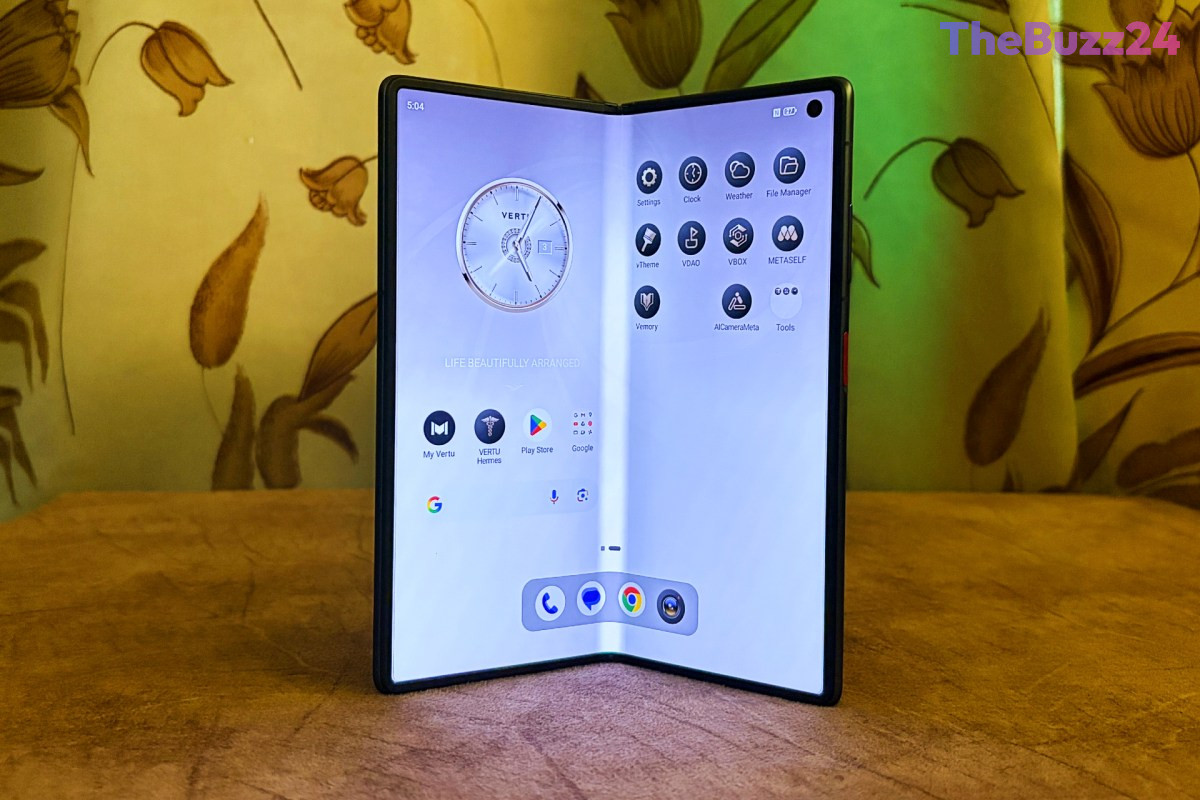
Luxury or Liability? Testing the $6,880 Vertu Alphafold AI Smartphone
The luxury smartphone market has long prioritized status over technical specifications, but a new entrant is attempting to bridge that gap by integrating advanced artificial intelligence. The Vertu Alphafold, priced at a staggering $6,880, targets high-level executives with a promise of a bespoke, AI-driven digital assistant. Wrapped in calfskin leather and titanium, the device is clearly designed to serve as both a functional tool and a high-end status symbol, distinguishing itself from the glass-and-metal aesthetic of mainstream foldable phones.
At the core of the Alphafold experience is the ‘Hermes Agent,’ an AI system designed to handle complex workflows, such as analyzing contracts, managing travel itineraries, and automating routine administrative tasks. Unlike standard smartphone assistants that primarily respond to simple voice prompts, the Hermes Agent is built to execute multi-step processes. However, the hardware itself reveals a more pragmatic reality; the device shares significant design DNA with existing mid-range foldable hardware, suggesting that the premium price is largely tied to the software ecosystem, luxury materials, and the inclusion of a human concierge service.
In practical testing, the Alphafold presents a mixed performance profile. While the Hermes Agent demonstrates an impressive ability to act autonomously—often outperforming competitors like Google’s Gemini in executing multi-step tasks—it frequently struggles with accuracy and consistency. During trials, the agent occasionally failed to schedule reminders correctly or lost context during document analysis. These inconsistencies highlight the current limitations of AI agents in high-stakes professional environments where precision is paramount.
Security remains a primary selling point for the device, with Vertu emphasizing hardware-level encryption and a dedicated security chip to protect sensitive corporate data. Despite these features, the Alphafold faces stiff competition from established flagship foldables that offer more mature software, superior hardware features like wireless charging, and more reliable AI integration at a fraction of the cost. For the average executive, the Alphafold serves as an ambitious experiment in luxury AI, but one that currently struggles to justify its extreme price point against more refined, mass-market alternatives.
Key Takeaways
- The Vertu Alphafold is a luxury foldable smartphone priced at $6,880, focusing on an AI-driven 'Hermes Agent' to assist executives with complex workflows.
- While the AI agent is designed for high autonomy, testing revealed significant inconsistencies in accuracy and task management compared to mainstream AI assistants.
- The device relies on high-end materials and a concierge service to justify its price, as the underlying hardware is based on existing, less expensive foldable platforms.
Editor’s Analysis & Impact
The Vertu Alphafold represents a niche attempt to commoditize ‘executive efficiency’ through AI. By bundling hardware with a proprietary agent and human concierge services, the company is attempting to move beyond the traditional smartphone model into a ‘service-as-a-device’ category. However, the market impact is likely to be limited. The reliance on existing supply chains for hardware while charging a massive premium creates a difficult value proposition, especially as mainstream manufacturers like Samsung continue to integrate sophisticated AI capabilities into their flagship devices. The future of such devices hinges on whether the ‘concierge’ element can provide tangible ROI for executives that software alone cannot. Without significant improvements in AI reliability and hardware differentiation, this device remains a luxury novelty rather than a disruptive business tool.
Frequently Asked Questions
Q: Does the Vertu Alphafold offer better hardware than standard flagship foldables?
A: No. While the Alphafold features premium materials like calfskin and titanium, its core hardware and hinge design are based on existing, more affordable foldable platforms.
Q: Is the Hermes Agent reliable for handling sensitive business contracts?
A: While the agent is designed for such tasks, testing showed that it can be inconsistent. Users should treat AI-generated summaries as starting points and independently verify all financial or legal information.
AI Disclosure: This article is based on verified data and official reports. Our Team and AI have cross-referenced every financial detail with primary sources to ensure total accuracy.
More from this Category