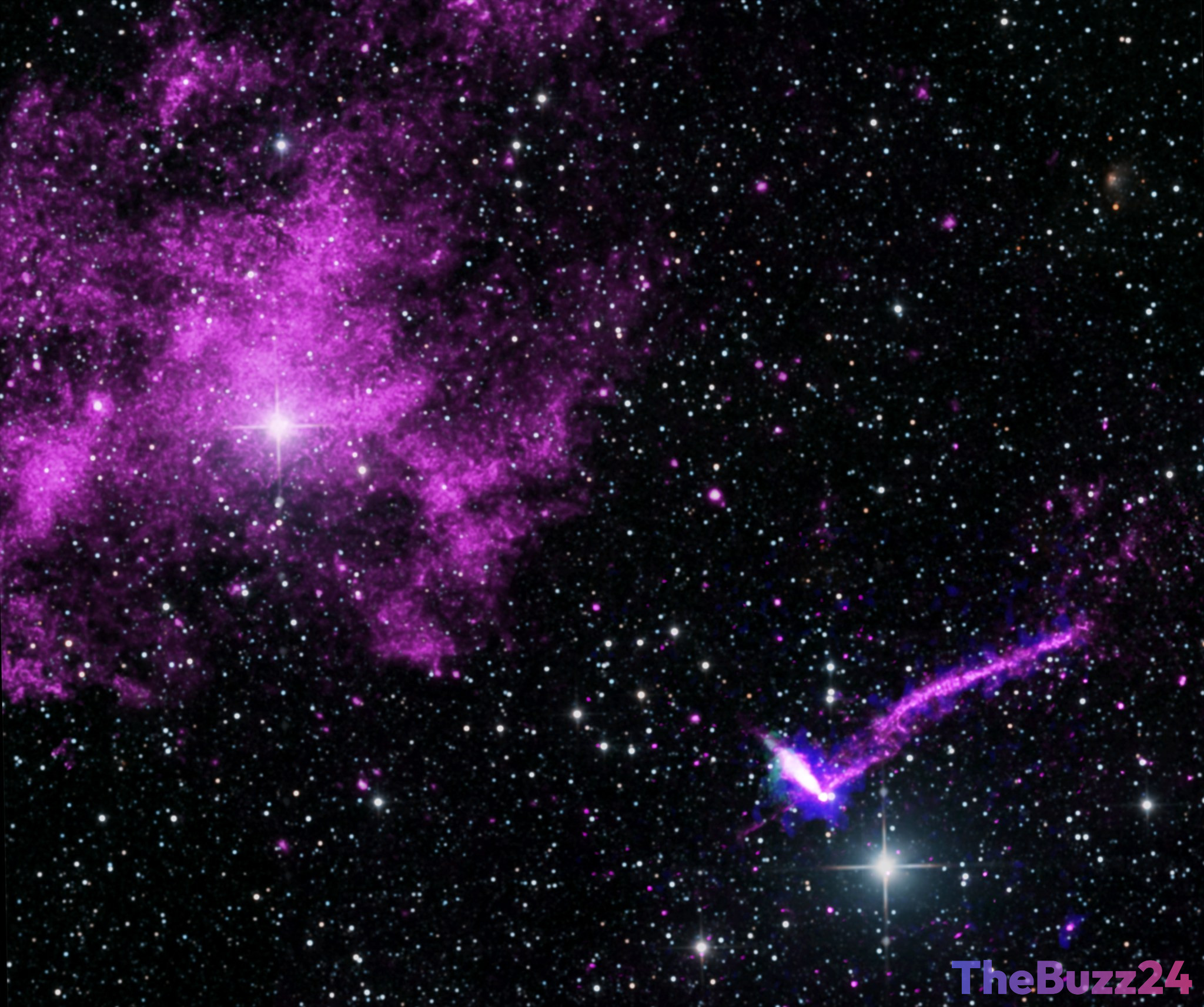
Unveiling Cosmic Secrets: NASA’s IXPE Maps Magnetic Fields of Pulsar in Lighthouse Nebula
Scientists have achieved a significant breakthrough in astrophysics, directly measuring the magnetic fields of PSR J1101−6101, a rapidly spinning neutron star located within the captivating “Lighthouse” Nebula. This unprecedented measurement, conducted using NASA’s Imaging X-ray Polarimetry Explorer (IXPE), marks a crucial step in understanding some of the universe’s most extreme and enigmatic objects. The findings offer fresh perspectives on the intricate structure and powerful forces at play within these cosmic powerhouses.
The groundbreaking study leveraged a sophisticated multi-wavelength approach, combining data from several advanced observatories. NASA’s IXPE provided critical X-ray polarization data, while the Chandra X-ray Observatory contributed additional X-ray insights. Further enhancing the composite view, radio emissions were captured by the Australia Compact Telescope Array, and optical data was integrated from 2MASS. This comprehensive observational strategy allowed researchers to construct a detailed picture of the pulsar and its surrounding environment, revealing the previously elusive magnetic field architecture.
Pulsars are the incredibly dense, rapidly rotating remnants of massive stars that have collapsed. They possess extraordinarily strong magnetic fields, which play a fundamental role in how these objects emit radiation and interact with their surroundings. By directly mapping these magnetic fields for the first time, scientists gain invaluable data to refine theoretical models of neutron stars, their evolution, and the high-energy phenomena they generate. The results of this pioneering research were recently published in the Astrophysical Journal, pushing the boundaries of our cosmic understanding.
Key Takeaways
- NASA's IXPE has achieved the first direct measurement of the magnetic fields of pulsar PSR J1101−6101 in the Lighthouse Nebula.
- The study utilized a multi-wavelength approach, combining X-ray, radio, and optical data from multiple observatories.
- This breakthrough provides crucial new insights into the structure and behavior of extreme cosmic objects like pulsars.
Editor’s Analysis & Impact
This discovery represents a significant leap forward in high-energy astrophysics and our understanding of fundamental physics under extreme conditions. The successful application of IXPE to directly map pulsar magnetic fields validates the capabilities of advanced X-ray polarimetry, paving the way for future missions and observations of other exotic celestial bodies. This research will undoubtedly stimulate new theoretical models and simulations, refining our comprehension of neutron star interiors, magnetospheres, and their role in galactic evolution. For the space science community, it underscores the value of international collaboration and multi-instrument approaches, promising a richer harvest of cosmic secrets in the years to come.
Frequently Asked Questions
Q: What is a pulsar?
A: A pulsar is a highly magnetized, rapidly rotating neutron star, which is the collapsed core of a massive star that has undergone a supernova explosion. They emit beams of electromagnetic radiation that can be detected as pulses when the beam sweeps past Earth.
Q: Why is measuring a pulsar's magnetic field significant?
A: Measuring a pulsar's magnetic field directly is crucial because these fields are incredibly strong and play a fundamental role in how pulsars generate their powerful radiation, interact with their environment, and evolve. Understanding these fields helps scientists unravel the extreme physics governing these dense objects and the universe at large.
Q: What is NASA's IXPE?
A: IXPE stands for Imaging X-ray Polarimetry Explorer. It is a space observatory designed to measure the polarization of X-rays from cosmic sources. By studying X-ray polarization, IXPE provides unique information about the magnetic fields, particle acceleration, and geometry of extreme objects like pulsars, black holes, and supernova remnants.
AI Disclosure: This article is based on verified data and official reports. Our Team and AI have cross-referenced every financial detail with primary sources to ensure total accuracy.
More from this Category