Revolutionizing Near-Space Monitoring with Photophoretic Levitating Tracers
A groundbreaking approach to atmospheric sensing is emerging, targeting the difficult-to-reach altitudes between 30 and 100 kilometers. Researchers are developing photophoretically levitating tracers—lightweight, engineered structures that utilize sunlight to remain suspended for months at a time. By acting as persistent, inert backscattering points, these tracers provide a novel way to measure wind, temperature, and pressure in the mesosphere and upper stratosphere, a region that has historically been a ‘blind spot’ for current satellite and balloon technologies.
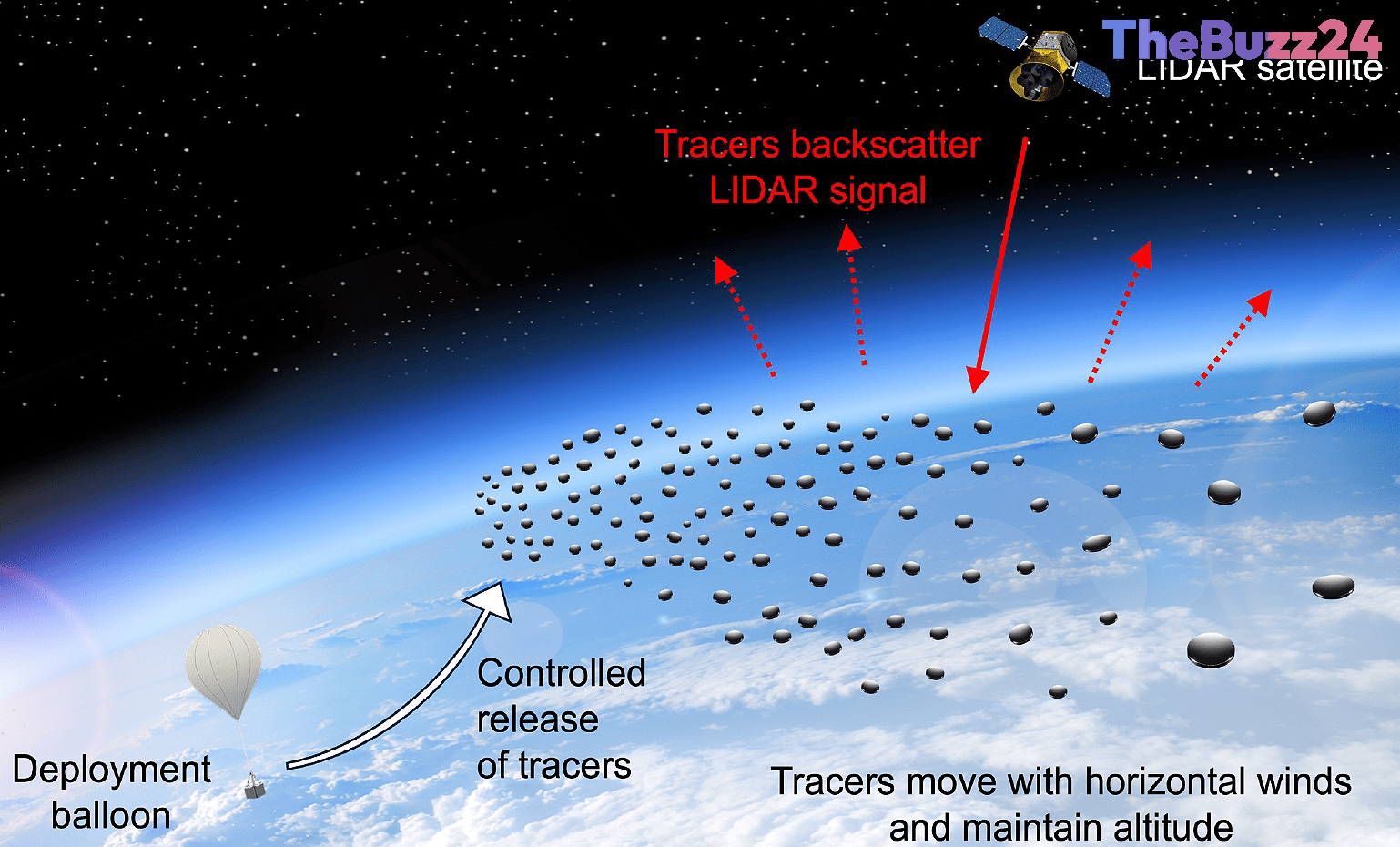
The mesosphere and upper stratosphere are critical for understanding atmospheric dynamics and space weather, yet they remain notoriously difficult to monitor. Traditional satellites orbit too high, while weather balloons cannot sustain flight at such extreme altitudes. The proposed photophoretic tracers solve this by requiring no onboard power, propulsion, or active control. Once deployed via high-altitude balloons or rockets, the tracers use their specific geometry and specialized coatings to autonomously reach and maintain their target altitudes, where they can be tracked by satellite-based lidar or radar.
In a typical mission scenario, thousands of these tracers would be released to form a stratified sensor layer. As they drift, their trajectories allow for the continuous mapping of wind shear and thermal gradients with sub-kilometer resolution. This real-time data is expected to significantly improve the accuracy of ionospheric space weather models, enhancing situational awareness and communications resilience for assets in low-Earth orbit. Furthermore, the tracers are designed to be environmentally safe, disintegrating at the end of their operational life.
This technology represents a shift in atmospheric remote sensing by engineering the medium itself to facilitate detection. With laboratory validation already confirming the feasibility of photophoretic levitation in near-space conditions, the project aims to provide a scalable, low-cost solution for meteorology, national security, and planetary exploration. By filling the data gap in the near-space environment, these tracers could fundamentally change how we monitor the transition zone between Earth’s atmosphere and the vacuum of space.
Key Takeaways
- Photophoretic tracers use sunlight to levitate in the 30-100 km altitude range, providing a persistent sensing layer without the need for onboard power or propulsion.
- The technology addresses a critical data gap in the mesosphere and upper stratosphere, enabling high-resolution mapping of wind, pressure, and temperature.
- Data collected by these tracers will improve space weather models and atmospheric forecasting, enhancing the safety and reliability of satellite communications.
Editor’s Analysis & Impact
The development of photophoretic tracers marks a significant evolution in atmospheric science and space-domain awareness. By creating a ‘passive’ sensor network, this technology drastically reduces the cost and complexity associated with high-altitude monitoring. The industry impact is twofold: it provides a vital tool for refining space weather models—which are increasingly important as commercial and government activity in low-Earth orbit intensifies—and it offers a scalable alternative to expensive, short-lived high-altitude platforms. If successfully deployed, this technology could become a standard component of global meteorological infrastructure, particularly for monitoring spaceports and sensitive atmospheric regions. The ability to ‘engineer the medium’ for remote sensing suggests a broader trend toward smarter, more autonomous, and environmentally conscious aerospace instrumentation.
Frequently Asked Questions
Q: How do the tracers stay in the air without propulsion?
A: The tracers utilize photophoresis, a phenomenon where light-induced forces act on particles, allowing them to levitate and remain suspended in the atmosphere using only energy from the sun.
Q: Are these tracers harmful to the environment?
A: No, the tracers are designed to be non-toxic and inert, and they are engineered to safely disintegrate at the end of their operational life.
AI Disclosure: This article is based on verified data and official reports. Our Team and AI have cross-referenced every financial detail with primary sources to ensure total accuracy.
More from this Category