NASA’s Juno Probe Unveils Hidden Thermal Secrets Beneath Io’s Crust
The Juno spacecraft has provided a groundbreaking look beneath the surface of Jupiter’s volcanic moon, Io, utilizing its Microwave Radiometer (MWR) to map internal heat signatures. While traditional infrared imaging is limited to surface temperatures, the MWR’s low-frequency channels allow scientists to peer between 6 and 20 feet into the moon’s crust, revealing a complex thermal landscape that was previously hidden from view.
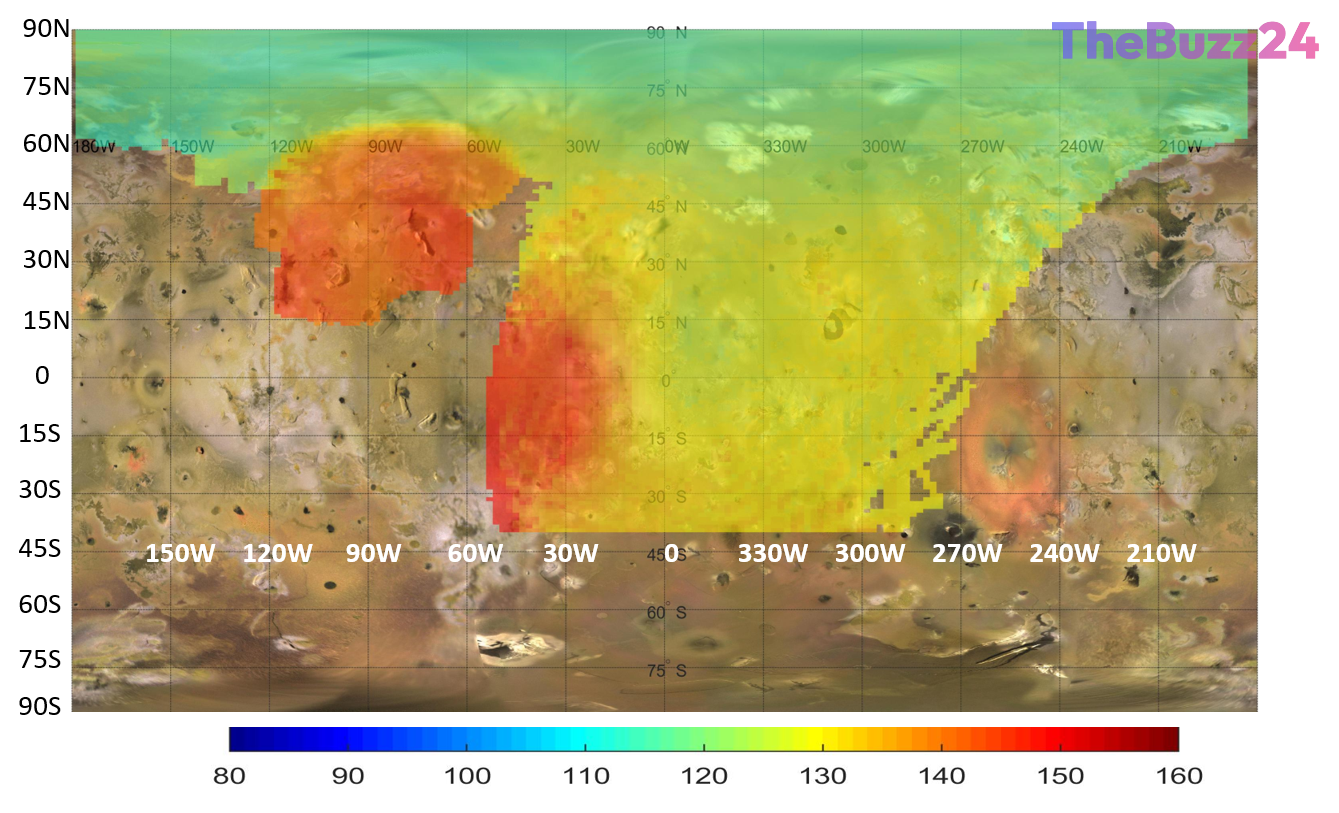
Data collected by the probe highlights significant temperature gradients, with localized anomalies indicating intense subsurface heat. A major thermal hotspot identified between 60 and 120 degrees west longitude shows temperatures 18 to 36 degrees Fahrenheit warmer than the surrounding crust. This region aligns with the Zal Montes Patera complex, where active lava flows have been documented, suggesting a direct link between surface volcanic activity and deep-seated internal heating processes.
Beyond these extreme hotspots, the mapping reveals a broader thermal distribution across the moon. Equatorial regions exhibit intermediate temperatures, warming to approximately -190 degrees Fahrenheit, while the northern polar regions remain significantly colder, with subsurface temperatures dropping to -298 degrees Fahrenheit. These findings provide critical insights into the internal dynamics of Io, confirming that significant thermal energy is being generated and stored within the upper layers of the moon’s crust.
Key Takeaways
- Juno's Microwave Radiometer can detect thermal signatures up to 20 feet beneath Io's surface.
- A major subsurface heat anomaly was discovered near the Zal Montes Patera complex, correlating with known volcanic activity.
- The data reveals a stark temperature contrast between the moon's equatorial regions and its frigid northern poles.
Editor’s Analysis & Impact
The ability of the Juno mission to map subsurface thermal activity on Io represents a significant leap in planetary science. By moving beyond surface-level infrared observations, researchers can now better model the internal geological processes of one of the most volcanically active bodies in our solar system. This data is essential for understanding the tidal heating mechanisms driven by Jupiter’s immense gravity, which keeps Io’s interior molten. In the broader context of space exploration, these techniques for ‘seeing’ beneath planetary crusts are vital for future missions to icy moons like Europa or Enceladus, where subsurface oceans are primary targets in the search for extraterrestrial life. The findings underscore the value of multi-spectral instrumentation in characterizing the volatile environments of the outer solar system.
Frequently Asked Questions
Q: How does Juno measure heat beneath the surface of Io?
A: Juno uses its Microwave Radiometer (MWR), which utilizes low-frequency microwave channels capable of penetrating several meters into the moon's crust to detect thermal emissions.
Q: Why is the Zal Montes Patera complex significant?
A: It is a region on Io where active lava flows have been observed, and it coincides with a major subsurface heat anomaly detected by Juno, suggesting a connection between surface volcanism and internal heat.
AI Disclosure: This article is based on verified data and official reports. Our Team and AI have cross-referenced every financial detail with primary sources to ensure total accuracy.
More from this Category