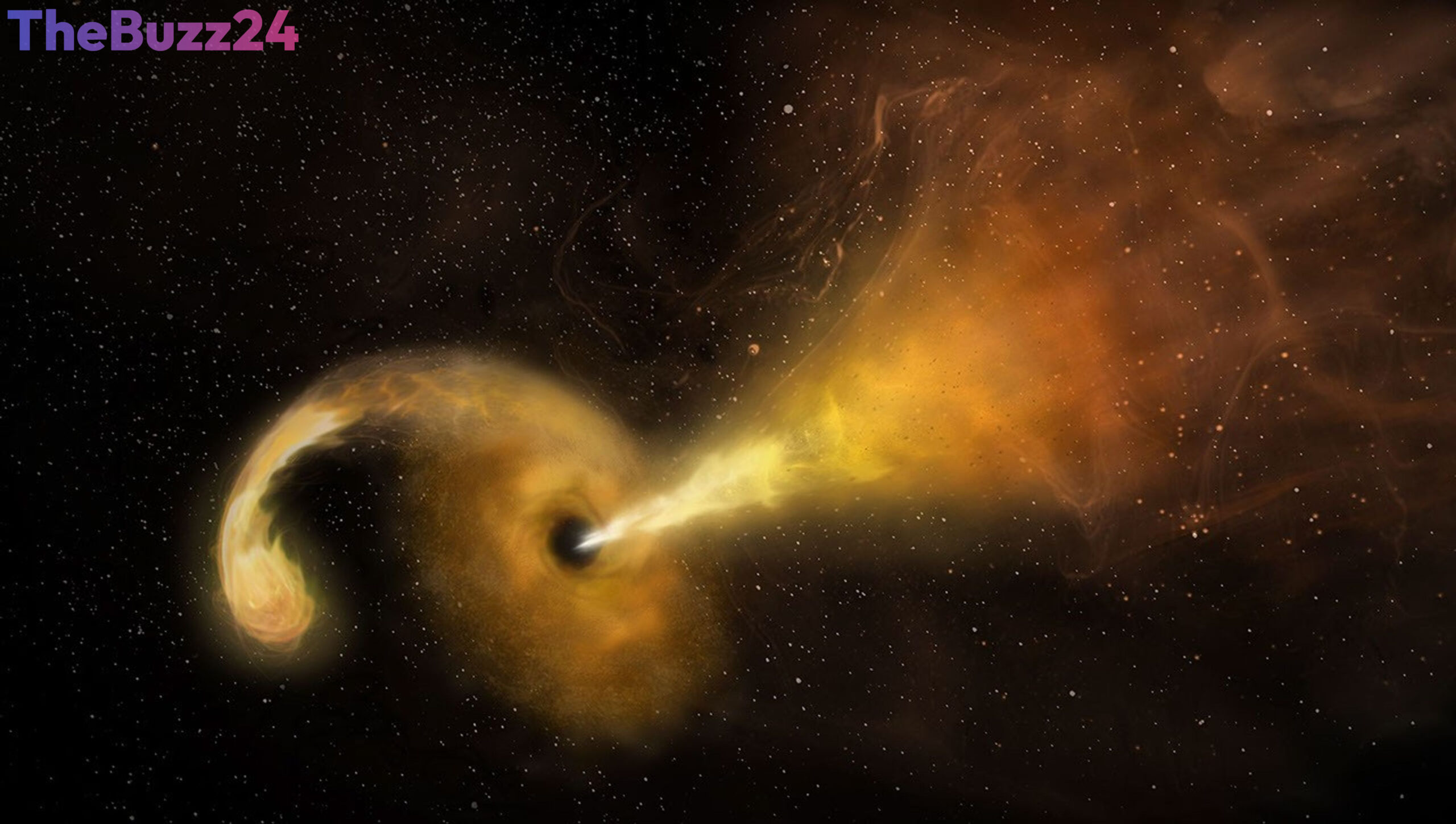
Rogue Black Hole Caught Devouring Star Far From Galactic Center
Astronomers have detected a colossal black hole, estimated to be a million times the mass of our Sun, in the act of consuming a star far from the typical galactic core. This rare cosmic event, known as a tidal disruption event, was observed by NASA’s Neil Gehrels Swift Observatory, providing crucial insights into the behavior of these enigmatic celestial objects.
The phenomenon occurred on the outskirts of a galaxy approximately 750 million light-years away. While tidal disruption events are not unheard of, this particular instance is significant because the black hole was found in an unusual location, far removed from the dense galactic center where supermassive black holes usually reside. Researchers utilized an artificial intelligence algorithm to identify the event from a vast dataset, flagging a flare that strongly resembled a tidal disruption event despite its atypical position.
This discovery validates a new method for detecting otherwise invisible supermassive black holes that have strayed from their usual galactic homes. The star, upon venturing too close to the black hole, was violently torn apart by extreme gravitational forces. The resulting debris heated up, creating an exceptionally bright flare that outshone its entire host galaxy in ultraviolet wavelengths for several months, radiating with the intensity of roughly 10 billion suns.
Further observations by various telescopes, including the SOAR telescope and Swift’s Ultraviolet/Optical Telescope, helped confirm the nature of the event and estimate the temperature of the stellar debris. The data allowed scientists to rule out alternative explanations and confidently identify the cosmic spectacle as a tidal disruption event. The existence of such ‘wandering’ black holes raises new questions about their origins, with theories suggesting they may have been ejected from galactic centers during galaxy mergers or originated in smaller, now-absorbed galaxies.
Key Takeaways
- A rogue black hole, a million times the Sun's mass, was observed consuming a star far from its galaxy's center.
- The event, a tidal disruption event, was detected using an AI algorithm and confirmed by NASA's Swift Observatory.
- This discovery validates a new technique for finding 'wandering' black holes and raises questions about their formation and prevalence.
Editor’s Analysis & Impact
This observation marks a significant advancement in our understanding of black hole dynamics and galactic evolution. The detection of a supermassive black hole far from a galactic core challenges traditional models and suggests that these massive objects may be more mobile than previously thought. The successful application of AI in identifying such rare events highlights the growing role of machine learning in astronomical research. Future observations with next-generation telescopes like the Vera C. Rubin Observatory and the Nancy Grace Roman Space Telescope are expected to uncover more such ‘orphan’ black holes, potentially revolutionizing our census of these cosmic behemoths and shedding light on the complex processes of galaxy mergers and black hole ejection.
Frequently Asked Questions
Q: What is a tidal disruption event?
A: A tidal disruption event occurs when a star passes too close to a massive object, like a black hole, and is torn apart by its intense gravitational forces. The stellar material is stretched and shredded, creating a bright flare of radiation as it spirals towards the black hole.
Q: Why is finding a black hole outside a galactic core significant?
A: Supermassive black holes are typically found at the centers of galaxies. Discovering one far from the core suggests that these black holes can be ejected or migrate, potentially due to galaxy mergers or other gravitational interactions, offering new insights into galactic evolution.
Q: How was this 'wandering' black hole detected?
A: An artificial intelligence algorithm identified an unusual bright flare in astronomical data. Subsequent observations by NASA's Swift Observatory and other telescopes confirmed the flare was caused by a star being torn apart by a black hole located unusually far from its galaxy's center.
AI Disclosure: This article is based on verified data and official reports. Our Team and AI have cross-referenced every financial detail with primary sources to ensure total accuracy.
More from this Category