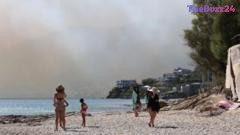
Crete Evacuations Surge as Violent Wildfires Sweep Across Southern Europe
A massive wildfire outbreak in Crete has forced the emergency evacuation of approximately 8,000 residents and tourists as violent winds push flames through the Rethymno region. The blaze, which spans a front of over 15 kilometers, has already caused significant damage to homes and agricultural land. Emergency crews are struggling to contain the inferno, as gusts reaching 125 kilometers per hour have grounded firefighting aircraft, leaving ground teams to battle the flames under extreme conditions.
The human toll of the disaster has been severe, with the Greek Fire Service confirming the deaths of three firefighters this week. Two individuals, identified as 58-year-old Emmanouil Stratidakis and 25-year-old Pantelis Diamantakis, lost their lives while operating near Krya Vrysi, while a third firefighter perished near the Peloponnese port of Gytheio. Local authorities have established temporary shelters to accommodate those displaced by the encroaching fire, prioritizing the safety of both the local population and the thousands of visitors currently on the island during the peak tourism season.
Beyond Crete, the broader European landscape remains under siege from extreme heat and fire. Spain is currently grappling with its largest recorded wildfire in the Ávila province, which has consumed over 43,000 hectares, while hundreds have been evacuated near the Spanish-Portuguese border. Although some regions in France have seen a reprieve due to cooling weather, the continent remains on high alert. Experts note that Europe is warming at twice the global average, a trend that is fueling more frequent and intense heatwaves, placing unprecedented strain on water supplies and emergency response infrastructure across the region.
Key Takeaways
- Approximately 8,000 people have been evacuated in Crete due to out-of-control wildfires fanned by violent winds.
- Three firefighters have died in Greece this week while attempting to combat the rapidly spreading blazes.
- Europe is experiencing record-breaking wildfire activity, with Spain and Greece facing some of the most significant destruction in recent history.
Editor’s Analysis & Impact
The current wildfire crisis across Southern Europe serves as a stark indicator of the escalating risks posed by climate change to regional stability and the tourism-dependent economies of the Mediterranean. As Europe warms faster than the global average, the frequency of these ‘violent’ fire events is likely to increase, necessitating a fundamental shift in emergency management strategies and infrastructure investment. The economic impact is twofold: the immediate destruction of property and agricultural assets, and the long-term threat to the tourism sector, which is vital for countries like Greece. Future outlooks suggest that governments will need to prioritize cross-border firefighting cooperation and advanced early-warning systems to mitigate the human and financial costs of these increasingly severe summer heatwaves.
Frequently Asked Questions
Q: Why are firefighting aircraft unable to assist in the Crete operations?
A: The firefighting aircraft have been grounded due to extremely high wind speeds, which reached up to 11 on the Beaufort scale, making aerial operations too dangerous for pilots.
Q: Is the wildfire situation in Europe limited only to Greece?
A: No, the crisis is widespread. Significant wildfires have also been reported in Spain, Portugal, and Turkey, with France also experiencing major fire events earlier in the week.
AI Disclosure: This article is based on verified data and official reports. Our Team and AI have cross-referenced every financial detail with primary sources to ensure total accuracy.
More from this Category