Wildfire Smoke Transforms Sun into Eerie Red Orb Over British Columbia
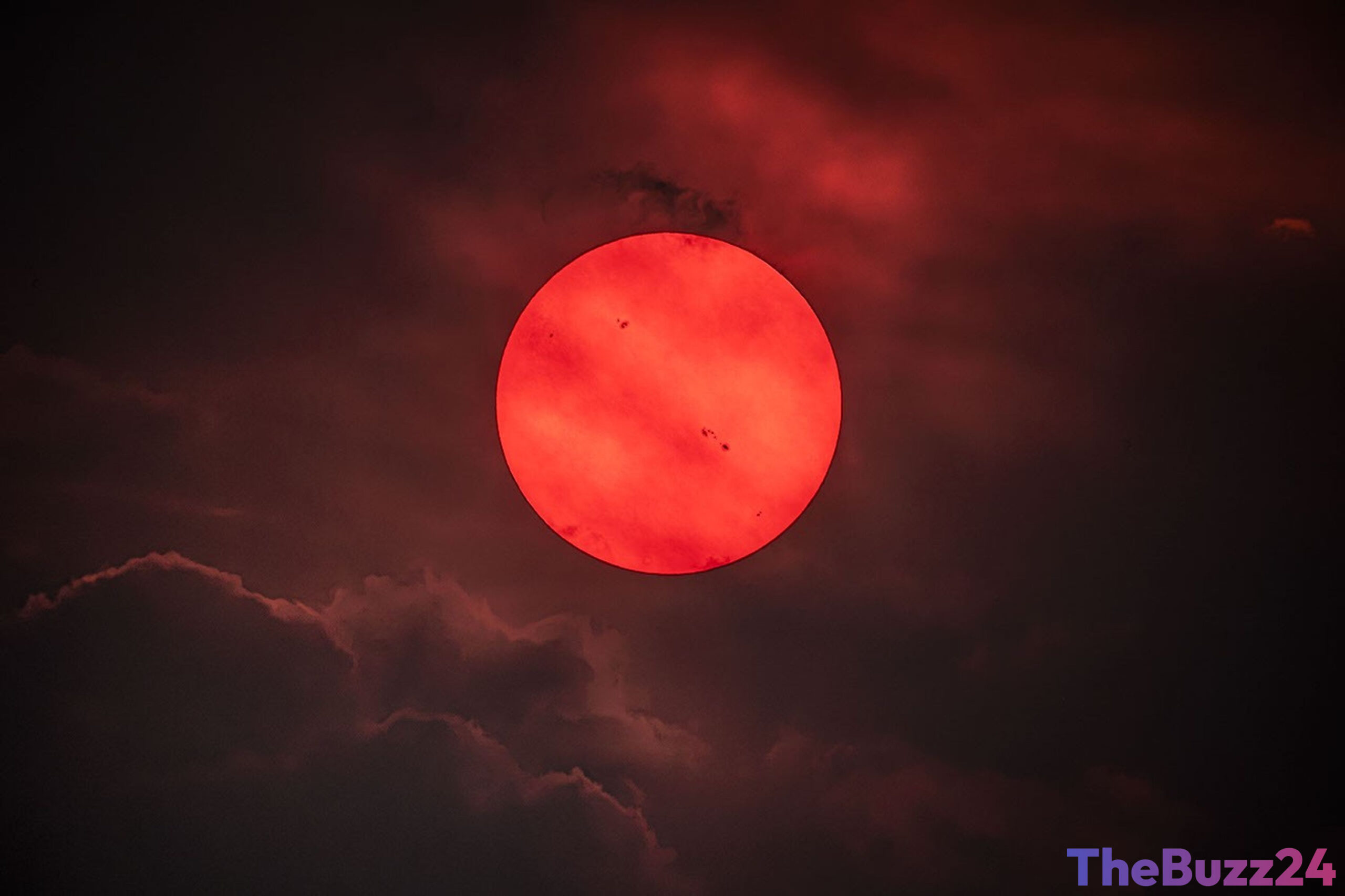
A striking celestial event unfolded over British Columbia’s Okanagan region on July 22, 2026, as dense wildfire smoke from the Pacific Northwest transformed our Sun into a deep, crimson orb. The phenomenon, captured by photographer Debra Ceravolo, presented a view reminiscent of an exoplanet orbiting a distant red dwarf star, offering a rare and dramatic spectacle.
The dramatic coloration is a direct consequence of microscopic particles suspended in the wildfire smoke. These particles act as a natural atmospheric filter, effectively scattering shorter-wavelength blue light while allowing longer-wavelength red light to pass through to the observer. This process not only dims the Sun’s usual brilliance but also intensifies the reds and oranges typically seen during sunrises and sunsets, creating an unusually vibrant and eerie sky.
Intriguingly, the unusual atmospheric conditions also made several sunspots visible to the naked eye, though direct staring at the sun is never advised. Notably, a rapidly evolving, giant active solar region identified as AR 4493 was prominent just below and to the right of the Sun’s center. This temporary dimming effect allowed for the observation of these solar features that are typically obscured by the Sun’s intense brightness.
While this crimson spectacle was a temporary atmospheric effect, it offered a unique glimpse into how our star might appear under vastly different conditions, or even billions of years from now when it naturally enters its red giant phase. The event underscores the profound visual impact that terrestrial environmental factors, such as widespread wildfires, can have on our perception of celestial bodies and the sky above.
Key Takeaways
- Wildfire smoke from the Pacific Northwest caused the Sun to appear deep red over British Columbia's Okanagan region on July 22, 2026.
- The phenomenon is due to smoke particles scattering blue light, allowing red light to dominate, and also made sunspots like AR 4493 visible.
- The event offered a unique visual spectacle, temporarily altering the Sun's appearance and highlighting the profound impact of atmospheric conditions.
Editor’s Analysis & Impact
This striking astronomical observation, while visually captivating, carries broader implications beyond its aesthetic appeal. The increasing frequency and intensity of wildfires, particularly in regions like the Pacific Northwest, suggest that such atmospheric phenomena may become more common. This event underscores the direct visual impact of climate change and environmental degradation on our daily lives and even our perception of the cosmos. For industries reliant on clear atmospheric conditions, such as aviation or solar energy, increased smoke could pose operational challenges. Furthermore, it highlights the critical role of atmospheric science in understanding and predicting these complex interactions, prompting further research into air quality, particulate matter, and their effects on light transmission.
Frequently Asked Questions
Q: Why did the Sun appear red through the smoke?
A: Wildfire smoke contains tiny particles that scatter shorter-wavelength blue light more effectively than longer-wavelength red light. This allows more red light to pass through to the observer, making the Sun appear dimmer and redder.
Q: Is it safe to look at the Sun when it appears red due to smoke?
A: No, it is never safe to stare directly at the Sun, regardless of its apparent color or dimness. Even with smoke acting as a filter, harmful ultraviolet and infrared radiation can still reach your eyes and cause permanent damage.
Q: What are sunspots, and why were they visible?
A: Sunspots are temporary regions on the Sun's surface that are cooler and darker than surrounding areas, caused by intense magnetic activity. The dimming effect of the wildfire smoke acted as a natural filter, reducing the Sun's overall brightness enough to make these darker sunspots, such as AR 4493, visible without specialized equipment (though still not safe for direct viewing).
AI Disclosure: This article is based on verified data and official reports. Our Team and AI have cross-referenced every financial detail with primary sources to ensure total accuracy.
More from this Category